

American Industrial Evolution
United States | How the revolution was actually an evolution


The transformation of the United States during the Industrial Revolution in the first half of the nineteenth century unfolded as an accumulation of forces — industrial, technological, demographic, and cultural — that together reshaped the structure of American life. What emerged between 1815 and 1860 was not merely economic growth, but a reordering of society itself: new classes, new forms of labor, new patterns of movement, and new tensions between promise and reality.
In the North, this transformation began most visibly with industrialization. After the War of 1812, wealthy merchants turned their capital toward manufacturing, building water-powered textile mills along the rivers of New England. These mills introduced a system of production that was both centralized and mechanized, relying first on water power and later on steam to drive machines. Within their walls, work was reorganized into discrete, repetitive tasks. The older artisan system — defined by skill, autonomy, and control over the production process — gave way to wage labor, in which workers performed fragmented roles for hourly compensation.
This shift fundamentally altered the nature of labor. Tasks were deskilled, broken down to their most elemental parts, allowing employers to hire unskilled workers at lower wages and thereby increase profits. The first of these wage laborers were often young women from rural New England farming families, drawn into mill towns constructed to sustain this new industrial order. Manufacturing soon spread beyond New England, and with it spread a labor system that separated workers from the products of their labor and from the independence that had once defined economic life.
As economic life shifted, so too did social structure. Distinct classes emerged and solidified, producing inequalities generally unseen in American society. In the North, an industrial capitalist elite arose in cities such as Boston, New York, and Philadelphia. Many of these elites descended from colonial merchant families whose wealth was built on trade in commodities such as tea, sugar, pepper, and even enslaved people. After the War of 1812, a new generation expanded these fortunes, specializing in banking, insurance, shipping, and manufacturing. Figures such as Junius Spencer Morgan exemplified this transition — rising through the import business, forming international partnerships, and laying the groundwork for financial empires that would extend into the next century.
Beneath this elite stood a growing middle class, defined less by inheritance than by aspiration. Many middle-class Americans came from humble origins, embodying the ideal of upward mobility through discipline and hard work. They valued education, consumption, and self-improvement, cultivating a culture that emphasized reading, music, and moral refinement. Middle-class families increasingly limited the number of children they had and invested in schooling rather than child labor, believing education to be the pathway to advancement.
At the base of this structure was the working class — wage laborers who formed their own distinct culture in industrial cities and mill villages. Long hours and low wages prevented them from consuming the goods they produced or educating their children, limiting their ability to rise economically. They developed separate neighborhoods, often beyond the direct oversight of employers, where social life revolved around taverns and communal spaces. Alcohol consumption was high, serving as both escape and social glue, even as middle-class reformers sought to impose temperance. This was a culture of release — a counterpoint to the discipline of factory life.
Few places captured the tensions of this new urban world more vividly than Five Points in New York City. Originally a settlement for freed slaves, it became by the 1830s a densely populated slum, home to day laborers, low-wage workers, and immigrants. Poverty, crime, and disease flourished there, illustrating the human cost of industrialization and the market revolution.
The rapid growth of cities was fueled in large part by immigration. Between the 1830s and 1840s, a chain of events linked American agriculture to European catastrophe. Ships returning from the United States carried sacks of American-grown seed potatoes to Ireland — small tubers capable of sprouting new crops. In 1845, however, these potatoes were infected with a fungus, likely tied to Peruvian guano used as fertilizer. While the fungus failed to thrive in the hot, dry summers of the United States, it spread rapidly in Ireland’s cool, damp climate. The result was a devastating famine from 1845 to 1849, prompting one of the largest and most sudden migrations in human history.
By 1845, New York City’s foreign-born population had risen to 36 percent, with Irish immigrants alone numbering around 70,000. Many were Catholic, intensifying religious tensions in a predominantly Protestant society. Nativist resentment grew as immigrant neighborhoods multiplied, reshaping the city's cultural and social fabric.
At the same time, transportation innovations knit the expanding nation together. Between 1815 and 1840, networks of roads, canals, steamboats, and railroads dramatically reduced the cost and time of travel. The Cumberland Road, begun in 1811, provided a crucial route from Maryland to Illinois, while canals offered low-friction waterways where a single mule could pull a fifty-ton barge at speeds under five miles per hour.
The Erie Canal, completed in 1825, linked New York City to the Great Lakes, transforming the city into the nation’s commercial hub. Steamboats, such as Robert Fulton’s Clermont, revolutionized river travel, though at significant cost — boiler explosions, overcrowded vessels, deforestation from wood fuel, and some of the nation’s earliest air pollution. Railroads soon followed, expanding from roughly 3,000 miles of track in the 1830s to 9,000 by 1850, and eventually to 30,000 miles — rivaling the rest of the world combined. Alongside them stretched Samuel Morse’s telegraph lines, exceeding 50,000 miles by 1861, enabling near-instant communication across vast distances.
Yet progress carried danger. Industrial labor, particularly in railroad construction, exposed workers to extreme risk. It was in this context that Phineas Gage, a twenty-five-year-old foreman in Cavendish, Vermont, suffered his now-famous accident in 1848. While tamping explosive powder with an iron rod — forty-three inches long, one and a quarter inches in diameter, and weighing 13.25 pounds — a premature detonation sent the rod through his skull. It entered through his left cheek, passed through his brain, and exited the top of his head, landing several dozen feet away.
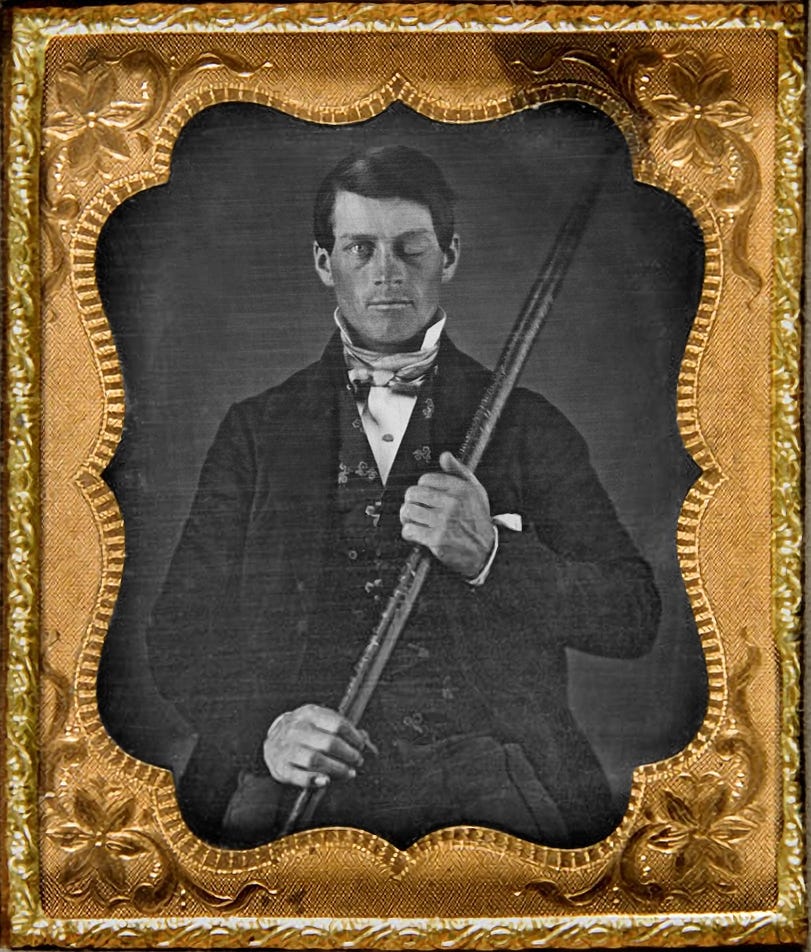

Gage survived — remarkably, perhaps without even losing consciousness — and reportedly told his doctor, “Here is business enough for you.” But survival did not mean restoration. In the months that followed, Dr. John Martyn Harlow observed dramatic changes in Gage’s personality. Once disciplined and reliable, he became impulsive, profane, and unable to adhere to plans. His friends concluded that he was “no longer Gage,” noting the loss of balance between his “intellectual faculties and animal propensities.”
The consequences were immediate. His employer refused to rehire him. He worked variously in a New Hampshire stable, as a coach driver in Chile, and later in San Francisco, where he died in 1860 at the age of thirty-six after a series of seizures. His case became the first to suggest a link between brain trauma and personality change, securing his place as the most famous patient in the history of neuroscience.
While industrialization transformed the North, westward expansion reshaped the nation’s geography. Federal land policies played a central role. The Land Law of 1820 reduced the minimum purchase size to eighty acres but eliminated credit, initially slowing sales before contributing to a surge in the 1830s — including 20 million acres sold in 1836 alone. Between 1820 and 1841, the federal government sold 75 million acres of land, compared to just 16 million in the previous two decades.
The Graduation Act of 1854 further reduced land prices over time — from $1 per acre after ten years to as little as 12.5 cents after thirty — though much of this land fell into the hands of speculators and corporations rather than independent farmers. The Homestead Act of 1862, long debated and resisted, ultimately sought to distribute land freely to settlers, overcoming opposition from industrialists, speculators, and slaveholding interests.
Technological innovation made this expansion viable. John Deere’s steel plow, introduced in 1837, enabled farmers to cut through the tough prairie soil, while Cyrus McCormick’s mechanical reaper allowed a single farmer to harvest up to twelve acres per day. By the 1850s, improved plows and reapers had doubled agricultural productivity, transforming the Midwest into a center of grain production.
The population followed. Between 1820 and 1860, the United States grew from 9.6 million to 31.5 million people, with particularly rapid growth in the Old Northwest. States such as Ohio, Indiana, Illinois, Michigan, and Wisconsin expanded sevenfold in population, while Missouri’s population increased nearly twentyfold.
Yet this expansion and industrialization were not mirrored in the South. Slavery, as both an economic and social institution, inhibited the development of industrial capitalism. The system discouraged immigration, tied wealth to land, and reinforced a social hierarchy that disdained industrial pursuits. The “productive surplus” generated by slavery came at the cost of flexibility and innovation, suppressing the kind of social rationality associated with capitalist development.
Even within the North, the promise of free labor was unevenly realized. By 1860, most Americans possessed modest wealth — nearly half had none at all, and about 60 percent owned no land. While the ideology of free labor celebrated self-reliance and upward mobility, economic inequality remained a defining feature of the system.
In this environment, culture itself became commercialized. Few figures embodied this more fully than Phineas Taylor Barnum, the showman who described his circus as “The Greatest Show on Earth.” Often called the first great advertising genius, Barnum understood that the public did not merely tolerate deception — it enjoyed it. His “humbuggery,” from the Fiji Mermaid to his promotion of performers like Jenny Lind and Tom Thumb, blurred the line between illusion and entertainment. As one historian observed, his true discovery was “not how easy it was to deceive the public, but rather, how much the public enjoyed being deceived.”
Barnum’s success reflected a broader cultural shift. In a market society defined by choice and competition, persuasion became an art form. Advertising, like Barnum’s exhibitions, offered the “illusion of realism,” inviting consumers to participate knowingly in a constructed world.
Thus, the United States between 1815 and 1860 emerged as a nation transformed — bound together by railroads and canals, driven by factories and farms, divided by class and region, and animated by both aspiration and illusion. It was a society in motion, expanding across a continent while redefining the nature of work, wealth, and identity.

Bibliography | Notes
Anbinder, Tyler. City of Dreams: The 400-Year Epic History of New York. Boston: Houghton Mifflin Harcourt, 2016.
Locke, Joseph L., and Ben Wright, eds. The American Yawp: A Massively Collaborative Open U.S. History Textbook. Vol. 1, To 1877. January 2019.
Roark, James L., Michael P. Johnson, Patricia Cline Cohen, Sarah Stage, and Susan M. Hartmann. The American Promise, Value Edition, Volume 1: To 1877. Bedford/St. Martin’s, 2014.
Twomey, Steve. “Phineas Gage: Neuroscience’s Most Famous Patient.” Smithsonian Magazine, January 2010. https://www.smithsonianmag.com/history/phineas-gage-neurosciences-most-famous-patient-11390067/.