


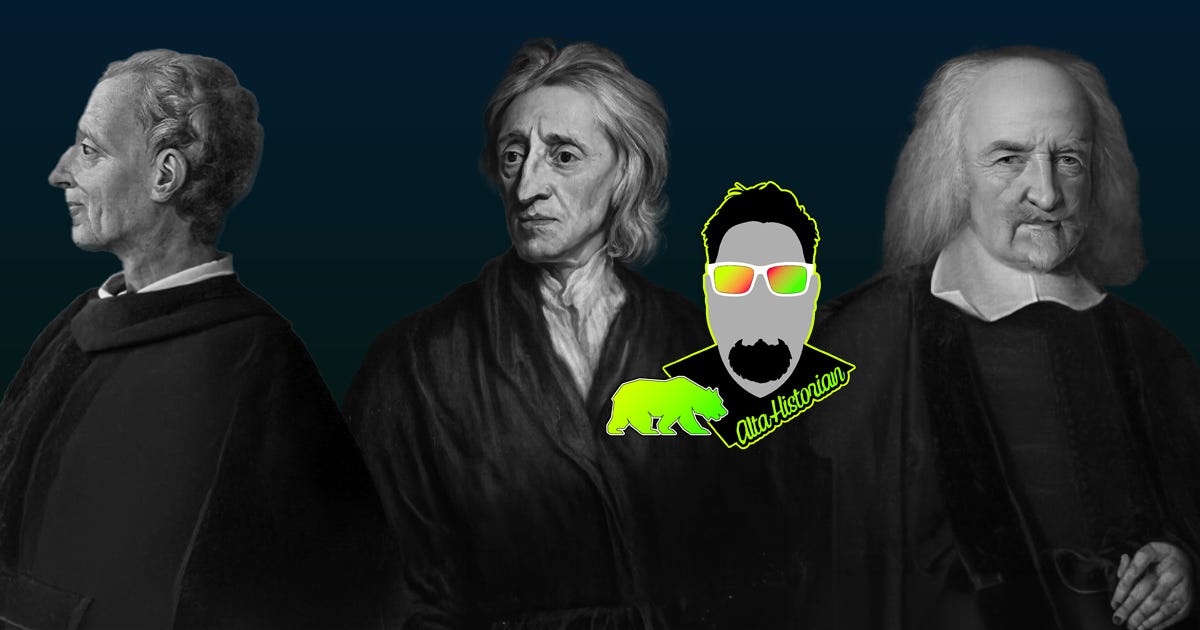
The intellectual origins of the American Revolution did not arise suddenly in 1776. They were the product of a long conversation — stretched across the Atlantic and back through centuries of philosophical reflection — about human nature, government, and the meaning of political authority.
In the mid-seventeenth century, Thomas Hobbes produced what has been described as perhaps the first great work of political theory written in English. Leviathan (1651) proceeded from a dark premise. Imagining humanity in an ancient, even prehistoric, “state of nature,” Hobbes argued that in such a condition man stood in war with every other man, and that life was “solitary, poor, nasty, brutish, and short.” The solution was the civil state. Men surrendered nearly all their rights to a monarch in exchange for protection from violent death, and so long as the sovereign delivered that protection, it held authority to impose nearly any other burden. From Hobbes, later revolutionary writers would borrow one crucial idea — the right to life — and carry it into a political language that bore almost no other resemblance to his intentions.
John Locke’s Second Treatise of Government agreed with Hobbes on one point: that a state of nature had once existed. But Locke imagined it very differently. His state of nature was beautiful and nearly sinless — a condition from which humanity had somehow fallen — and the social compact that replaced it was not capitulation but protection. The natural rights Locke wished to preserve were “life, liberty, and estate.” Government, therefore, should be limited: strong enough only to secure those three inalienable rights, and no stronger. Revolutionary writers would draw from Locke the language of liberty and property.
The contrast between Hobbes and Locke is itself instructive. Both believed a state of nature had existed — they differed entirely in their views of its character. Both also departed sharply from classical antiquity — from Aristotle, who had argued that government was not a remedy for human nature but an expression of it, a natural condition of social existence rather than a compromise with disorder.
Together, these theories helped lay the intellectual groundwork for documents that would follow in America — first the Declaration of Rights and Grievances, and eventually the Declaration of Independence. Yet a third Enlightenment thinker addressed a different problem: not whether rights existed, but how to preserve them once established. In The Spirit of the Laws, the French aristocrat Baron Charles de Montesquieu admired the British constitutional system and proposed dividing governmental authority into separate branches with defined functions — a principle that would become structural doctrine for the American founders.
The ideas that animated the Revolution were not, however, purely philosophical in the transatlantic, Enlightenment sense. They were also shaped by religion. Most revolutionary leaders were steeped in Christian traditions and teachings — nearly half of the signers of the Declaration had some form of seminary training or degree. Others, such as John Hancock, echoed a straightforward reliance on God. Figures like Thomas Jefferson belonged to the Freemasons and invoked divine authority in their declarations while holding the doctrines of revealed religion at a careful distance.
Religious adherence in colonial society was, in practice, more complex than its rhetoric suggested. On the eve of the Revolution, perhaps no more than twenty percent of the population regularly attended church. Yet this did not mean Americans were irreligious. God remained a powerful idea in revolutionary society — deeply embedded in state constitutions and earlier colonial charters — even among those who rarely appeared in a pew.
Enlightenment thought had introduced an alternative idiom for that religious impulse: Deism. Many educated colonists began seeking evidence of God’s design in nature rather than in scripture exclusively, studying the world around them for the principles of a deeper natural order. Philadelphia became a center of such inquiry. The American Philosophical Society — the oldest learned society in the United States — emerged from this culture, founded under the impetus of Benjamin Franklin in 1743 and growing out of an earlier circle of young men, the Junto, which Franklin had formed in the city in 1727 when he was only twenty-one. Through these networks, ideas circulated among colonial intellectuals, cultivating the atmosphere in which revolutionary thought would emerge.
Religious life in the colonies was also transformed, in a more popular direction, by the Great Awakening. Ministers alarmed by spiritual indifference adopted a new style of preaching — aimed not at the head but at the heart. Revivalist sermons attacked the conscience and stirred emotional response, and thousands answered the call. These revivals refreshed the colonies’ spiritual energy and helped create a shared cultural experience, one that emphasized the individual soul and the possibility of chosen salvation. In doing so, they helped bridge divisions of faith, region, class, and status across colonial society — a leveling, in the religious register, that would find its political counterpart a generation later.
By October 1765, political ideas and colonial grievances had begun to converge in explicit form. Thomas Jefferson drafted what is often referred to as the List of Grievances. After a preamble centered on natural rights and equality, he catalogued two dozen complaints against King George III. Delegates debated the list for two days. Jefferson’s draft initially blamed the king for the institution of slavery, but delegates from Georgia and South Carolina struck the passage out. The document retained another charge, however: that the king had mobilized Native Americans to wage warfare along the frontier.
Even the material symbols of the Revolution carried political meaning. Paper currency issued under the authority of the Continental Congress bore the image of an eagle attacking a crane and the Latin motto EXITUS IN DUBIO EST — “The Outcome is in Doubt.” Because Congress lacked authority to levy taxes, its paper currency depreciated rapidly, a problem compounded by the circulation of British counterfeit bills, which gave rise to the bitter phrase “Not worth a Continental.”
Colonial complaints addressed specific policies as well as general principles. Among them was the practice of quartering troops. At the beginning of 1775, Parliament dispatched ten thousand soldiers to the colonies and stationed them in Boston, New York, Philadelphia, Charleston, and other seaports. Colonists protested the burden of quartering large bodies of armed troops among them. Another grievance involved the loss of trial by jury: Britain established Courts of Admiralty in America, bypassing traditional legal procedure so that colonists accused of certain crimes were brought not before a jury of peers but before a single judge appointed by the Crown.
These specific injuries — combined with Enlightenment philosophy, religious conviction, and colonial experience — formed the ideological foundation for the American Revolution. The argument that followed was not improvised in a moment of crisis. It had been assembled, slowly and from many sources, across the better part of a century.

Bibliography | Notes
Foner, Eric, and John A. Garraty, eds. The Reader’s Companion to American History. Boston: Houghton Mifflin Harcourt Publishing Company, 1991.
Hobbes, Thomas. Leviathan. 1661.
Jefferson, Thomas. Drafts and debates surrounding the Declaration of Independence.
Locke, John. Second Treatise of Government.
Locke, Joseph L., and Ben Wright, eds. The American Yawp: A Massively Collaborative Open U.S. History Textbook. Vol. 1, To 1877. January 2019.
Montesquieu, Charles de Secondat, Baron de. The Spirit of the Laws.
Roark, James L., Michael P. Johnson, Patricia Cline Cohen, Sarah Stage, and Susan M. Hartmann. The American Promise, Value Edition, Volume 1: To 1877. Bedford/St. Martin’s, 2014.
Schweikart, Larry, and Michael Allen. A Patriot’s History of the United States: From Columbus’s Great Discovery to the War on Terror. New York: Sentinel, 2004.
Zinn, Howard. A People’s History of the United States. New York: Harper & Row, 1980.Luther, Martin. Protestant Reformation, sixteenth century.