

Ancient Egypt
World Civilizations

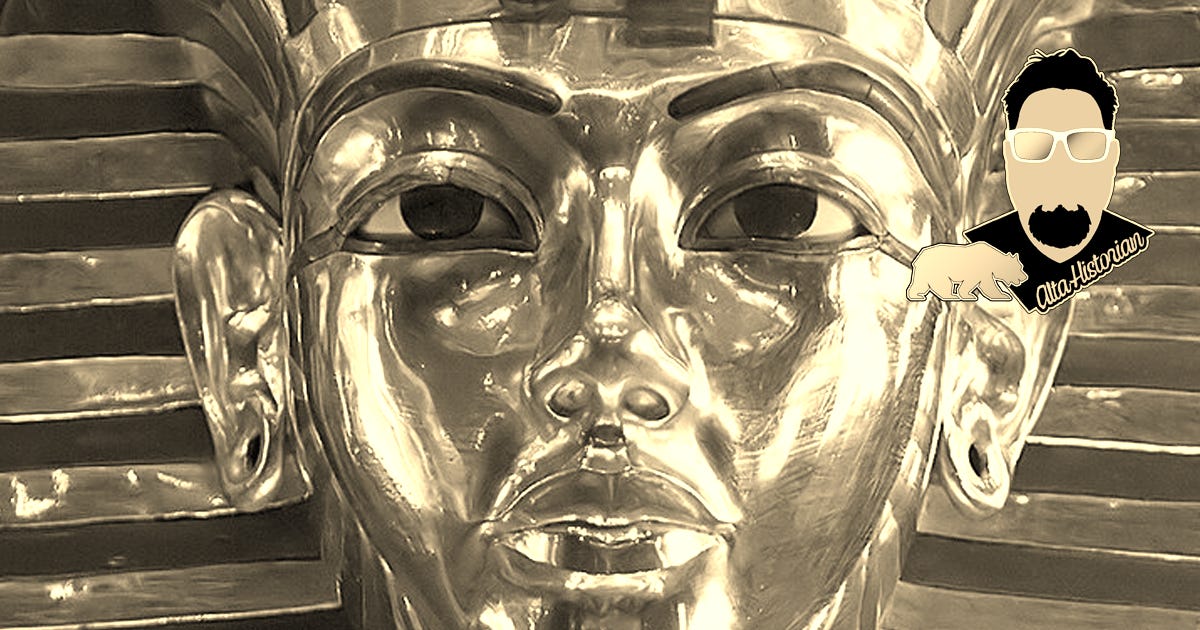
Estimated Date Range: c. 6000 BC – AD 30
The fertile river valleys of the ancient world did not all give rise to civilization in the same way, nor did they move at the same pace. In the fourth millennium BC, the region later known as the Fertile Crescent witnessed the emergence of early urban societies along the Tigris and Euphrates. Nearby, however, another river valley was shaping a civilization that would prove unusually durable, unified, and confident in its place within the cosmos. Along the Nile River in northeast Africa, Egypt arose as a single political and cultural organism whose coherence would endure (with interruptions) for nearly two millennia.
This outcome was neither sudden nor inevitable. Around 10,000 BC, much of North Africa was far wetter than it is today. Grasslands stretched across regions that are now desert, and lakes dotted the landscape. Paleolithic peoples thrived in this environment, hunting and gathering from abundant natural resources. But around 6000 BC, the climate began to change. Rainfall declined, lakes vanished, and the Sahara emerged through a long process of desiccation. As survival became more difficult, populations retreated toward the remaining reliable water sources. Chief among them was the Nile, a long, narrow corridor of fertility cutting through an increasingly hostile environment.
At roughly the same time, between 7000 and 6000 BC, agricultural knowledge entered the Nile Valley, likely through contact with the Levant (a historical geographical term referring to the eastern Mediterranean coastal lands). Wheat, barley, sheep, goats, and cattle were introduced, complementing older subsistence strategies. Communities settled more permanently along the riverbanks. They lived in simple huts, fished the Nile, cultivated crops, produced pottery, and practiced early burial rituals. Over thousands of years, these riverine societies grew denser and more complex, gradually differentiating into two related regions: Upper Egypt in the south, upriver toward the first cataract, and Lower Egypt in the north, where the Nile fans out into the Mediterranean delta.
The Nile itself shaped this development in decisive ways. Fed by the White Nile from central Africa and the Blue Nile from the Ethiopian highlands, the river predictably flooded each summer, depositing rich silt across its narrow floodplain. Unlike the destructive and erratic floods of Mesopotamia, the Nile’s flooding was regular and benevolent. It encouraged confidence rather than fear, planning rather than resignation. Winds blowing north to south allowed boats to sail upstream while the current carried them northward, binding Upper and Lower Egypt together through trade and communication. Geography, climate, and river combined to produce unusually high population densities clustered close to the water.
Between 3600 and 3300 BC, complex societies emerged along the Nile. Communities such as Naqada (nah-KAH-duh) and Hierakonpolis (hy-RAK-on-puh-liss) cleared land, built dykes and canals, and expanded irrigation systems. Archaeological evidence reveals social differentiation, labor specialization, and increasing control over the environment. Leaders likely legitimized their authority by claiming command over floods and rainfall, eventually asserting divine connections. Power, religion, and ecology were already converging.
This convergence reached a decisive point around 3150 BC, when Upper and Lower Egypt were unified under a single ruler, traditionally identified as Narmer and remembered in later sources as Menes. Whether achieved through conquest, negotiation, or ritualized symbolism, unification transformed the Nile Valley into the first large, territorially unified state in the ancient world. The Narmer Palette, dating to roughly 3150–3000 BC, depicts the king wearing both the white crown of Upper Egypt and the red crown of Lower Egypt, visually announcing a new political reality sanctioned by the gods.
Unification marked the beginning of the Early Dynastic Period (3150–2613 BC). Unlike Mesopotamia, where city-states competed, and empires rose only later, Egypt began its historical life as a centralized kingdom. Its deserts acted as natural barriers, protecting it from frequent invasion and allowing internal institutions to develop with remarkable continuity. During this period, many of the defining features of Egyptian civilization emerged: the institution of the pharaoh, a centralized bureaucracy, distinctive religious practices, and a complex writing system.
The pharaoh ruled a population that may have numbered as many as two million people at unification, far exceeding the scale of contemporary Near Eastern polities. The term pharaoh meant “great house,” referring both to the royal palace and to the concentration of authority within it. Taxes were paid in kind, primarily through agricultural surplus, which supported priests, scribes, artisans, administrators, and officials clustered around palaces and temples. Most Egyptians were peasant farmers, living just above the floodplain and contributing labor to state projects when not tending their fields.
Yet the pharaoh was not merely a king. He was the high priest of the land and a living god, the earthly incarnation of Horus. Through ritual, he unified the many local cults of the Nile Valley, ensuring divine favor throughout the kingdom. His divine presence maintained Ma’at — the principle of order, truth, balance, and justice that governed both the cosmos and society. When the Nile flooded on time and harvests were plentiful, it was evidence that Ma’at prevailed.
Egyptian religion reflected this confidence in order. The pantheon included gods such as Re, the sun god, Isis, goddess of fertility, and Osiris, god of the Nile and the afterlife. The myth of Osiris explained the annual flood: murdered by his brother Seth, god of the desert wind, Osiris was resurrected by Isis, just as the river returned each year to restore life to the land. Osiris became lord of the underworld and judge of the dead, promising a blessed afterlife to those who lived in harmony with Ma’at. In contrast to Mesopotamian pessimism, Egyptians envisioned the afterlife as a continuation of life’s best aspects, a familiar and orderly world beyond death.
Writing emerged early as a tool of administration and memory. By at least 3000 BC, Egyptian hieroglyphics had developed into a sophisticated script combining sounds, symbols, and images. Known to the Egyptians as medu-netjer, “the god’s words,” writing was mastered by trained scribes and used for ritual texts, tax records, royal inscriptions, and historical commemoration. Alongside hieroglyphics, Egyptians developed hieratic and later demotic scripts for everyday administrative use. Papyrus, made from Nile reeds, allowed records to be stored and preserved, and many survive to this day due to Egypt’s dry climate.
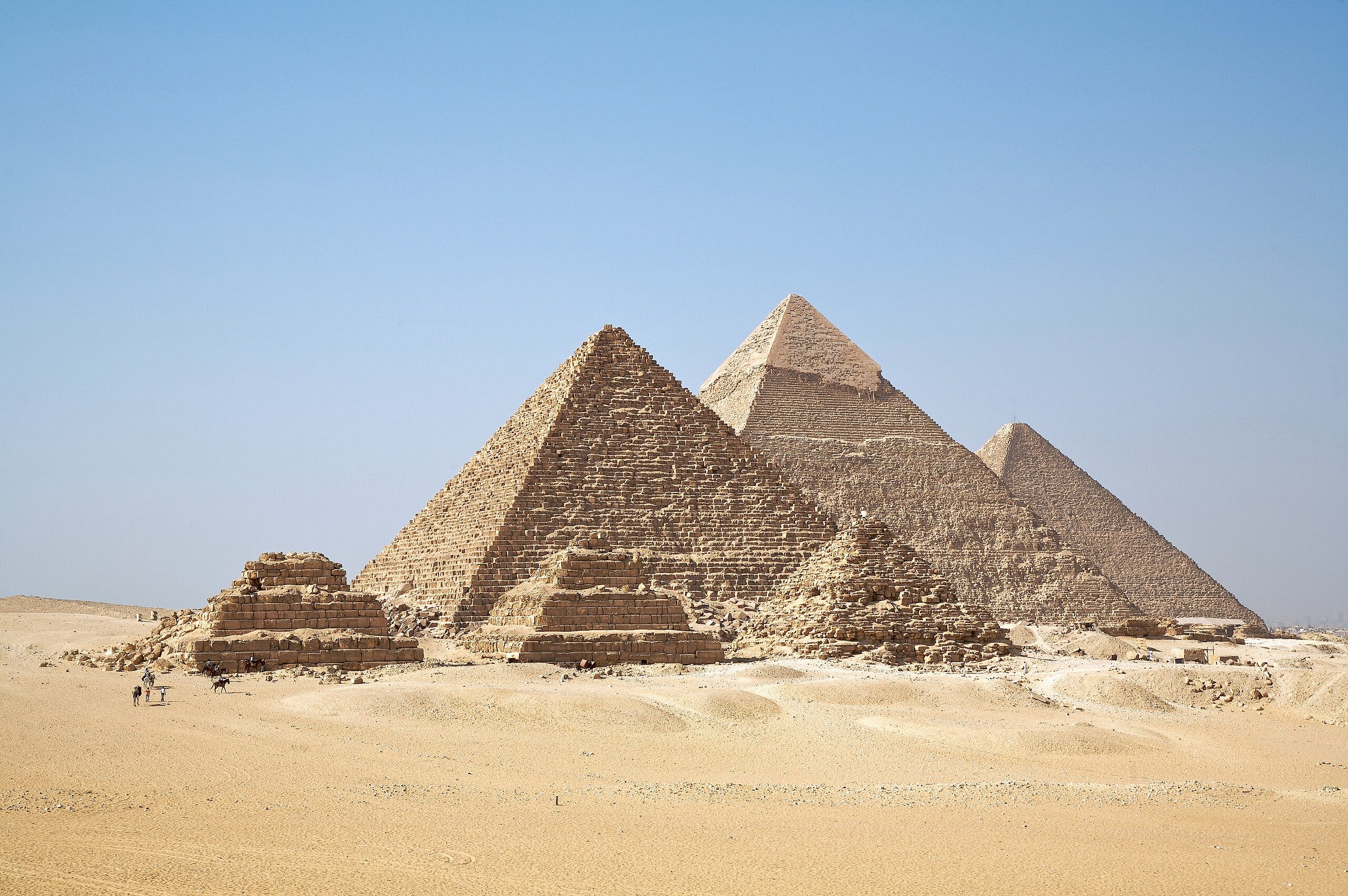
By the 2600s BC, Egypt entered the Old Kingdom (2613–2181 BC), an era defined by unprecedented state power and monumental ambition. Pharaohs now commanded the resources and labor necessary to build in stone on a massive scale. Tombs evolved from simple mud-brick mastabas into pyramids, architectural expressions of divine kingship and eternal order. Under Pharaoh Djoser, the architect Imhotep designed the Step Pyramid at Saqqara, stacking stone mastabas into a towering form never before attempted. A few decades later, smooth-sided pyramids appeared under Snefru, culminating in the Great Pyramid at Giza, built for his son Khufu.
The Great Pyramid originally stood 481 feet high, covered an area of four city blocks, and contained over two million stone blocks. It was not built by slaves, as once believed, but by skilled craftsmen and rotating labor forces of Egyptians who were housed, fed, and medically cared for by the state. These monuments were not expressions of oppression but of collective organization, religious conviction, and political authority focused on the afterlife. Preservation of the body through mummification was essential, for the soul was composed of multiple elements — the ka, ba, and akh — all of which depended on the physical body to survive and reunite in eternity.
Over time, however, the very complexity that enabled Egypt’s greatness strained centralized power. As temples grew wealthier and regional governors accumulated authority, the pharaohs of the late Old Kingdom delegated more control. By around 2200 BC, central authority weakened, ushering in the First Intermediate Period (2181–2040 BC). Once characterized as a dark age, it is now understood as a redistribution of power from the center to the regions rather than a total collapse.
Renewal came with reunification under Mentuhotep II around 2040 BC, marking the beginning of the Middle Kingdom (2040–1782 BC), Egypt’s classical age. Strong rulers reorganized administration, expanded trade, and created Egypt’s first standing army. Under Amenemhat I and his successors, Egypt extended influence into Nubia and the Levant, secured gold supplies, and flourished culturally. Monumental energy shifted from pyramids to vast temple complexes, particularly those dedicated to Amun-Re at Thebes, whose ruins at Karnak still testify to this renewed power.
The Middle Kingdom reached its height under Senusret III in the nineteenth century BC, a warrior and administrator who strengthened central authority and expanded Egypt’s borders. Yet even this resurgence was temporary. Weak successors and increased migration from the Levant led to the Second Intermediate Period (1782–1570 BC), during which the Hyksos, foreign rulers armed with bronze weapons and horse-drawn chariots, seized control of the Nile delta.
Egyptian recovery came again through force. Around 1530 BC, Ahmose I expelled the Hyksos and inaugurated the New Kingdom (1570–1069 BC), the zenith of Egyptian imperial power. Egypt became an empire, controlling territory from Nubia to Syria, maintaining a large standing army, and dominating trade routes across northeast Africa and the eastern Mediterranean. Monumental building resumed on an unprecedented scale, though burial practices shifted from pyramids to hidden rock-cut tombs in the Valley of the Kings.
Religious continuity largely endured, though it was briefly challenged during the Amarna Period (c. 1350–1325 BC), when Pharaoh Akhenaten promoted the worship of a single god, Aten. His experiment in state-sponsored monotheism collapsed shortly after his death, and traditional religious practices were restored under his successors, including Tutankhamun. The later New Kingdom, especially under Ramesses II, marked both Egypt’s cultural brilliance and the beginning of its long decline.
By around 1100 BC, foreign invasions, internal divisions, and the rising power of priesthoods weakened Egypt’s centralized state once again. Yet despite conquest by Assyrians, Persians, Greeks, and Romans in later centuries, the civilization forged along the Nile left an enduring imprint. For thousands of years, Egypt demonstrated how geography, environment, belief, and political imagination could combine to create one of the most resilient and influential civilizations in human history — a civilization that saw life not as chaos to be endured, but as order to be maintained, remembered, and carried forward into eternity.

Bibliography | Notes
OpenStax. World History, Volume 1. Houston: OpenStax, Rice University, 2018.
https://openstax.org/details/books/world-history-volume-1.
University of North Georgia Press. World History. Dahlonega, GA: University of North Georgia Press, 2017.
https://web.ung.edu/media/university-press/World%20History%20Textbook-082817.pdf.
World History Encyclopedia. “Egypt.” Last modified 2023.
https://www.worldhistory.org/egypt/.