

Ancient Oasisamerica, no. 1
United States History

Oasisamerica. The term was coined by Paul Kirchoff, the same scholar who coined the term Mesoamerica, the cultural region that encompasses Mexico, in 1954. Oasisamerica brings to the imagination the idea of water in the desert, life, encompassing the area that would become the American Southwest. This was, as the Hopi called it, the “Center Place.” It was exactly that — a central zone of social, cultural, and economic interaction, adaptation, and so much more — the crossroads of exchanges between North America and Mesoamerica.
Kirchhoff’s terms, like Oasisamerica, can be detrimental as well, as scholars often regionalize culture to ease understanding for the general public. Common traits become the defining features of a region's cultural complexity, a generalization that strips us of details that are both fascinating and important for a better understanding of regional dynamics. In this region, there are many cultures, the most notable of which are the Anasazi, Hohokam (ho-ho-KAHM), Mogollon (moh-goh-YONE), Hkataya (hah-kah-TAH-yah), Frémont, and Patayán (pah-tah-YAN).
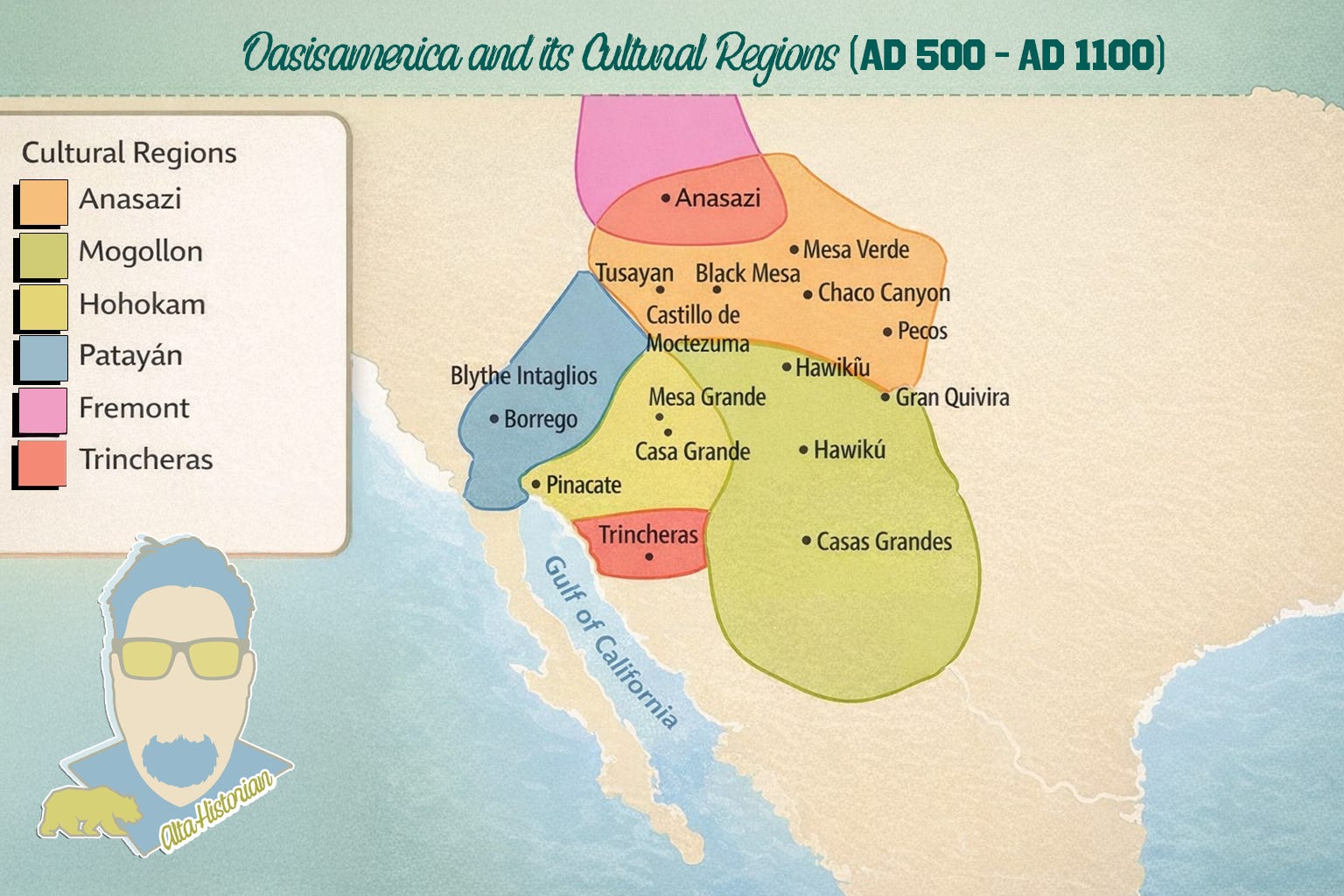
Some of the less notable are the Sinagua and Salado, and then there are those who played the role of antagonists — this is the part of American Indian history that is left out. These groups maintained a more nomadic lifestyle, frequently interacting with the more sedentary cultures through raids and trade. We will dig into those groups later, but the primary point is that the Oasisamerican peoples were agriculturalists (even living in desert environments) like other agrarian societies worldwide — they gravitated toward reliable water sources — and in this region, the most notable are the Río Grande, Colorado, Yaqui, Gila, and Conchos rivers.
Much of what we know of these early Oasisamerican peoples comes from archaeology, and the evidence, lacking a formal writing system, makes much of their world a mystery. Recent discoveries keep pushing that starting point back further and further, as with the recent discovery in White Sands National Park in New Mexico, as presented in the New York Times. At the very least, it is still my view that the ancient past remains provisional and is still being shaped by new technologies, archaeological discoveries, and interpretive frameworks. What is firm is that Oasisamerica’s role as the centerpoint was clearly true, and anything discovered will likely make this more true than it is as I write this today. How do we know this?
There is a lot of evidence left behind by the groups of the Oasisamerican territory, with technology likely adapted or redistributed from the region of sedentary cultures. Pottery and its styles, irrigation systems, and the Mesoamerican ballgame moved through the region, adapting, shaping, and reshaping local conditions and needs. The region is believed to have been a cosmological and cultural focal point, with important regional resources like turquoise moved south — what moved north in exchange were things like copper hawk bells, pyrite mosaics, and macaw skeletons — we may also look at the proliferation of Mesoamerican ritual mounds, like those seen in Cahokia, appearently traveled northward.
Before Oasisamerica became a center of exchange, the foundations were in agricultural settlements. This is not uncommon; in fact, most of what we know of ancient settlements is similar. The Anasazi, Hohokam, and Mogollon were among the first in the region to transition from hunter-gatherer to agricultural societies. This transition seems to have occurred as early as 3500 BC (interestingly, the same as Norte Chico in South America) — if you have ever driven through the Sonoran Desert, you know the Southwest’s infrequent rainfall made reliance on wild plants unsustainable for growing populations — as they say, “Necessity is the mother of invention.”
Some of the earliest evidence of maize cultivation comes from Bat Cave, New Mexico, where primitive versions of corn cobs date to around 3500 BC, and, as many of us know, food is almost always the foundation of culture. And I always like to say that American Indian cultures were logical in their thinking, primarily because making life easier is much the same today as it was then. Technology, tools, for the Oasisamericans, baskets, pottery, art — all made life more manageable, and in the case of art, more beautiful, and I dare say, tolerable. Migration slowed, permanent settlements emerged, and with those settlements came buildings, roads, long-distance trade, an economy, and cultural boundaries.
This concludes part one of this two-part series. In the next section, we will zoom in on the specific cultural developments in these regions.

Bibliography | Notes
Archaeology Southwest. “Patayan Culture.” https://www.archaeologysouthwest.org/ancient-cultures/patayan/.
Britannica, The Editors of Encyclopaedia. “Ancestral Pueblo Culture.” Encyclopaedia Britannica. https://www.britannica.com/topic/Ancestral-Pueblo-culture.
Britannica, The Editors of Encyclopaedia. “Cochise Culture.” Encyclopaedia Britannica. https://www.britannica.com/topic/Cochise-culture.
Chacón, Richard J., and Rubén G. Mendoza, eds. North American Indigenous Warfare and Ritual Violence. Tucson: University of Arizona Press, 2007.
Christianson, Justine, transmittal documentation; Historic American Engineering Record, creator; Texas Tech University Water Resources Center, sponsor. “Hohokam Irrigation Canals, Pueblo Grande Museum, Phoenix, Maricopa County, AZ.” Library of Congress (HAER), documentation compiled after 1968. https://www.loc.gov/pictures/item/az0627/.
Hämäläinen, Pekka. The Comanche Empire. New Haven, CT: Yale University Press, 2008.
Lambert, Patricia M. “The Osteological Evidence for Indigenous Warfare in North America.” In North American Indigenous Warfare and Ritual Violence, edited by Richard J. Chacon and Rubén G. Mendoza, 202–221. Tucson: University of Arizona Press, 2007. https://open.library.ubc.ca/media/download/full-text/24/1.0363040/.
López Austin, Alfredo, and Leonardo López Luján. Mexico’s Indigenous Past. The Civilization of the American Indian Series, vol. 240. Norman: University of Oklahoma Press, 2001. https://archive.org/details/mexicosindigenou0000lope.
Mesa Verde National Park (U.S. National Park Service). “Cliff Dwellings.” https://www.nps.gov/meve/learn/historyculture/cliff_dwellings_home.htm.
National Park Service. A Brief History of Chaco Culture National Historical Park. Chaco Culture National Historical Park brochure (PDF). https://www.nps.gov/chcu/learn/upload/Chaco-Brief-History.pdf.
National Park Service. “Fremont Culture.” Capitol Reef National Park (U.S. National Park Service). https://www.nps.gov/care/learn/historyculture/fremont.htm.
National Park Service. “Fremont Culture.” Great Basin National Park (U.S. National Park Service). https://www.nps.gov/grba/learn/historyculture/fremont-culture.htm.
Neuman, Scott. “Ancient Footprints Suggest Humans Lived In The Americas Earlier Than Once Thought.” NPR, September 24, 2021. https://www.npr.org/2021/09/24/1040381802/ancient-footprints-new-mexico-white-sands-humans.
PBS LearningMedia. “The Hopi Origin Story.” Native America (PBS), 2018. https://www.pbslearningmedia.org/collection/native-america/.
Roberts, David. “Riddles of the Anasazi: What Awful Event Forced the Anasazi to Flee Their Homeland, Never to Return?” Smithsonian Magazine, July 2003. https://www.smithsonianmag.com/history/riddles-of-the-anasazi-85274508/.
Schaafsma, Polly. “Documenting Conflict in the Prehistoric Pueblo Southwest.” In North American Indigenous Warfare and Ritual Violence, edited by Richard J. Chacon and Rubén G. Mendoza, 114–128. Tucson: University of Arizona Press, 2007. https://www.academia.edu/52638134/House_of_Shields_Defensive_Imagery_at_Defensive_Sites_in_Tsegi_Canyon.
ScienceDaily. “Localized Climate Change Contributed to Ancient Southwest Depopulation.” December 4, 2014. https://www.sciencedaily.com/releases/2014/12/141204074309.htm.
UtahIndians.org. “History: The Navajo.” https://utahindians.org/archives/navajo/history.html.
Waldman, Carl. Encyclopedia of Native American Tribes. 3rd rev. ed. New York: Facts On File, 2006. https://cmc.marmot.org/Record/.b58763971.
Waldman, Carl, and Molly Braun. Atlas of the North American Indian. 3rd ed. New York: Facts On File, 2009. https://books.google.com/books/about/Atlas_of_the_North_American_Indian.html?id=P2HKD9PgC6wC&utm_.
Wei-Haas, Maya. “New Evidence That Ancient Footprints Push Back Human Arrival in North America.” New York Times, October 5, 2023. https://www.nytimes.com/2023/10/05/science/footprints-tracks-new-mexico-age.html.