Aug. 22, 1920: "Did Babe Ruth Get Another One To-day?"
Pop History

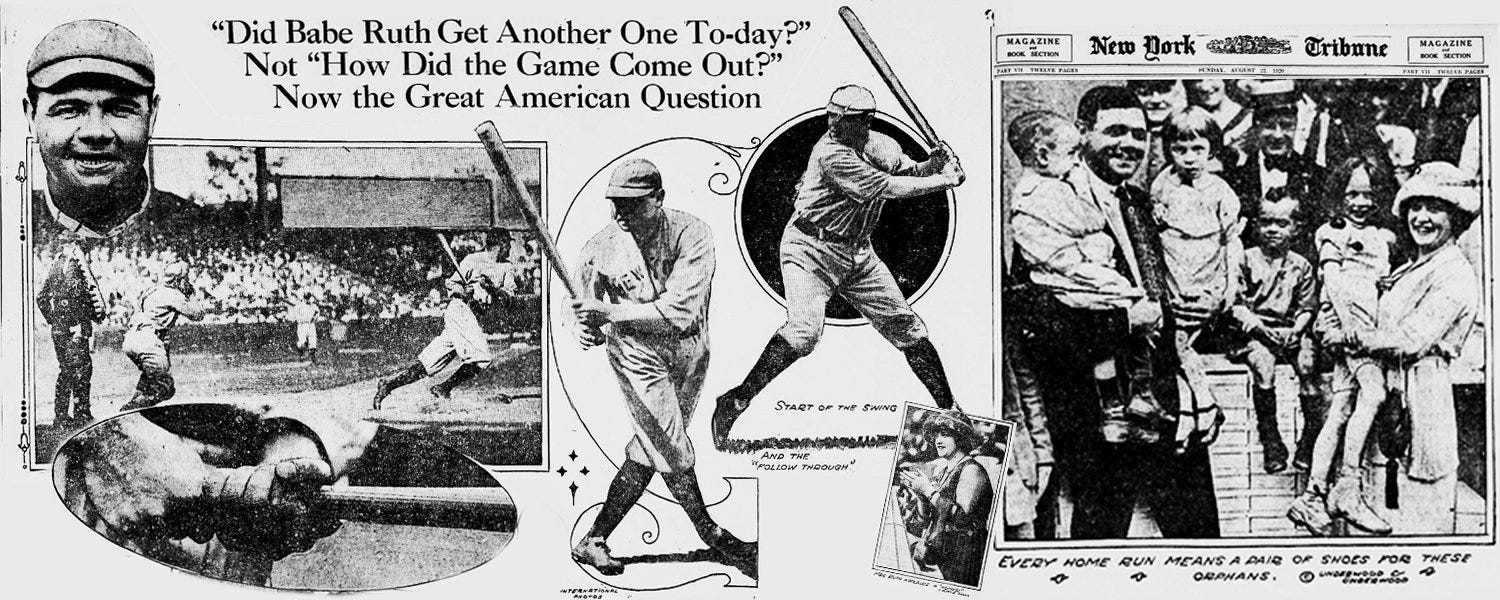
Annotation
I love old baseball and thought I'd share this article from W. O. McGeehan. What I found very interesting is that McGeehan explores Ruth’s origins, emphasizing his working-class background, time spent in a Baltimore orphanage, and his rise to superstardom. The piece subtly critiques the moralistic rags-to-riches narratives of Horatio Alger, suggesting that Ruth’s success was less about conventional hard work and more about his natural talent and love for the game. Additionally, the article captures how Ruth’s presence boosted baseball's popularity and financial success, drawing massive crowds and shifting attention away from traditional team rivalries.
"Did Babe Ruth Get Another One To-day? Not 'How Did the Game Come Out?' Now the Great American Question"
New York Tribune, August 22, 1920, Magazine and Book Section, Part VII, p. 1.
By W. O. McGeehan
If the late lamented Shakespeare were a baseball writer he might use a line that he wasted upon some more or less obscure hero of antiquity and say of "Babe" Ruth, "He doth bestride the narrow baseball fields like a Colossus." For "Babe" Ruth is Hercules and Thor reincarnated, the Colossus of Swat. His bat is the club of Hercules and the hammer of Thor, the symbol of sheer, primitive might before which the puny folk bow and offer worship.
But for the game of baseball, the youngest game of the youngest people, George Herman Ruth, the "Babe" Ruth who dwarfs all other personalities in the daily news, might have been a peaceful cigar-maker or perhaps a third-rate heavyweight pugilist instead of the national idol of the American people.
The "Babe" was Fortune's darling, though Fortune concealed her great and kindly intentions as far as he was concerned when the "Babe" was a boy. For the "Babe" was born left-handed. Hercules was a right-hander. Thor never was pictured as wielding his hammer from the port side. None of the heroes of antiquity, as far as can be ascertained, was a southpaw. Harry Leon Wilson was the first novelist to put a left-hander in the near-hero class, and he did it in a half-hearted fashion.
Moreover, little George Herman Ruth was a half-orphan at a very early age and was sent to an institution for orphans. He was nearly an orphan boy, and, according to the Sanford and Merton books, he should have taken a morbid sort of point of view at an early age and learned something useful. But the youth of "Babe" Ruth was applied mostly to the study of the great American game of baseball.
You are not going to draw any conventional moral from the early boyhood of "Babe" Ruth. He was not a particularly industrious or thrifty lad, chock-full of conventional virtues. He was just a normal, chuckle-headed combination of Tom Sawyer and Huckleberry Finn. He was just natural and just human.
Fortunately, the boyhood of "Babe" Ruth was intrusted to men who understood human nature, and particularly the human boy—the Christian Brothers, of Baltimore. The fraternity is not limited to Baltimore. It is all over the world. It is made up of big-hearted men, consecrated to the work of making men out of the raw material. They had charge of the bringing up of George Herman Ruth and they have turned over to the world the Colossus of Swat. It is due to their human understanding that George Herman Ruth was not thwarted and turned aside into more prosaic lines of endeavor.
More fantastic than any of the boy romances of Tattered Tom and Ragged Dick, by Horatio Alger Jr., is the rise of "Babe" Ruth. The Alger heroes became mere bankers or traction magnates, but George Herman Ruth, the waif of Baltimore, became "Babe" Ruth, at whose shrine bankers and traction magnates burn incense. Ever and anon these jaded near-successes pick up the tape, not to see the condition of the market, but to learn whether the latest is the forty-fifth or forty-sixth home run knocked out by the "Babe" for the season.
And these heroes envy "Babe" Ruth the left-handed, the boy who was regarded as far from bright in his classes. For the "Babe" can hit them out with the joyous freedom of Hercules swinging his club or Thor throwing his hammer through the clouds. All the tricks of the pitchers are vain when he faces them, and all the walls of the baseball parks are lowered when his bat crashes against the baseball. Homer would have loved him if the blind singer had had a season pass to the Polo Grounds.
That Ruth is the greatest batter of them all is admitted by two members of the old Orioles; and when two members of the old Orioles agree upon anything, that makes it official and irrefutable. If there is anybody so ignorant of important American history that he does not know who the old Orioles are, we will explain, more in pity than in indignation, that the old Orioles were members of the greatest baseball team of a generation or so ago.
The two Orioles who made the admission that "Babe" Ruth was the greatest baseball player in the whole world are Wilbert Robinson, manager of the Brooklyn National League baseball team, and Joseph Kelly, scout for the Yankees. Both of these gentlemen are grandfathers and citizens of high repute in the city where they dwell, which also happens to be the home of "Babe" Ruth. Wilbert Robinson was a catcher, and still holds the world's record for consecutive base hits in one game. Joseph Kelly was an outfielder of sorts on the old Orioles, and his present occupation is "ivory hunting," looking upon baseball players and appraising them at their true worth to their employers and to the national pastime.
These two authorities admitted to me in the presence of witnesses that never, even in the days of the old Orioles, was there a baseball player who could hit like "Babe" Ruth. Consider the importance of this admission. The members of the old Orioles are the most conservative persons in the world. Never before have they admitted that any player of the present was anywhere near as wonderful as the players of their glorious day.
"He can hit them harder than anybody, and he can hit them oftener," they admitted from the fullness of their hearts. They did not qualify the statement. They did not assert that the pitchers were less canny and that the ballparks were smaller. They admitted that the heroes of their day were lost in the shadow of the Colossus of Swat. They admitted that even in the days when the old Orioles were young, "Babe" Ruth would have loomed up above them all.
That Ruth broke all big league records for home run getting last year is in the book. That he has broken his own record this year and is on the way to setting a mark far beyond the misty horizons of the baseball world is known. But the old Orioles have explained away the performances of other more modern heroes of baseball. Ruth's achievements they accept ungrudgingly.
That is almost as marvelous as the achievements themselves.