

Before Jamestown
Faith, Pestilence, Trade, and the Partition of the World

America’s European history does not begin at Jamestown. Nor does it begin in 1492. The European movement westward — the impulse that would eventually produce colonization, conquest, slavery, missionary zeal, racial hierarchy, and representative assemblies — had roots that long predated the Virginia Company and the tobacco fields of the Chesapeake.
In 1000 CE, Leif Erikson sailed. He had first traveled to Norway, where King Olaf I converted him to Christianity. On his return voyage to Greenland, he sailed off course and landed in North America. He explored a region he called “Vinland,” spent the winter there, and then departed — never returning to North American shores.
The settlement is said to have stretched from the St. Lawrence River in Quebec down toward Boston, Massachusetts. Erikson did not inaugurate colonization. Few sailors, merchants, or aristocrats were willing to risk exploration beyond the perceived limits of Europe. The Atlantic remained more myth than highway.
Yet memory has a political afterlife.
In 1925, at the 100th Anniversary of the first Norwegian immigrants, President Calvin Coolidge proclaimed before 100,000 people at the Minnesota State Fairgrounds that “Leif Erickson had indeed been the first European to discover America.” A journalist recorded the reaction:
“The great roar that rose from Nordic throats to Thor and Odin above the lowering gray clouds told that the pride of the race had been touched.”
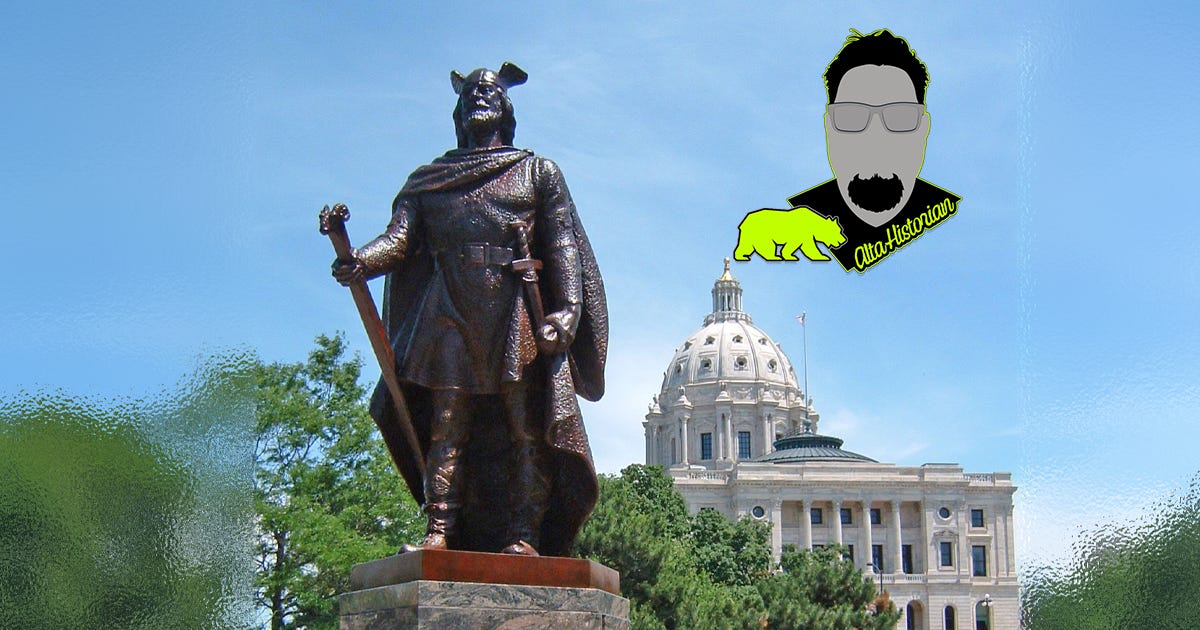
In 1949, the Minnesota State Capitol raised a statue in Eriksson’s honor — as if he were one of the state’s founders. In 1964, Lyndon Johnson declared October 9th Leif Erikson Day. Memory elevated him. History had nearly forgotten him. The medieval world that produced Erikson was rigidly structured. Europe in the Middle Ages was feudal. Lords owned land. Knights gave military service to the lord and carried out justice. Serfs — roughly sixty percent of society — worked the land in exchange for protection and were bound to it.
Above all stood the Catholic Church — the only church in Europe at the time. It owned vast tracts of land and accumulated wealth through tithes — ten percent of earnings.
Then catastrophe intervened. In 1346, the Bubonic Plague struck Europe and killed two-thirds of its population. The reduction in population meant more food and property for survivors to inherit. Peasants, freed from demographic pressure, sought opportunity. A civilization accustomed to stability was shaken. Some, facing a world emptied of certainty, were more willing to take risks. Europe stood on the brink of change.
Christianity had long encountered Islam — not abstractly, but militarily.
In 622, Muhammad received the revelation that became the cornerstone of the Islamic faith. By 632, upon his death, Islam spread through conversion and military conquest. By 732, Islamic forces controlled much of Spain — an extension, in European memory, of what would become the Crusading struggle.
In 1099, Crusaders — mainly French knights — retook Jerusalem amid horrific slaughter. The Crusades and the Reconquista fused faith and violence. In 1492, after an eight-hundred-year holy war, the Reconquista ended. Portugal cooperated with Spain to expel Muslims from the Iberian Peninsula. Religious zeal justified expansion into what the Portuguese regarded as heathen lands.
The consequences were double-edged.
Negatively, persecution of Jews intensified. Christians classified them as “infidel Muslims” and “killers of Christ.” Positively, European trade expanded. Crusaders encountered silk, spices, and the utility of porcelain. Merchant ships brought valuable goods along the Silk Road. Between 1200 and 1400, goods traveled overland through Asia and Africa before being funneled into Europe through Mediterranean markets dominated by Italian cities. Those cities controlled trade routes — an arrangement that incentivized alternatives.
Technological innovation made alternatives plausible. The compass, the hourglass, and other navigational tools — first systematically used by the Portuguese — made longer voyages feasible.
Prince Henry the Navigator, operating from Lisbon, collected information on sailing techniques and geography. He pushed explorers to find new trade routes to secure gold and other trade goods.
The caravel — fast, sturdy, capable of stowing supplies for long periods at sea and able to withstand ocean battering — allowed Portuguese sailors to reach as far south as the Congo by 1480.
The sea route to Asia altered the commercial balance of Europe.
In 1488, Bartolomeu Dias rounded the Cape of Good Hope. In 1498, Vasco da Gama sailed all the way to India, enabling Portuguese merchants to obtain goods from the East Indies directly. They undercut Mediterranean merchants, eliminated old monopolies, and broke the existing commercial order.
Spain would not remain secondary.
In 1469, King Ferdinand of Aragon married Queen Isabella of Castile, uniting two of the most powerful independent kingdoms on the Iberian Peninsula and laying the foundation for modern Spain. They ruled for twenty-five years, centralizing authority and funding exploration and trade with the East.
One of their daughters, Catherine of Aragon, became the first wife of King Henry VIII of England — a dynastic thread linking Iberian consolidation to future English upheaval.
Christopher Columbus entered this world of consolidation and ambition.
He married Felipa Moniz, whose father had been raised in the household of Prince Henry the Navigator. Through this connection, Columbus gained access to maps and Atlantic navigational knowledge. He dramatically underestimated the westward distance to Asia — calculating 2,500 miles instead of approximately 11,000.
Portugal, Spain, England, and France initially rejected him.
Ferdinand and Isabella ultimately financed his voyage, calculating that the potential gain outweighed the small potential loss. In 1492, the Niña, the Pinta, and the Santa María landed on a Caribbean island roughly 300 miles north of Cuba. Columbus claimed it for Isabella and Ferdinand and named it San Salvador in honor of Jesus Christ. He called its inhabitants “Indians,” believing he had reached the East Indies. They were Taino. He knew he had made a monumental discovery. He was disappointed by the Tainos’ lack of riches. Ferdinand and Isabella were overjoyed. Columbus joined the ranks of nobility.
But discovery required partition.
In 1494, Portuguese and Spanish monarchs negotiated the Treaty of Tordesillas. An imaginary line was drawn 1,100 miles west of the Canary Islands. Lands discovered west of the line belonged to Spain. Lands east belonged to Portugal. The globe was divided before it was fully known.
By the late sixteenth century, English writers were already articulating ideological justifications for expansion.
In 1583, Sir George Peckham published A True Reporte of The Newfound Landes. Though he had never been to Newfoundland and relied heavily on the testimony of David Ingram and Spanish settlers, he argued comprehensively for colonization — citing trade, religion, and social welfare. He wrote:
“For it appeareth . . . that the savages generally for the most part are at continual wars with their next adjoining neighbors, and especially the cannibals, being a cruel kind of people, whose food is man’s flesh, and have teeth like dogs, and do pursue them with ravenous minds, to eat their flesh, and devour them. And it is not to be doubted, but that the Christians may in this case justly and lawfully aid the savages against the cannibals. . . .
. . . . Wherein if also they shall not be suffered in reasonable quietness to continue, there is no bar (as I judge) but that in stout assemblies the Christians may issue out, and by strong hand pursue their enemies, subdue them, take possession of their towns, cities, or villages, and (in avoiding murderous tyranny) to use the law of arms, as in like case among all nations at this day is used. And most especially to the end they may with security hold their lawful possession, lest happily after the departure of the Christians, such savages as have been converted, should afterwards through compulsion and enforcement of their wicked rulers, return to their horrible idolatry (as did the children of Israel, after the decease of Joshua) and continue their wicked custom of most unnaturally sacrificing human creatures.”
He further insisted that the third chapter demonstrated the lawful title which the Queen’s Majesty possessed unto those countries. At the same time, English readers encountered translations of Bartolomé de Las Casas, known in English as The Spanish Cruelties (1583). Catholic actions in the New World disgusted Protestant readers and intensified anti-Catholic suspicion.
The Black Legend drew upon religious difference and political rivalry. Spain’s conquests in France, Italy, Germany, and the Netherlands had left rivals eager to break free from Spanish influence. English writers argued that Spanish barbarities obstructed Christian expansion and that benevolent conquest by non-Spanish monarchies offered a surer salvation for pagan masses.
With religious justification and economic motive intertwined, Spain’s rivals entered the New World.
By the time Jamestown was conceived, Europe had endured plague, holy war, commercial revolution, dynastic consolidation, technological innovation, transatlantic gamble, and moral controversy.
Empire was not an accident.
It was argued into existence by crown, cross, and commerce.

Bibliography | Notes
Foner, Eric, and John A. Garraty, eds. The Reader’s Companion to American History. Boston: Houghton Mifflin Harcourt Publishing Company, 1991.
Locke, Joseph L., and Ben Wright, eds. The American Yawp: A Massively Collaborative Open U.S. History Textbook. Vol. 1, To 1877. January 2019.
Roark, James L., Michael P. Johnson, Patricia Cline Cohen, Sarah Stage, and Susan M. Hartmann. The American Promise, Value Edition, Volume 1: To 1877. Bedford/St. Martin’s, 2014.
Schweikart, Larry, and Michael Allen. A Patriot’s History of the United States: From Columbus’s Great Discovery to the War on Terror. New York: Sentinel, 2004.
Zinn, Howard. A People’s History of the United States. New York: Harper & Row, 1980.
—
Coolidge, Calvin. Address at the 100th Anniversary of the First Norwegian Immigrants, Minnesota State Fairgrounds, 1925.
Peckham, Sir George. A True Reporte of The Newfound Landes. London, 1583.
Las Casas, Bartolomé de. The Spanish Cruelties. English translation, 1583.
Treaty of Tordesillas, 1494.
Hall, Patricia. “Our Long Roanoke Nightmare.” JSTOR Daily.