

Cahuenga & Hispanic-Americans
California History

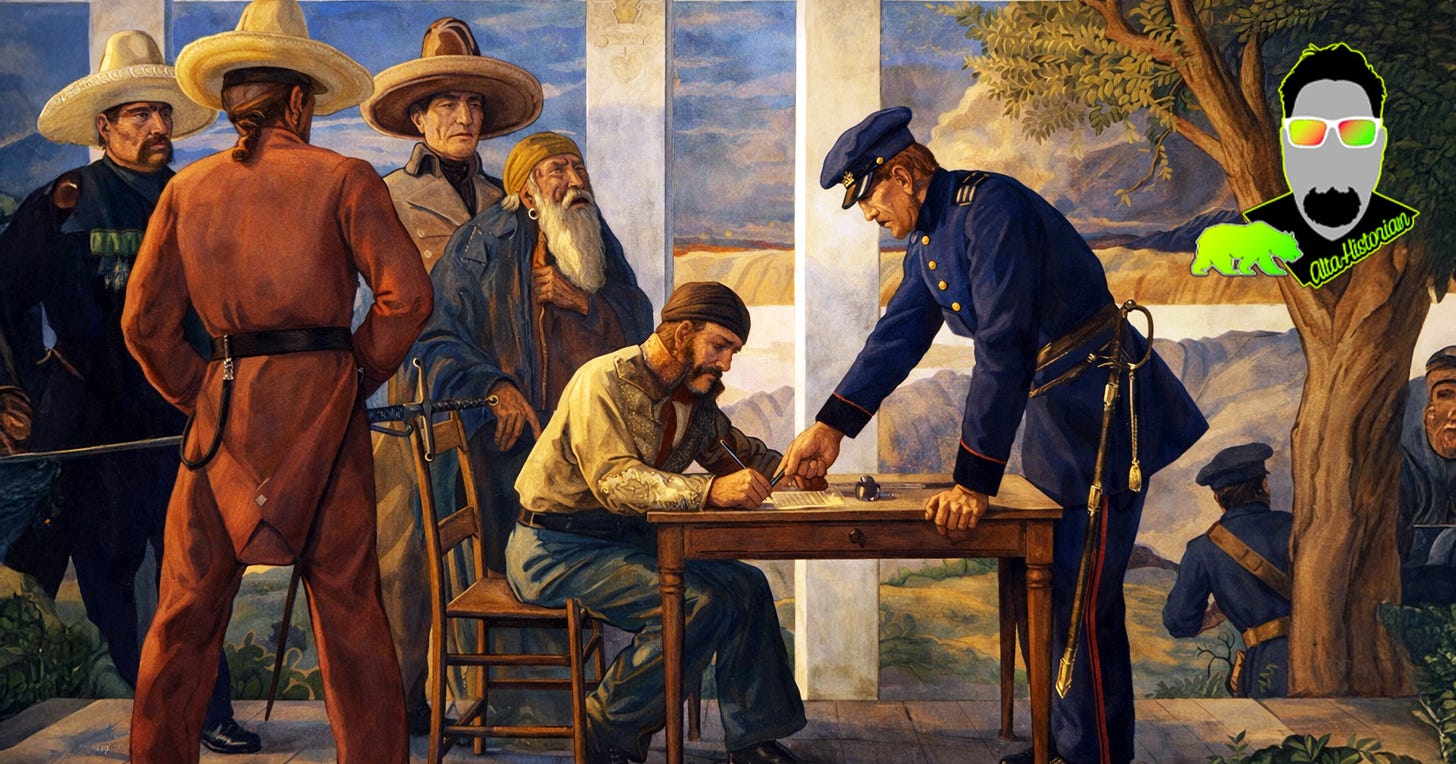

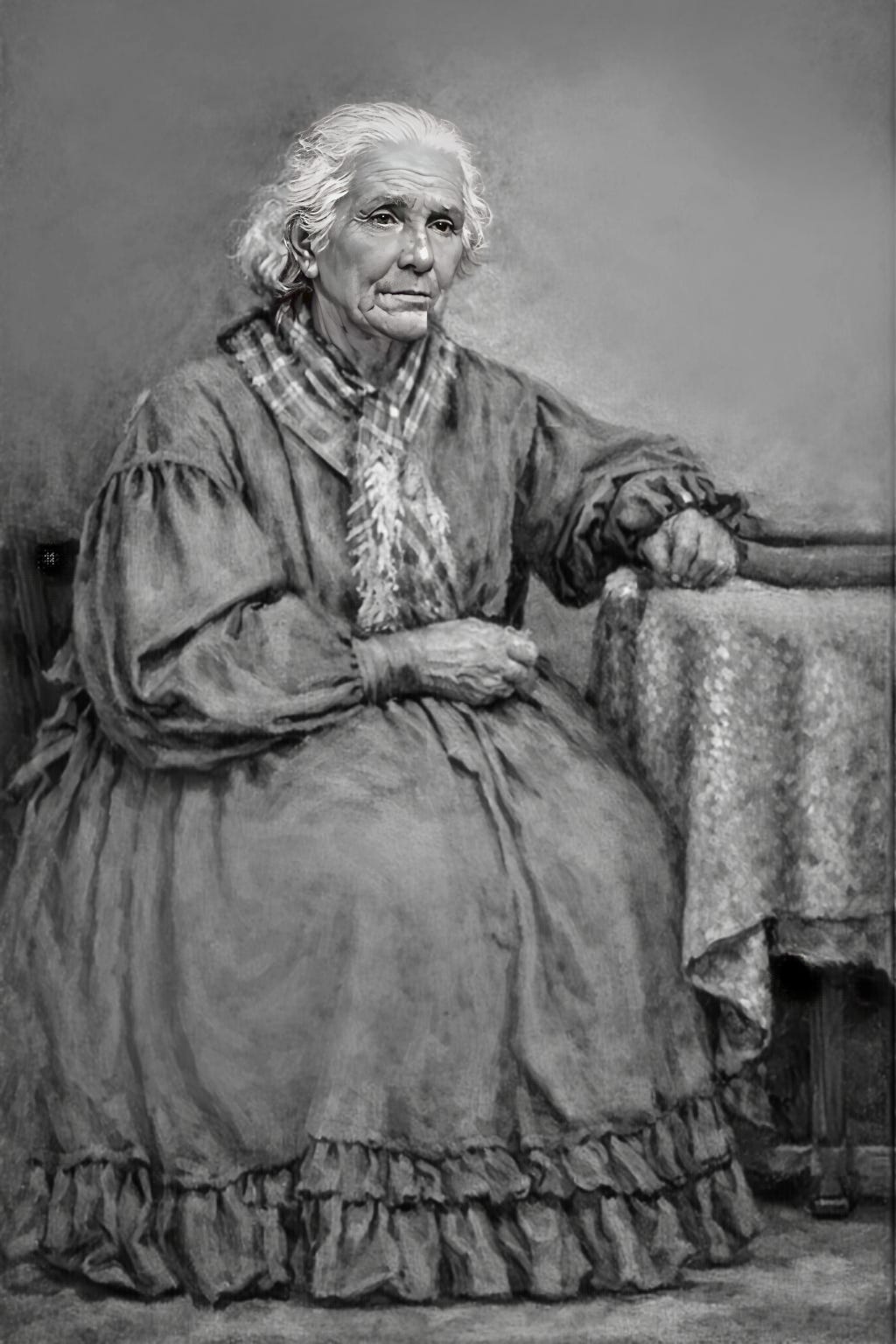
On the cold, rain-soaked morning of January 13, 1847, at the Tomás Felíz Adobe, the Treaty of Cahuenga ended the Mexican War in California. At this crossroads of Manifest Destiny stood Doña Bernarda Ruíz. In the correspondence between the two nations, Ruíz served as both interpreter and negotiator to American Lieutenant Colonel John C. Frémont and Mexican General Andrés Pico. Pico, the nephew of Ruíz and the commander who had defeated American forces at San Pasqual, would finally capitulate under her guidance. The moment belonged to Frémont. At Campo de Cahuenga, he secured a glorious capitulation that he hoped would propel a future political career, perhaps even the presidency of the United States — he would become the first Republican nominee for President of the United States.
For General Pico, the moment carried a different weight. As he surrendered California’s future as a Mexican territory with the submission of two old Spanish horse pistols, his life and career bent sharply. He could not have known — and likely could not have imagined — the serpentine path of consequences that lay ahead. The American invasion had exposed deep fractures among the Californio ranks. Families turned on one another. The Bandini, Domínguez, and Argüello families aligned themselves with the Americans. Others, such as the Carrillo and Estudillo families, remained neutral or split their loyalties. Indigenous communities were equally divided. Across the Southwest, many tribes welcomed the invasion, seeing the Americans as reliable and well-paying trade partners, while other Indian groups had long done business with the Californios. Each group, in its own way, contributed to a moment of transnational rupture.
Pico understood the gravity of the situation. On April 5, 1847, he wrote to the Mexican Republic, expressing both despair and resolve:
“I was left…in command of the small force of volunteer defenders of the Fatherland, by virtue of the fact that I held the rank of Major General, although without hopes of even the smallest success, because I no longer flattered myself that we might attain a victory... together with my compatriots we made the last efforts, notwithstanding the extreme lack of powder, arms, men, and all kinds of supplies... I nevertheless wished to give the last impulse to save the country and to guarantee the lives and properties of the inhabitants that had been for some time at the mercy and will of the occupying force since the revolt of the country.”
Despite the defeat, the Treaty of Cahuenga achieved something remarkable. It shielded Californios and Mexican-Americans from immediate disenfranchisement and outright American domination. It was clear the Californios were well-versed in American republicanism. General Pico and his advisors, one of them being Agustín Olvera (1820–1876), Californio, ranchero, and would-be judge and politician in American Los Angeles. They understood that their capitulation would have long-term consequences if not handled carefully — it is clear that the few Californios left in the fight would see their lives, liberties, and pursuit of happiness extinguished if not negotiated upon their surrender.
This is exemplified in Article II of the Treaty of Cahuenga, which guaranteed protection of “life and property whether on parole or otherwise.” Article V went further, ensuring that “equal rights and privileges are vouchsafed to every citizen of California, as are enjoyed by the citizens of the United States of North America.” As rain soaked the negotiators and muted any sense of triumph, Pico and Ruíz leveraged Frémont’s desire for capitulation to secure concessions on civil rights.
Based on those two articles alone, it was clear that the Californios fully grasped the magnitude of that moment. It marked a pivotal shift — one that moved Mexican-Americans toward the promise of American citizenship, a promise denied to African Americans, Native peoples, Chinese, and others in California for decades to come.
One of the Americans said that Pico understood the symbolic power of the moment and took visible satisfaction in his “Quaker” demonstrations at Cahuenga. The protections secured there were later confirmed by Article IX of the Treaty of Guadalupe Hidalgo in February 1848. On paper, Mexicans of the Southwest fractured the porcelain hierarchy of race nearly two decades before the Fourteenth Amendment. In practice, applying those laws would prove far more subjective.
For Frémont, the deeper implications mattered little. Whether Mexicans enjoyed civil rights was secondary to the political persona he crafted at Cahuenga. Mounted on his horse, steam rising as cold rain clashed with bubbling brea, Frémont embodied Manifest Destiny in human form. He pushed onward through the mud to Los Angeles, permitting Californios to return to their homes unmolested and pardoned of all previous violations.
What followed, however, was not peace — but endurance. Californios and Mexican-Americans weathered the American military’s internal disorder and political infighting. For older Californios, this marked the third transnational shift of their lives — though unlike the others, this one would challenge everything: sovereignty, land titles, language, culture, and ultimately their historical existence. The wave of American migration from the city centers of Boston, New York, and other parts of the eastern seaboard — a place where racial hierarchy was strongly enforced — would batter Californio society for the remainder of the century.
Two weeks before the Treaty of Guadalupe Hidalgo was formally ratified, and an irony only fate could execute, James W. Marshall discovered gold at Sutter’s Mill in Coloma. With that strike, any realistic prospect of long-term Californio political dominance in northern California evaporated. Still, members of California’s old families refused to surrender to politics. Drawing on their experience as merchants, soldiers, and rebellious republican thinkers, they fought to preserve their rights through active participation. The California Constitution reaffirmed Californios’ political engagement as they sought common ground with American patriots determined to make California a state.
The Constitutional Convention wrestled with enfranchisement, slavery, and language. Rivalries among American military men made the proceedings contentious, but ambition drove compromise. Figures such as Frémont and William M. Gwin eyed California’s future Senate seats. Many delegates understood the political reality: statehood first, revisions later. From a national perspective, admitting California as a free state would rebalance sectional power. Some Wilmot Proviso supporters were present, though not for moral clarity. The goal was a white California — as white as possible — despite the many ethnic Mexican delegates in attendance.
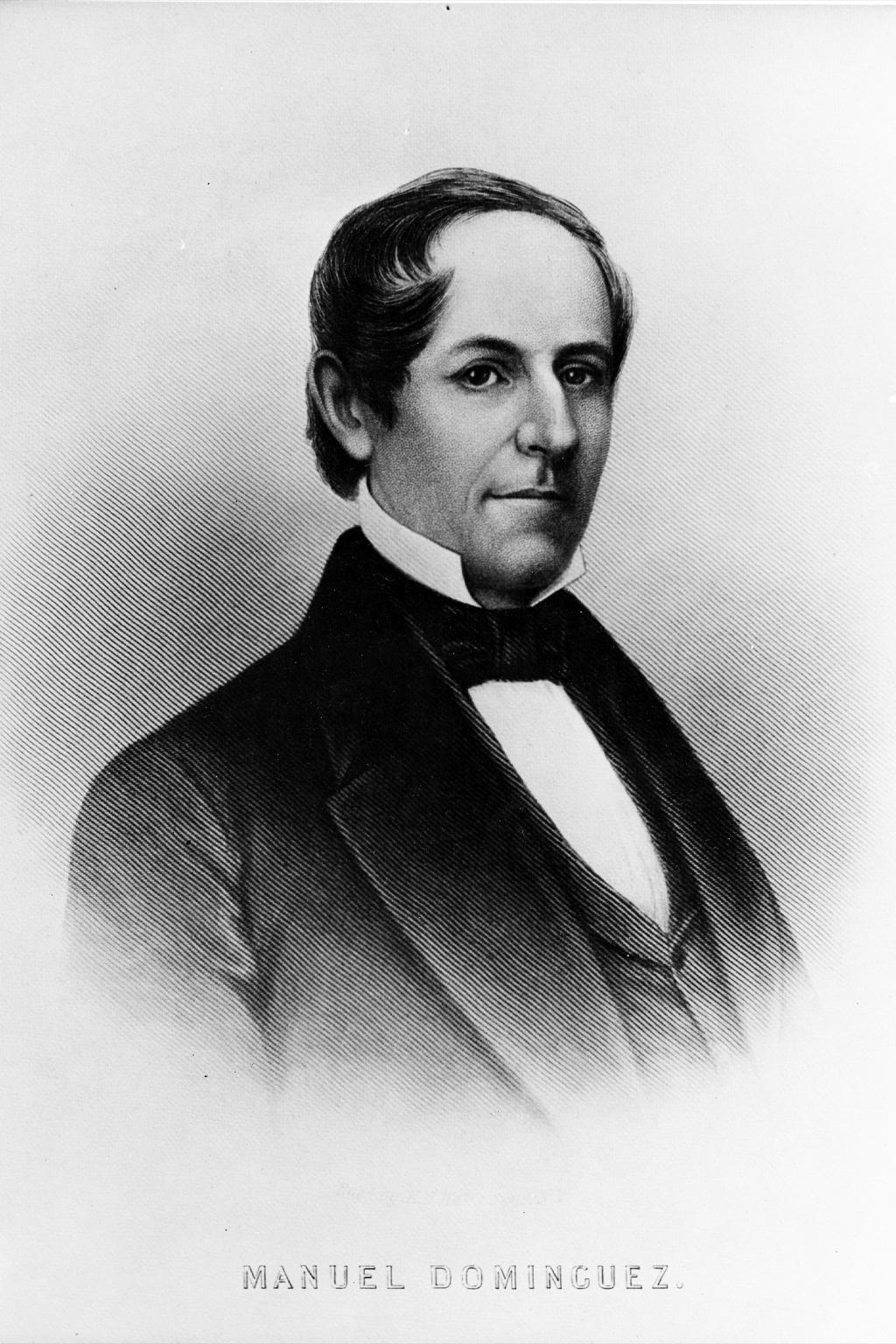
Mexican-Americans played a direct role in shaping the new state’s laws, including some who had betrayed their Californio kin. Miguel de Pedrorena of San Diego attended, fortunate to be alive after nearly being killed by Californio sniper fire during the war — a shot that took only his hat. Seven native-born delegates participated: Pablo de la Guerra, José María Covarrubias, Mariano Guadalupe Vallejo, Antonio María Pico, José Antonio Carrillo, and Manuel Domínguez. Each had played a role in the war — each now navigated American governance. Domínguez, who had guided American troops into Los Angeles, served what Bayard Taylor called the Convention’s “Indian member.” In that role, he surely reflected on betrayal — and on what American exceptionalism truly meant beyond law, economy, and military power.
The Convention’s language drew heavily from the constitutions of Iowa and New York. The debate centered on the phrase “no member of this State shall be disfranchised.” Serranus Clinton Hastings posed the critical question: how could a man who had never been franchised be “disfranchised”? His concern was not white men, but Indians and Africans. “Words are things,” Hastings warned. “If this is true, we are giving to all inhabitants, whites, Indians, blacks, and mulattoes, the right of suffrage.” Many delegates recoiled at that implication. Those at the Convention were careful. Deliberate. Intentional in their words, put into California’s original Constitution.
Vallejo, David F. Douglas, and John Bidwell attempted to carve space for Indians in the Constitution. Lacking linguistic precision, Californios relied on Bidwell, who drafted An Act Relative to the Protection, Punishment, and Government of the Indians. Douglas sought to prevent future uprisings — Vallejo sought protection for mestizo and mulatto Californios. Families like the Picos and Domínguezes — whose features fell outside American definitions of “whiteness” — some of Vallejo’s grandchildren were mestizo.
Their draft included Indian suffrage, Indian justices of the peace, and protection of hunting and fishing rights. Yet this political maneuver carried a strategic motive. With Anglos flooding California, Californios sought Indian votes from laborers bound to their ranchos. Observers like James Delavan noted the contradiction. In Notes on California and the Placers, noting that Indian laborers had been “subdued to labor at the different rancheros,” their condition was “worse than that of the Peons of Yucatán.” Sarcastically, he wrote, “No doubt all these respectable proprietors are Wilmont Proviso men… but their mode of recruiting… is something more exceptionable than the far-famed slave-market at Washington.”
Hastings rejected the proposal outright. Granting Indians and Africans equal rights, he argued, was unacceptable. “Member and inhabitant mean different things,” he concluded. “A member of a State is a citizen.”
Despite defeat, the debate nearly shattered the Convention, as J. Ross Browne (who documented the Convention) later admitted. Bayard Taylor observed that wealthy Californio families had Indian blood, and that even Domínguez would be excluded. De la Guerra proposed deferring Indian suffrage to the legislature — a near impossibility for success, as New Englanders flooded northern California for California’s Gold Rush. The attempt failed, but it revealed Californios’ willingness to confront systemic injustice, even in defeat.
What emerged resembled the Black Codes of the postwar South. Informally known as the Indian Indenture Act, the Constitution embedded California’s vision as a white man’s paradise. Slavery was banned — except as punishment (twenty years later, after the Civil War, it would be similarly worded in the 13th Amendment). Voting was limited to white male citizens, including Mexicans who elected U.S. citizenship. Laws were to be published in English and Spanish. The Californios lost the war, but not their political intellect.
Yet unity proved elusive. Stereotypes flourished. During the war, the Illinois State Register called Mexicans “reptiles in the path of progressive democracy.” New Englanders dismissed them as indolent and unfit for Americanization. The Sacramento Daily Union painted a portrait of shameful laziness and depravity, projecting Mexico’s past onto California’s future,
“For two centuries and more he has moped away his time in this manner of shameful indolence, or arousing himself to depraved action, wastes the long hours of the day in rioting and gambling. The picture is by no means overdrawn. At the present time, the evidence is before our eyes. What must be the reflections of these people, when they look around them and behold the sudden change that has come over the face of their country?”
Ethnic Mexican identity — shaped above all by Iberian, Indigenous, and African ancestry — defied the racial categories Americans carried west. To “white” Americans of largely Anglo or Anglo-adjacent stock, that complexity did not invite curiosity — it justified exclusion. Californios occupied a peculiar legal fiction: citizens on paper, outsiders in practice. Figures such as Pío Pico — and his brother Andrés — whose Afro-Mexican and Native heritage resisted easy classification, embodied a past Americans sought to hold at bay and that many Mexican elites themselves preferred to forget.
Mexican identity in the United States did not emerge organically from culture or ancestry alone. It was forged within legal frameworks constructed in the aftermath of the American Revolution — frameworks that tied civic belonging to race and never contemplated annexed, hybrid peoples such as Californios, Tejanos, and Nuevomexicanos becoming citizens at all. The Naturalization Acts of the 1790s restricted citizenship by naturalization to “free white persons,” a racial prerequisite designed for European immigrants rather than for borderland populations whose histories confounded Anglo-American binaries. When sovereignty shifted after Cahuenga and Hidalgo, treaty-made citizenship collided with racialized law. Californios became citizens without ever being clearly named white, yet they would increasingly be treated as white for legal convenience even as social practice denied them whiteness altogether. Mexican-American identity was thus bound permanently to contradiction — less a matter of blood than of law, expedience, and power.
That contradiction endures. Its residue remains visible in the bureaucratic absurdity that still instructs Mexican-Americans to identify as “White, of Hispanic origin.” For the political forces consolidating control of the American West, precision mattered little. Speed mattered. Statehood mattered. Definitions fixed in ink could always be revised later through legislation, litigation, or neglect, once authority was secured and resistance blunted. Identity, after all, was flexible — except when it was not. What the Californio believed himself to be carried little weight.
To Anglo-Americans, what mattered was that the Californio was not white. That truth was rendered unmistakable in figures like Pío Pico, the last Mexican governor of Alta California, whose Afro-Mexican and Native ancestry shattered any comfortable racial fiction. Pico — like his heritage, his culture, his land, and his wealth — was to be relegated to a fading past. He, like the Californios, Mexicanos, and Indians of the region, and like the land itself, was there for the taking.
Racial categorization alone, however, does not fully explain American hostility. New England attitudes toward Californios were also shaped by how observers understood their own white counterparts in the American South. Californios’ sprawling ranchos, gambling, and heavy drinking — hardly unique in the nineteenth-century West — were recast as moral failings. What truly distinguished them in the New England imagination was something else entirely: they appeared as the West’s version of slaveholding planters. Like southern elites, they seemed to labor little while extracting wealth through the coerced labor of others. On that basis alone, their displacement could be framed not as conquest, but as moral correction.
From there, the logic extended easily. Americans drew a straight line between the supposed inferiority of Mexicans — regardless of class — and that of Indians. Mexicans, they reasoned, were derived from the Indian — both were therefore obstacles to progress, fit to be conquered, displaced, and erased. Their removal would clear the way for a new, prosperous, and republican civilization — one imagined as WASP (White, Anglo-Saxon, Protestant), orderly, and cleansed of the Indian presence that American expansion defined as incompatible with its future.

Bibliography | Notes
Bancroft, Hubert Howe. The Works of Hubert Howe Bancroft. Vol. 22. San Francisco: A. L. Bancroft, 1883–1890.
Browne, J. Ross. Report of the Debates in the Convention of California on the Formation of the State Constitution. Washington, DC: 1850.
Bryant, Edwin. What I Saw in California, in the Years 1846–1847. London: R. Bentley, 1849.
Consulate-General of Japan. Documental History of Law Cases Affecting Japanese in the United States, 1916–1924. Vol. 1. San Francisco: Consulate-General of Japan, 1925.
Gutierrez, Ramon A., and Tomas Almaguer. The New Latino Studies Reader: A Twenty-First Century Perspective. Oakland: University of California Press, 2016.
Heifer, Robert F., and Alan J. Almquist. The Other Californians: Prejudice and Discrimination Under Spain, Mexico, and the United States to 1920. Berkeley: University of California Press, 1977.
Madley, Benjamin. An American Genocide: The United States and the California Indian Catastrophe. New Haven: Yale University Press, 2016.
Perkins, William. Three Years in California: William Perkins’ Journal of Life at Sonora, 1849–1852. Berkeley: University of California Press, 1964.
Pico, Andrés. Quoted in George Tays, “Pío Pico’s Correspondence with the Mexican Government, 1846–1848.” California Historical Society Quarterly 13, no. 2 (June 1934).
Sacramento Daily Union. “The Spanish Races in California.” November 27, 1852.
Sioli, Paolo. Historical Souvenir of El Dorado County, California, with Illustrations and Biographical Sketches of Its Prominent Men and Pioneers. Oakland: Paolo Sioli, 1883.
Street, Richard Steven. Beasts of the Field: A Narrative History of California Farmworkers, 1769–1913. Palo Alto: Stanford University Press, 2004.