


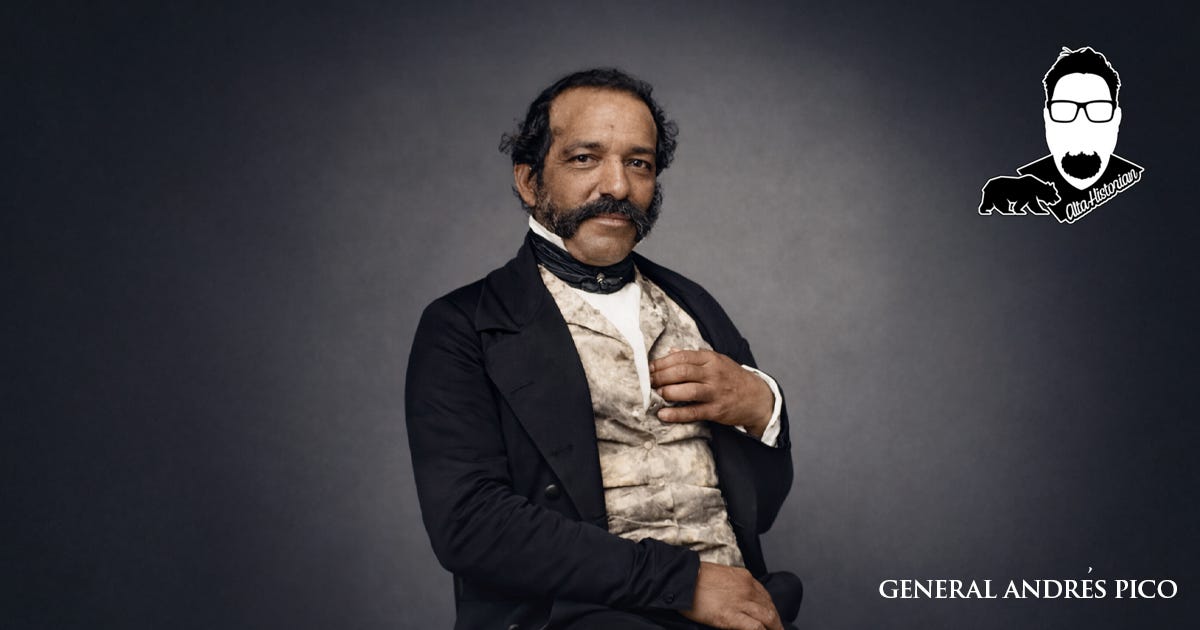
On a cold, rainy January day in 1847, at the Tomás Felíz Adobe, the Treaty of Cahuenga ended the Mexican War in California. At the crossroads of Manifest Destiny stood Doña Bernarda Ruíz — part interpreter, part negotiator — threading her way through the correspondence of two nations. Under her guidance, General Andrés Pico, the man who had driven the Americans back at San Pasqual, finally capitulated to Lieutenant-Colonel John C. Frémont. The glorious submission belonged to Frémont, who arrived at Cahuenga with an eye toward politics and, ultimately, the presidency. For Pico, the road bent hard. He avouched California’s end as a Mexican territory with the offering of two old Spanish horse pistols, and whatever private grief he carried into that rain-soaked room, he carried it alone.
Pico could not have fully reckoned what awaited him. The American invasion had exposed something rotten in the Californio ranks — families turning on each other, alliances fracturing along lines that had once seemed stable. The Bandini, Dominguez, and Argüello families had joined the American cause. The Carrillo and Estudillo families either stayed neutral or split. The Indians, for their part, were equally divided; tribes across the southwest had welcomed the invasion, finding Americans to be competent trading partners, and each in their own way had pushed the territory toward this moment of transnational rupture. On April 5th, Pico wrote to the Mexican Republic with the measured despair of a man who had watched everything unravel in slow motion:
“I was left…in command of the small force of volunteer defenders of the Fatherland, by virtue of the fact that I held the rank of Major General, although without hopes of even the smallest success, because I no longer flattered myself that we might attain a victory... together with my compatriots we made the last efforts, notwithstanding the extreme lack of powder, arms, men, and all kinds of supplies... I nevertheless wished to give the last impulse to save the country and to guarantee the lives and properties of the inhabitants that had been for some time at the mercy and will of the occupying force since the revolt of the country.”
The Treaty of Cahuenga did much to shield Californios and Mexican-Americans from the worst of American domination. Article II guaranteed the Californios “protection of life and property whether on parole or otherwise.” Article V went further, ensuring that “equal rights and privileges are vouchsafed to every citizen of California, as are enjoyed by the citizens of the United States of North America.” Drenched, numb, shorn of any feeling of triumph, the negotiators had nonetheless found the leverage hidden inside Frémont’s appetite for capitulation and used it to extract something approaching American civil rights. Whether they recognized it as such is nearly impossible to say. Yet the moment shifted the trajectory of Mexican-Americans toward citizenship in ways that would remain closed to African, Native, and other Californians for years to come.
Pico understood the gravity of what had transpired — he was rather pleased with his Quaker theater at Cahuenga. The privileges secured there were later confirmed by Article IX of the Treaty of Guadalupe Hidalgo in February of 1848. On paper, the southwest’s Mexicans had fractured the porcelain hierarchy of American race twenty years before the Fourteenth Amendment — though the reality of how those protections would be applied to Mexican-Americans would prove far more subjective than any article of treaty could guarantee.
For Frémont, what Mexicans did or did not possess in the way of civil rights was secondary to the political mythology he was busy constructing. As he rode through the mud of Cahuenga toward Los Angeles — steam rising where cold rain met the bubbling hot brea — he made for a physical tableau of Manifest Destiny. He permitted the Californios to retire home, unmolested, pardoned of all prior violations, and gave them over to the mercy of the American military’s internal chaos. For older Californios, this was a third transnational shift in a single lifetime, and nothing in their experience had prepared them for its scope. The reconstruction of their society after the quasi-war would not merely challenge their sovereignty. It would challenge their land titles, their language, their culture, and, in time, their very history. The wave of American imperialism had only just begun its long work.
Two weeks before the Treaty of Guadalupe Hidalgo was made official, James W. Marshall found gold at Sutter’s Mill in Coloma — an event that all but extinguished whatever chance the Californios had of sustaining long-term political power in the north. And yet, despite the mounting pressures threatening their standing from every direction, the men of California’s old families moved to preserve their rights through active political engagement. That tenacity was no accident. It was the inheritance of merchants, soldiers, and republican thinkers who had grown up understanding that political contestation was the price of survival.
California’s Constitutional Convention took up the hard questions: enfranchisement, slavery, language. The rivalry among the American military men made it contentious from the first day, as anyone who knew these men might have expected. Ambitious politicians like Frémont and William M. Gwin fixed their sights on the two Senate seats a newly minted state would produce — if, that is, they could agree on the terms of statehood at all. The more calculating men in that room understood the larger arithmetic: California entering the Union as a free state would restore the political balance, and the matter could be ratified now and revised later. There were Wilmot Proviso men present, though that was less to the credit of their moral compass than to the logic of keeping California as white as possible — a proposition complicated, with some irony, by the very presence of ethnic Mexican Californios seated at the table.
The seven native-born delegates — Pablo de la Guerra, José María Covarrubias, Mariano Guadalupe Vallejo, Antonio María Pico, José Antonio Carrillo, Manuel Dominguez, and Miguel de Pedrorena — had each played some part in the Mexican War. Each now navigated the ambiguous waters of American governance. Pedrorena had survived the war through betrayal, and the fact that a Californio sniper’s shot had taken only his hat rather than his head was a mercy less sentimental men might not have shown. Dominguez, who had welcomed the Americans and guided them into Los Angeles, occupied a peculiar position. Bayard Taylor noted him serving as the Convention’s “Indian member” — a categorization that must have clarified, more sharply than any law, precisely what American exceptionalism meant in practice.
The delegates leaned heavily on Iowa’s Constitution, and parts of New York’s, as they crafted California’s. The debate turned on a deceptively simple phrase: “no member of this State shall be disfranchised.” Serranus Clinton Hastings posed the problem plainly — how can a man never franchised be disfranchised? His concern was not with the definition of white men but with the exclusion of Indian and African “members” or “inhabitants” of the State. “Words are things,” Hastings argued. “If this is true, we are giving to all inhabitants, whites, Indians, blacks, and mulattoes, the right of suffrage.” Many in the room had no desire to open that door.
Mariano Guadalupe Vallejo, David F. Douglas, and John Bidwell attempted to write the Indian into California’s Constitution in some form. The Californios, lacking the fluency required to draft such language themselves, relied on Bidwell, who produced “An Act Relative to the Protection, Punishment, and Government of the Indians” — a step toward formal recognition as persons under law. Douglas, Tennessee-born, who had come by way of Arkansas, Texas, and Mississippi, harbored his own reasons for wanting to quiet future Indian uprisings. Vallejo’s motivations ran deeper. As the protector of the Californios, he understood that enfranchising mestizo and mulatto blood in America carried stakes extending well beyond the Convention. The point was existential for families like the Picos and the Dominguezes, whose features placed them nowhere near the definitions of whiteness that American political success increasingly required.
Their original draft included Indian justices of the peace, Indian suffrage, and recognition of the natural rights to traditional hunting, fishing, and gathering grounds. The political calculation underneath that pursuit deserves acknowledgment. With Anglo settlers flooding the territory at a pace that threatened to overwhelm Californio numbers, the prospect of extracting votes from the Indian workers who had long labored on their ranchos carried its own strategic logic.
To American observers like James Delavan, the spectacle was worth a certain acid commentary. In his Notes on California and the Placers, Delavan noted that Indian laborers had long been “subdued to labor at the different rancheros,” and he could not resist the irony — that the same men who had exploited that labor were now positioning themselves as champions of Indian enfranchisement. “No doubt all these respectable proprietors are Wilmot Proviso men, and eschew slavery,” he wrote, with undisguised sarcasm, adding that the condition of the Indian under Californio rule was “worse than that of the Peons of Yucatán, and other parts of Mexico, and yet there are no slaves in California!”
Despite the efforts of Vallejo, Douglas, and Bidwell, Hastings was unmoved. The adoption of the bill of rights provision, he argued, “would secure certain classes, Indians and Africans...precisely the same rights that we ourselves enjoy.” As Manuel Dominguez heard the translation and watched through eyes that Hastings himself had just defined as disqualifying, Hastings concluded with a clarity that left little to interpretation:
“The word ‘inhabitant’ would not be proper. Indians are inhabitants, but they do not enjoy those privileges in any portion of the United States if they are disenfranchised. Yet we declare here, that they shall not be disfranchised without due process of law...Member and inhabitant mean different things. A member of a State, is a citizen.”
That the issue nearly tore the Convention apart is a fact J. Ross Browne’s official record obscures but historian Benjamin Madley did not. Browne himself admitted the Indian suffrage battle threatened “the withdrawal of the Spanish delegation, and consequent breaking up the whole Convention.” Bayard Taylor bore witness to what was happening and understood why the Californios were fighting it — noting plainly that many of the most prominent families in California carried Indian blood, and that Dominguez himself “would be excluded from voting” under the Convention’s prevailing definitions.
De la Guerra finally proposed allowing the legislature to grant Indians the vote at a future date, a compromise that deferred the question without resolving it. As Anglo settlers from New England flooded northern California and filled its political seats, the two-thirds threshold became mathematically implausible. The Californios had attempted once more to use American political ambition as a lever for minority civil rights. They were stopped. In defeat, however, they had demonstrated a willingness to fight the systemic inequities of the American order that deserves recognition on its own terms. Mob rule failed the Indian again.
What the Convention ultimately produced bore a closer resemblance to the Black Codes of the postwar South than to any charter of equal protection. The bill’s unofficial name said everything: “The Indian Indenture Act.” Without formal political sovereignty, the California Indian laborer would endure decades of cruelty as bound to the system as any enslaved person in Alabama or Mississippi. The long Constitution of California was deliberate in its design. The State prohibited slavery and involuntary servitude except as punishment for crime, but it embedded the dream of California as a white man’s paradise in the architecture of every article.
Article II, Section 1 is a small masterwork of careful exclusion: “Every white male citizen of the United States, and every white male citizen of Mexico, who shall have elected to become a citizen of the United States...shall be entitled to vote at all elections which are now or hereafter.” Article XIII, Section 21 offered at least a gesture toward Californio standing: “All laws, decrees, regulations, and provisions, which from their nature require publication, shall be published in English and Spanish.” Californios had lost the war, yet their political agency in the contest over American law remains worth examining. They lost ground at every turn and continued to fight anyway.
There was never a serious doubt that the Californio would adapt politically. What threatened whatever strength remained lay in the disunity of their own community. Californios had once built their identity through separation from Mexico proper. Now los hijos del pais sought coalition — with the Indians, with the Mexicanos — finding common ground in their shared exposure to Anglo dispossession. The entire community was navigating the damage done by the war’s propaganda.
During the war, the Illinois State Register had called Mexicans “reptiles in the path of progressive democracy...they must either crawl or be crushed.” The New Englanders who followed the soldiers brought with them the settled conviction that the Mexican was too slow-going, too resistant to Americanization, too given to indolence and excess. The Sacramento Daily Union made it plain: “For two centuries and more he has moped away his time in this manner of shameful indolence, or arousing himself to depraved action, wastes the long hours of the day in rioting and gambling... What must be the reflections of these people, when they look around them and behold the sudden change that has come over the face of their country?”
The ethnic Mexican was, in truth, a strange and irreducible mixture — Iberian, Native, African, Asian, and Middle Eastern blood braided into something no American vocabulary could adequately name. The Americans who arrived with and after the Mexican War had no particular desire to find one. As the dominant body politic, they operated with the confidence of numbers, and they knew one thing with the certainty of the unconflicted: the Mexican was not white, and what was not white required neither history nor recognition. California of 1848 was a new time, a new place, demanding a new history — one written by the men arriving daily with their own visions of what California should become, visions that had no room for the territory’s ancient Californio. The Californio did not accept this quietly. Their continued contestation of every boundary, new and old, slowly widened the fractures in American law that would take generations to fully measure.
Mexican identity had, in a sense, been improvised from the wreckage of post-Revolutionary naturalization law — law that had never imagined hybrid Californios, Tejanos, and Nuevo Mexicanos becoming citizens. The Naturalization Acts of the 1790s handled the problem by miscategorization, folding Californios and their kin into the category of “free white persons” rather than confronting the complexity of what they actually were. Section I stated that “any alien, being a free white person, may be admitted to become a citizen of the United States.” Cahuenga and Guadalupe Hidalgo complicated this arrangement permanently.
The legacy persists — Mexican-Americans are often directed to check the box marked “White, of Hispanic origin,” a bureaucratic relic of that original evasion. Most of the American politicians in control of the West that year cared little about such definitional gymnastics. Statehood was the prize. Definitions were adjustable. Everything could be corrected by men like themselves, at a time of their choosing. What the Californio thought of himself was beside the point. His visible lack of whiteness was what registered. This was nowhere more apparent than in the case of Pío Pico — the last Mexican governor of California, the living embodiment of California’s Afro-Mexican and Native inheritance. Governor Pico, like his heritage, his culture, his power, and his land, was to be consigned to a usable past.
Racial category mattered. But so did the New Englander’s contempt for his own white brothers from the South. The Californios’ large ranchos, their gambling, their drinking, their evident pleasure in leisure — all of it drew comparisons to the southern planter class. They had grown wealthy on the labor of others, and to the New England eye, men who did not work for their own prosperity deserved to lose it. The connection to the Indian was equally obvious to those who wanted it to be: the Californio descended from the Indian, and what descended from the Indian was naturally beneath conquest. A prosperous, democratic civilization — properly ordered — had no obligation to preserve what stood in its path.
In the aftermath of the Mexican War, the gold rush arrived as another damaging proposition for the Mexican communities of Los Angeles. For some Californios, it opened a brief window. There was a booming cattle market. Andrés Pico, characteristically undeterred, organized a prospecting party by September of 1848 — primarily Sonoran miners, men who had spent their lives digging gold, raising stock, and fighting Indians. Pico brought his trusted second, the Spaniard Juan Manso from Mission San Fernando, and the General went north well-supplied and optimistic. The Sonoran laborers would pay market rate in gold for their provisions. The vaqueros saddled up and rode north.
Pico’s men were noted as freer than most, yet they remained laborers within a system not built for their advancement — one notch above the Indian in the unspoken hierarchy, still bound by the same oligarchic logic. The men worked for seven months, through the Yuba River country and down toward the Stanislaus placer diggings. By March of 1849, the rapid demographic transformation of northern California had become something else entirely — unsettling, intolerant, organized along lines of race and vigilance that were hardening by the week.
The first noted vigilance committee had emerged in Los Angeles in 1836, the word itself coming from the Spanish for “lookout” or “guard,” one of the territory’s older habits now turned against its originators. Anglo-Americans, Englishmen, and Australians found solidarity in their Anglo heritage, where Californios, Mexicanos, and Indians remained fractured. The disappointed men of the gold rush turned their eyes toward the dark-skinned oligarchs and the labor they had long controlled. The sheer numerical weight of Anglo settlement foreclosed what might otherwise have been America’s first genuine multiethnic polity.
California was a melting pot — but only for those designated for melting. The New Englander and the Australian did not distinguish between Californios and Mexicanos, and sometimes not between either and the Indian. Anglo vigilance groups used mob rule and law in equal measure to enforce the order they were building. Mexicans came to understand quickly, as Black Californians had already understood, how American law on paper behaved differently when applied to a darker skin.
Blacks, whites, and people from across the world descended on San Francisco in search of fortune. The Mexicans, Peruvians, and other Hispanics who came north for the gold rush were soon driven out or broken by punishing taxes and organized violence. The injustices multiplied faster than they could be counted.

Bibliography | Notes
Browne, J. Ross. Report of the Debates in the Convention of California on the Formation of the State Constitution in September and October, 1849. Washington, D.C.: John T. Towers, 1850.
Delavan, James. Notes on California and the Placers: How to Get There, and What to Do Afterwards. New York: H. Long & Brother, 1850.
Illinois State Register. 1846.
Madley, Benjamin. An American Genocide: The United States and the California Indian Catastrophe, 1846–1873. New Haven: Yale University Press, 2016.
Pico, Andrés. Letter to the Mexican Republic, April 5, 1848. [Manuscript source — verify repository and collection for full citation.]
Sacramento Daily Union.
Taylor, Bayard. Eldorado, or, Adventures in the Path of Empire. New York: G.P. Putnam, 1850.
Treaty of Cahuenga, January 13, 1847. Articles II and V.
Treaty of Guadalupe Hidalgo, February 2, 1848. Article IX.
United States. Naturalization Act of 1790. 1st Cong., 2nd sess. March 26, 1790.