

California at War: World War II on the Home Front
California

I. America Mobilizes: A Nation Rebuilt in Steel and Resolve
In the winter of 1940, as Europe burned and Asia marched, the United States began preparing for a war it had not yet entered. Between 1940 and 1946, the federal government spent a staggering $360 billion, a sum that transformed the nation’s industrial landscape. California, already a land of promise during the Depression, became a cornerstone of that mobilization. The federal government directed $35 billion of wartime spending into the state; in 1945 alone, California received $8.5 billion—a torrent of funding that reshaped its cities, industries, and demography.
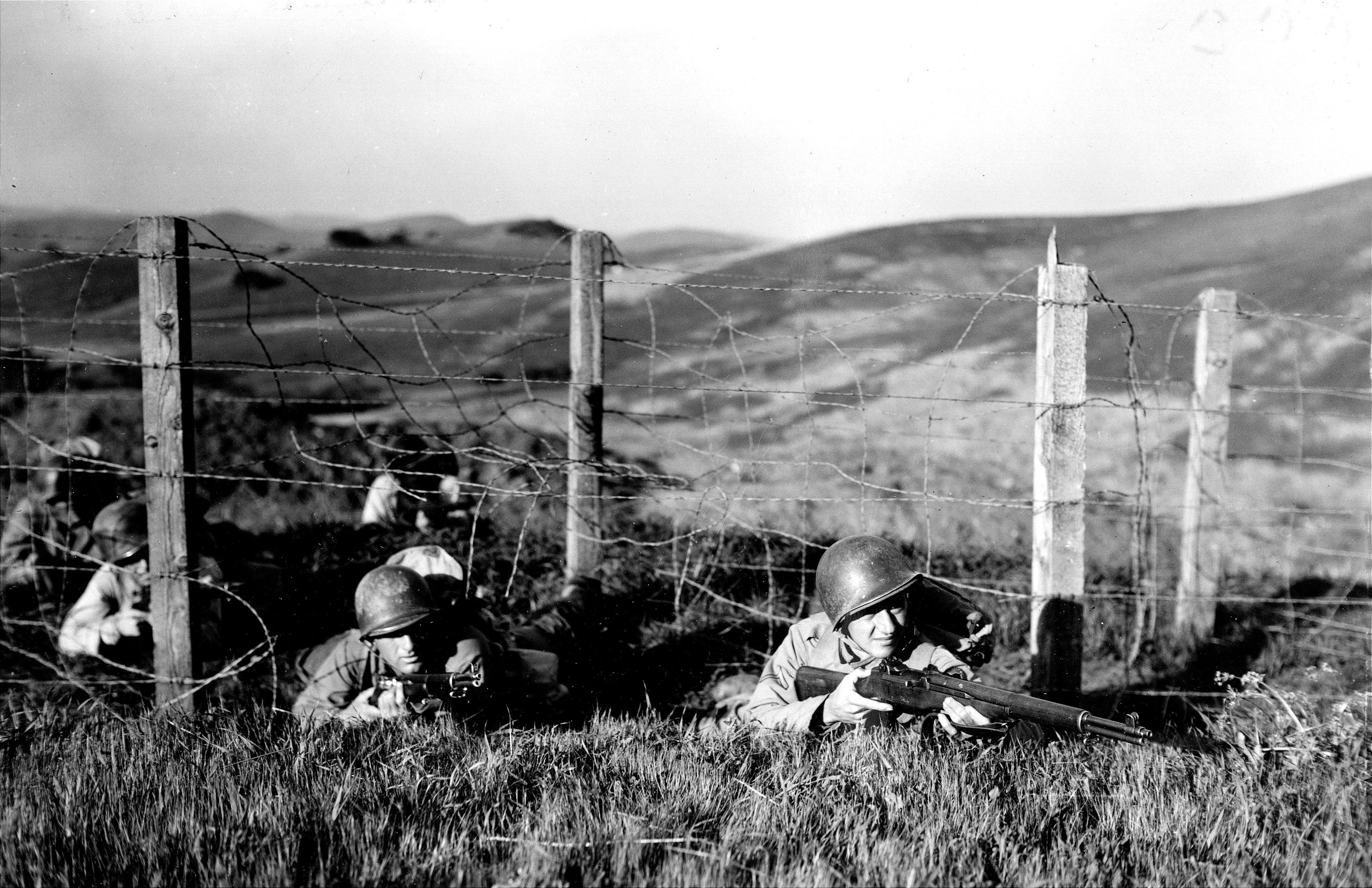
California’s population had already grown 22% during the Depression, its lowest rate for any decade since becoming part of the United States. But war spending unleashed a new wave of migration and an industrial surge. Bases that had existed quietly during the 1930s—San Francisco’s Presidio, Fort Ord, Mare Island Naval Shipyard, San Diego’s naval facilities, and March Field—expanded into enormous military installations. New camps appeared across the state: Beale, Cooke, Pendleton, Roberts, Stoneman, as well as the Oakland Army Base, the Oakland Naval Supply Center, Alameda Naval Air Station, San Francisco Naval Shipyard, and Treasure Island Naval Station. The Air Force added major bases at Castle, McClellan, Parks, and Travis.
By war’s end, California had become not simply a state, but a vast staging ground for the Pacific frontier.
II. Building the Citizen Army
The armed forces that fought World War II did not spring solely from professional ranks. It was a citizen army, built on a principle as old as the republic—that civilian soldiers could defend a free nation. In 1940, President Franklin Roosevelt urged Congress to pass the Selective Service Act, requiring the registration of men of military age, to be drafted if the need arose.
Ultimately, more than 16 million men and women served in uniform during the war. Nearly two-thirds were draftees, most of them young men pulled from farms, factories, and city neighborhoods. It was a nation mobilized by duty rather than ideology, strengthened by the belief that freedom sometimes requires personal sacrifice.
III. Minorities and the Demands of Mobilization
Even as the Selective Service Act prohibited discrimination “on account of race or color,” the reality of American life was more complicated. Nearly a million African American men and women served, alongside 500,000 Mexican Americans, 25,000 Native Americans, and 13,000 Chinese Americans.
The armed forces remained segregated. African Americans were often consigned to manual labor units. Homosexual Americans—another minority group rarely discussed openly in the era—also served, seeking, like others, an opportunity to prove their worth under fire.
Latinos, broadly classified as “white” except for Puerto Ricans, served in integrated units, and their full numbers remain unknown. But their contributions were vast, and their casualty rates high—evidence of patriotism expressed through service, even amid social inequality.
IV. The Second Great Migration: A People on the Move
Before the war, African Americans in California were often “out of sight and out of mind,” their communities small and politically marginalized. But migration changed that.
Between 1910 and 1940, 1.8 million African Americans left the South; between 1940 and 1970, nearly 3.6 million followed. In 1940, 78% still lived in the South, yet California’s frontier image—of opportunity, wages, and a new start—drew them west. The defense boom accelerated this flow.
Federal initiatives like the Fair Employment Practice Committee created expectations that Washington might intervene on behalf of Black workers—expectations that would shape the coming civil rights movement. Housing, schools, and infrastructure strained under the pressure. Defense jobs expanded. Unions grew. And California’s cities—especially Los Angeles—became symbols of both possibility and racial tension.
V. “Americans All”: Shipyards and the Wartime Workforce
The wartime shipbuilding boom forced open opportunities previously denied to many Americans. With labor shortages everywhere, shipyards could not afford to exclude anyone. Women and minorities entered skilled occupations with high wages, on-the-job training, and even draft exemptions for essential industry work.
Still, disunity simmered. Some white male workers resented the newcomers. Black workers organized the United Negro Labor Committee to demand equal insurance benefits and voting privileges denied by discriminatory unions. Historian Roger Lotchin described African Americans’ hope for a “Double V”—victory abroad and victory against racism at home.
VI. The Liberty Fleet: Industrial Might on a Deadline
War forced the United States to relearn the urgent lessons of World War I shipbuilding. Beginning in 1936, the Maritime Commission expanded and standardized ship production. By 1943, American shipyards were turning out three ships a day, building nearly 3,300 vessels over the course of the war.
These were the Liberty and Victory Ships, identical models designed for speed of construction. Production pressure was immense; absenteeism was equated with sabotage. Posters warned workers that “missing a day of work was unpatriotic.”
Housing shortages plagued coastal communities. Prefabricated neighborhoods and massive trailer camps sprang up—including one in Wilmington, California, in 1942. Family life scrambled — children traveled across the country as parents followed defense jobs.
Dorothea Lange captured this upheaval in a 1942 Richmond photograph, observing, “Every hand up signifies a child not born in California.”
VII. California’s Shipyard Revolution
In 1942, shipyards in Richmond, Oakland, Sausalito, Vallejo, and San Pedro increased labor demand. Leading this charge was Henry J. Kaiser, the master builder who oversaw a workforce of 300,000 civilian employees at its wartime peak.
Kaiser’s yards operated three shifts a day, 24 hours a day, building Liberty ships in as little as 25 days. In 1943, a new freighter launched every ten hours.
Permanente Metals, Richmond: 489 Liberty ships
Marinship Corporation, Sausalito: 15 ships
California Shipbuilding Corp., Terminal Island: 336 ships
A sign in one yard summed up the urgency:
“Help Wanted!!! Male or Female, Young or Old, Experienced or Inexperienced. Dead or Alive.”
These shipyards strained local infrastructure: schools, sewers, and housing buckled under explosive population growth. Richmond and Vallejo swelled from 20,000 to over 100,000 residents between 1940 and 1945, with their nonwhite populations rising from less than 2% to 14%. The “temporary” wartime housing that followed often decayed into postwar slums.
VIII. Women at War: The Home Front Army
The war redrew the lines of American gender roles. Millions of women entered defense industries, not from ideology but necessity: with men siphoned into the military, factories begged for workers.
Still, most married women remained at home, tending households, raising children, and supporting the war through victory gardens, recycling drives, and the purchase of bonds.
American abundance stood in sharp contrast to Allied suffering: British consumption fell 22%, and the Soviet Union endured widespread hunger.
Government campaigns urged women into factories, insisting their domestic skills prepared them for the “Victory Line.” “Rosie the Riveter” became the symbol of this transformation—a mix of propaganda and genuine patriotism. Norman Rockwell’s famous portrait, published in 1943, helped shape public admiration for working women and broadened social acceptance of their wartime roles.
Though “Rosie” riveted, in truth, most women were more akin to “Wendy the Welder,” assembling the first generation of welded ships. At the height of production in 1943, women made up over 10% of the shipyard workforce.
IX. The West Coast Arsenal: Douglas and Consolidated Aircraft
On September 25, 1942, President Roosevelt secretly visited California’s aircraft plants, recognizing their essential role in the war. At Douglas Aircraft in Long Beach, he joined California Governor Culbert Olson in reviewing production. The plant produced 16% of all American aircraft and, at peak, turned out one airplane per hour.
Recruitment was relentless. Douglas sent Boy Scouts, “Victory Scouts,” door-to-door to enlist women workers. In early 1942, the plant employed 500 women — by year’s end, 30,000. Over the war, more than 175,000 people worked there, 40% of them women.
Yet when the war ended, Douglas — like other defense firms — dismissed its female workforce to make room for returning servicemen, accompanied by a fresh propaganda campaign urging women back into domestic roles and traditional fashion.
Farther south, Consolidated Aircraft Corporation had relocated from Buffalo to San Diego in 1935 to take advantage of warm weather and accessible water for testing landplanes and flying boats. There, the company built the B-24 Liberator, superior in speed, altitude, and bomb capacity to the Boeing B-17, though its Davis wing made it vulnerable to midair breakups after flak hits.
Many B-24s were built in sub-assembly plants and shipped to San Diego for final assembly. Women cleaned the crucial glass panes through which the Norden bombsight operated—one of the few components not made of Plexiglas.
X. War Hysteria and the Japanese in America
The attack on Pearl Harbor did not create anti-Asian sentiment in America—it merely ignited kindling that had been accumulating for decades. Since the Chinese Exclusion Act of 1882, Californians had repeatedly pressured Washington to restrict Asian labor. When Chinese immigration was closed, employers simply hired Japanese workers in their place, and tension rose again. By the early twentieth century, Japan had become a world power, and restricting Japanese immigration risked diplomatic consequences.
President Theodore Roosevelt attempted a delicate balance: calm California’s hostility to Asian labor while maintaining relations with Japan. The result was the Gentlemen’s Agreement of 1906–07, an exchange of letters between American and Japanese officials. The agreement halted contract labor but allowed Japanese immigration through the so-called picture bride system. Photographs replaced face-to-face meetings, allowing marriages—and therefore immigration—to continue despite restrictions.
By the 1930s, 70% of America’s Japanese population lived in California. The 1930 census listed 97,456 Japanese residents statewide, concentrated in counties like Los Angeles (35,390), Sacramento (8,114), San Francisco (6,250), Alameda (5,715), Fresno (5,280), and San Joaquin (4,339). By 1940, 61% of California’s Japanese were Nisei — American-born citizens. For comparison, 52% of America’s Chinese population was native-born.
This demographic reality made California the epicenter of what came next.
XI. The Road to Internment: Frank Knox and a Nation on Edge
In the days before December 7, 1941, Secretary of the Navy Frank Knox assured colleagues that the Pacific Fleet was prepared for anything. When the attack came, killing more than 2,400 people, the nation was stunned—and Knox stepped before reporters on December 15 with a grave accusation. He endorsed a baseless conspiracy theory that Japanese Americans had aided the attack.
The allegation was wrong—flatly contradicted by a classified Office of Naval Intelligence report concluding that Japanese Americans posed no significant military threat. Still, Knox’s words provided political fuel to those who already favored mass removal.
Newspaper hysteria followed. Neighbors turned suspicious. Anyone of Japanese descent was driven out of restricted West Coast areas in the name of security.
The damage, as one historian put it, “was remarkable.”
XII. Executive Order 9066 and the Rise of the Camps
On February 19, 1942, President Roosevelt signed Executive Order 9066, authorizing the forced removal of 120,000 Japanese Americans, most from California, to ten camps euphemistically called “relocation centers.”
The Supreme Court later upheld this policy in Korematsu v. United States (1944), accepting the government’s claim of “military necessity”—a decision widely criticized today.
The interiors of the camps told a harsher truth. As internee Joseph Y. Kurihara described in The Spoilage:
“The desert was bad enough. The mushroom barracks made it worse… After living in well-furnished homes… and suddenly forced to live the life of a dog is something which one cannot so readily forget. Down in our hearts we cried and cursed this government… It was not the question of protection. It was because we were Japs! Yes, Japs!”
Kurihara’s bitterness reflected the sense of betrayal among many loyal American citizens.
XIII. Manzanar and Tule Lake: Life Behind Barbed Wire
Manzanar, located in the high desert of the Owens Valley, had once been home to Paiute tribes, then to miners and ranchers. The town, founded in 1910, was abandoned after Los Angeles purchased the region’s water rights in 1929. During the war, Manzanar confined more than 10,000 internees in 36 blocks of tar-paper barracks, each building measuring 100 by 20 feet, subdivided into five 20-by-20-foot one-room apartments.
Tule Lake, in northern California, was one of the ten government camps, and it became the infamous “Segregation Center.” Internees from other camps who refused to swear undivided loyalty to the United States were sent there. At its peak, Tule Lake held 18,789 people, many of whom worked the government-owned farmlands growing vegetables for the camp mess halls.
The camps were run with military efficiency but created profound social dislocation—family fractures, long-term economic losses, and enduring mistrust of federal power.
XIV. Fred Korematsu: Citizenship on Trial
One young Californian, Fred Korematsu, refused to obey Executive Order 9066. Arrested and imprisoned, he appealed his conviction all the way to the Supreme Court—and lost. He spent more than two years in camps in California and Utah.
After the war, Korematsu was shunned within segments of the Japanese American community, seen as a troublemaker in an era that prized conformity. Yet in 1983, it was revealed that federal officials—including the Solicitor General—had suppressed evidence undermining the claim of “military necessity.” Korematsu’s conviction was vacated by a San Francisco district court.
In 1998, he received the Presidential Medal of Freedom. His daughter, Karen Korematsu, later reflected:
“He believed for almost forty years that we have the ability in this country to come to justice… And he never gave up hope.”
In later life, Korematsu advocated for the rights of Muslim detainees at Guantanamo Bay, drawing parallels between wartime hysteria in 1942 and the fears of the post-9/11 era.
XV. San Francisco: The Gateway to the Pacific War
Before war reached American shores, San Francisco was a city of optimism. The 1939 World’s Fair on Treasure Island showcased Mickey Mouse films presented by Walt Disney. Families spent weekends at Playland at the Beach or watching the San Francisco Seals baseball team. The Bay Bridge and Golden Gate Bridge, completed during the Depression, stood as monuments to a confident West Coast.
War transformed the city overnight.
Treasure Island became a major shipping port, sending more than 1.6 million service members into the Pacific. The city installed 30 air-raid sirens, searchlights atop Twin Peaks, and built underground bunkers beneath Union Square. Blackouts became routine.
Gardens were dug up to grow food for the war effort. Children practiced air-raid drills in schoolyards. For many soldiers, San Francisco was “the last American soil” they saw before boarding troopships bound for the Pacific.
XVI. Japanese Americans in San Francisco: Tokyo Rose and the Shadow of Propaganda
San Francisco was also home to a large Japanese American community. Its residents included Issei (immigrants), Nisei (second-generation Americans), and Keibei—American-born Japanese educated in Japan.
During the war, Japanese-language propaganda broadcasts like “The Zero Hour,” featuring the voice of American servicemen nicknamed “Tokyo Rose,” were faintly heard on West Coast radios. One of the women associated with these broadcasts was Iva Ikuko Toguri d’Aquino, a Keibei who found herself at the center of a national controversy.
In 1945, the FBI investigated her and found no grounds for prosecution, releasing her. But when she applied for a U.S. passport later that year, public outrage—fueled by veterans’ groups and broadcaster Walter Winchell—demanded her arrest.
After a second investigation involving hundreds of interviews, recovered Japanese documents, and surviving recordings, a grand jury indicted her. In 1949, on a single count, the jury convicted her of treason for a broadcast referencing the loss of American ships.
She was only the seventh person in U.S. history convicted of treason. Sentenced to 10 years and a $10,000 fine, she served six years and two months before release. She resisted deportation, returned to Chicago, and worked in her father’s shop until his death.
On January 19, 1977, President Gerald Ford pardoned her. She died in 2006.
XVII. Wartime Los Angeles: Submarines, Searchlights, and the “Battle of L.A.”
The war cast its own peculiar shadow over Los Angeles. On February 24–25, 1942, after a Japanese submarine fired on oil tanks near Ellwood, outside Santa Barbara, panic spread. President Roosevelt warned the nation that no part of the United States was safe.
Later that night, strange lights appeared near defense plants. Radar detected aircraft 120 miles off the coast. A blackout was ordered. Searchlights swept the sky. Anti-aircraft guns blasted 1,500 rounds into the darkness. Photographs captured beams converging on a glowing shape, though nothing was ever found.
The next day, both the Secretary of the Navy and the Secretary of the Army dismissed the incident—but not before newspapers branded it the “Battle of Los Angeles.”
An Army report later concluded:
Weather balloons carrying lights had been misidentified as enemy aircraft.
Exploding shells illuminated by searchlights were mistaken for attackers.
The New York Times called it “a sign of expensive incompetence and jitters.”
It was not the first mistake associated with Frank Knox.
XVIII. Mexican Americans and the War: “Americans All”
For Mexican Americans, the war opened economic and political opportunities previously denied. Higher-paying defense jobs, combined with large-scale enlistment, accelerated entry into the middle class and fueled a growing struggle for civil rights, citizenship, and identity.
Despite the mass deportations of the 1930s, thousands of Mexican Americans volunteered for the armed forces. One wartime slogan captured their spirit: “Americans All.”
Their sacrifice was extraordinary. Though they made up 1/10 of Los Angeles’s population, they accounted for 1/5 of its wartime casualties.
Congressman Jerry Voorhis of Orange County observed:
“Anywhere from one-fourth to one-third of those names are… Gonzales or Sanchez… the very lifeblood of our citizens of Latin-American descent… poured out to win victory. We ought not to forget that.”
XIX. Zoot Suit Culture: Youth, Style, and Misunderstanding in Wartime America
By the early 1940s, virtually every major American city had its share of young men who dressed in zoot suits—broad-brimmed hats, long drape jackets, ballooned pants tapered sharply at the ankles, and often a long gold or silver chain. Young women wore short skirts, heavy makeup, and oversized coats.
This was not merely fashion; it was a kind of social language. Zoot suiters—many of them Mexican Americans, but also African Americans, Filipino Americans, Japanese Americans, and poor whites—were deeply immersed in jazz, jitterbug dancing, and big-band culture. Their clothing and music created a new kind of American youth identity that crossed racial lines at a moment when the nation was fighting fascism abroad while still struggling with segregation at home.
To older Americans—already on edge from wartime fears—zoot suits appeared threatening. The exaggerated clothing seemed a waste of precious fabric during wartime rationing. Newspapers and social reformers linked zoot culture to crime, danger, and a supposed unwillingness to “contribute to the war effort.”
But for the youth themselves, the suit symbolized dignity—an insistence on visibility in a world that often tried to push them aside.
A young Mexican American, Alfred Barela, wrote to a municipal judge in Los Angeles:
“Ever since I can remember I’ve been pushed around and called names because I’m a Mexican… I want to be treated like everybody else. We’re tired of being pushed around… or that we can’t wear draped pants or have our hair cut the way we want to.”
For Barela and others, zoot culture was as much about belonging as rebellion.
XX. A Multiracial Youth Movement and a Nation on Edge
Despite newspaper caricatures, the zoot suit phenomenon was not limited to California nor defined by race. In Los Angeles, many zoot suiters were Mexican American; in other cities, they were predominantly African American, including a young Malcolm X.
The subculture’s multiracial character—shared music, shared dance halls, shared streets—challenged the segregationist sensibilities of 1940s America. Teens from different races shared a “public space style,” something new and unsettling to many in power.
Yet wartime America was primed for xenophobia. With Japanese Americans confined in internment camps, African Americans migrating in unprecedented numbers, and Mexican American communities growing rapidly, many Angelenos feared cultural change. Zoot suits became lightning rods for anxieties fueled by pitched nationalism and paranoia over “fifth columns.”
Historian Luis Alvarez observed that zoot suiters practiced their own form of cultural politics, crafting identity and dignity even in an era that afforded them little formal power.
XXI. Sleepy Lagoon: Crime, Hysteria, and the Criminalization of Youth
Tension boiled over with the Sleepy Lagoon case. In 1942, the body of José Díaz was found near a swimming hole known as “Sleepy Lagoon.” Police arrested members of the 38th Street Boys, largely Mexican American youths. The subsequent trial—filled with sensationalist media coverage, racial stereotyping, and questionable evidence—captivated Los Angeles.
Civil rights pioneer Carey McWilliams helped organize the Sleepy Lagoon Defense Committee, composed of leftists, unionists, communists, and Hollywood figures like Orson Welles and Rita Hayworth. They argued that the trial criminalized an entire community under the guise of wartime vigilance.
Ordinarily, the LAPD ignored violence within minority neighborhoods. But in wartime, the exaggerated clothing, swagger, and interracial friendships of zoot suiters signaled—to a nervous white public—a cultural rebellion. The Díaz murder became a vehicle through which authorities attempted to reassert social control.
The prosecution dramatized the trial “like a Hollywood movie.” Defendants were denied the right to change clothes or cut their hair, forcing them to appear in zoot suits before the jury. This imagery reinforced the notion that fashion equaled criminality.
XXII. The Zoot Suit Riots: Panic Becomes Violence
By June 1943, wartime tension, racial anxiety, and media sensationalism erupted into open conflict.
Roving groups of U.S. servicemen, many recently relocated to Southern California, took to the streets of Los Angeles searching for youths wearing zoot suits. They dragged them from movie theaters, cafés, and streetcars, beating them and stripping them of their clothing. Mexican American women were also attacked, shocking public sensibilities.
Though newspapers framed the riots as fights between servicemen and “gangs,” many zoot suiters were not gang members at all. Notably, several prominent zoot suiters—including Henry “Hank” Leyvas, the alleged leader of the 38th Street Boys—had enlisted or hoped to enlist in the U.S. military. Leyvas himself joined the merchant marines.
The riots were less about patriotism than about fear. Wartime California, strained by massive migration, racial change, and national anxiety, lashed out at its own youth. Zoot suits became symbols of everything Americans feared: nonconformity, racial mixing, and cultural transformation.
The response was swift. City officials banned zoot suits, claiming the clothing itself caused violence. The move did little to calm tensions but symbolized the desire to restore order by controlling outward expressions of identity.
XXIII. Panic and the Lessons of War
Today, historians cite both the internment of Japanese Americans and the Zoot Suit Riots as sobering examples of how panic and mob rule can take hold in wartime. Fear—of attack, of sabotage, of change—can reshape civic life in ways that contradict the very ideals the nation fights to defend.
California, more than any other state, embodied this contradiction. It was the arsenal of democracy, the launching point for millions of troops, the home of immense industry and innovation. But it was also a place where wartime anxiety exposed deep fractures about race, citizenship, and belonging.
And yet, the story is not one of despair. It is a story of transformation. The experiences of African Americans, Japanese Americans, Mexican Americans, and women in wartime California helped set the stage for the great civil rights struggles of the mid-twentieth century—struggles animated not by ideology, but by a simple truth:
Citizens who serve their country expect to receive the full rights and dignity of citizenship in return.
XXIV. Conclusion: California’s War and the Making of Modern America
World War II reshaped every corner of the United States, but nowhere more dramatically than California. In the space of five years, the state transformed from a peripheral western territory into the nation’s beating military-industrial heart. The numbers alone tell part of the story: $35 billion in federal spending; 300,000 shipyard workers; nearly 1,000,000 minority servicemembers nationwide; and California cities doubling or tripling in size almost overnight.
But the deeper story is one of identity, belonging, and the enduring test of American citizenship.
Bibliography⎮References
Alvarez, Luis. 2008. The Power of the Zoot: Youth Culture and Resistance during World War II. Berkeley: University of California Press.
Graff, Cory Peyton. 2016. Southern California’s World War II Aircraft. Charleston, SC: Arcadia Publishing.
Harrison, Scott. “The Battle of LA Turns 75: When a Panicked City Fought a Japanese Invasion That Never Happened.” Los Angeles Times, February 25, 2017. http://www.latimes.com/local/lanow/la-me-battle-of-la-20170225-story.html.
Lewis, Danny. 2017. “75 Years Ago, the Secretary of the Navy Falsely Blamed Japanese-Americans for Pearl Harbor.” Smithsonian, February 7, 2017. https://www.smithsonianmag.com/smart-news/75-years-ago-secretary-navy-blamed-japanese-americans-pearl-harbor-180961417/.
Palmore, Haley M. 2014. “Beyond Objectification: Norman Rockwell’s Depictions of Women for the Saturday Evening Post.” Norman Rockwell Museum. February 2014. https://www.nrm.org/2014/02/beyond-objectification-norman-rockwells-depictions-of-women-for-the-saturday-evening-post/.
Picture This: California Perspectives on American History. n.d. “World War II Homefront Era (1940s).” Oakland Museum of California. http://picturethis.museumca.org/timeline/world-war-ii-homefront-era-1940s.
Randle, Kevin D. 2016. The UFO Dossier: 100 Years of Government Secrets, Conspiracies, and Cover-Ups. Canton, MI: Visible Ink Press.
Reft, Ryan. 2013. “Seventy Years Later: The Zoot Suit Riots and the Complexity of Youth Culture.” KCET, June 7, 2013. https://www.kcet.org/history-society/seventy-years-later-the-zoot-suit-riots-and-the-complexity-of-youth-culture.
Schipske, Gerrie. 2008. Rosie the Riveter in Long Beach. Charleston, SC: Arcadia Publishing.
Sheen, Aviva. 2015. “Fred Korematsu Joins Civil Rights Heroes in the Portrait Gallery.” Smithsonian, February 3, 2015. https://www.smithsonianmag.com/smithsonian-institution/fred-korematsu-joins-civil-rights-heroes-in-the-portrait-gallery-62586536/.
Sides, Josh. 2006. L.A. City Limits: African American Los Angeles from the Great Depression to Present. Berkeley: University of California Press.
Smithsonian Institution. n.d. “Building Ships for Victory.” On the Water. http://americanhistory.si.edu/onthewater/exhibition/6_2.html.
Thomas, Dorothy Swaine, and Richard S. Nishimoto. 1946. The Spoilage. Berkeley: University of California Press.
U.S. Federal Bureau of Investigation. n.d. “Iva Toguri d’Aquino and ‘Tokyo Rose.’” FBI History. https://www.fbi.gov/history/famous-cases/iva-toguri-daquino-and-tokyo-rose.
The Women of Douglas Aircraft. n.d. “The Women of Douglas Aircraft Company, 1942–WWII.” Old Photo Archive. http://oldphotoarchive.com/stories/the-women-of-douglas-aircraft-company-1942-wwii/3.