

The problem is money.
Growing up in a working-class family, in a working-class Hispanic community, trying to find my way, money was always the problem. Those are problems that come from not having enough of it. But the inverse is also true.
When money is injected into everything, it becomes a problem of a different kind. In politics, in collegiate sports, and in the press, the pattern is the same: more money, more problems — minus Diddy.
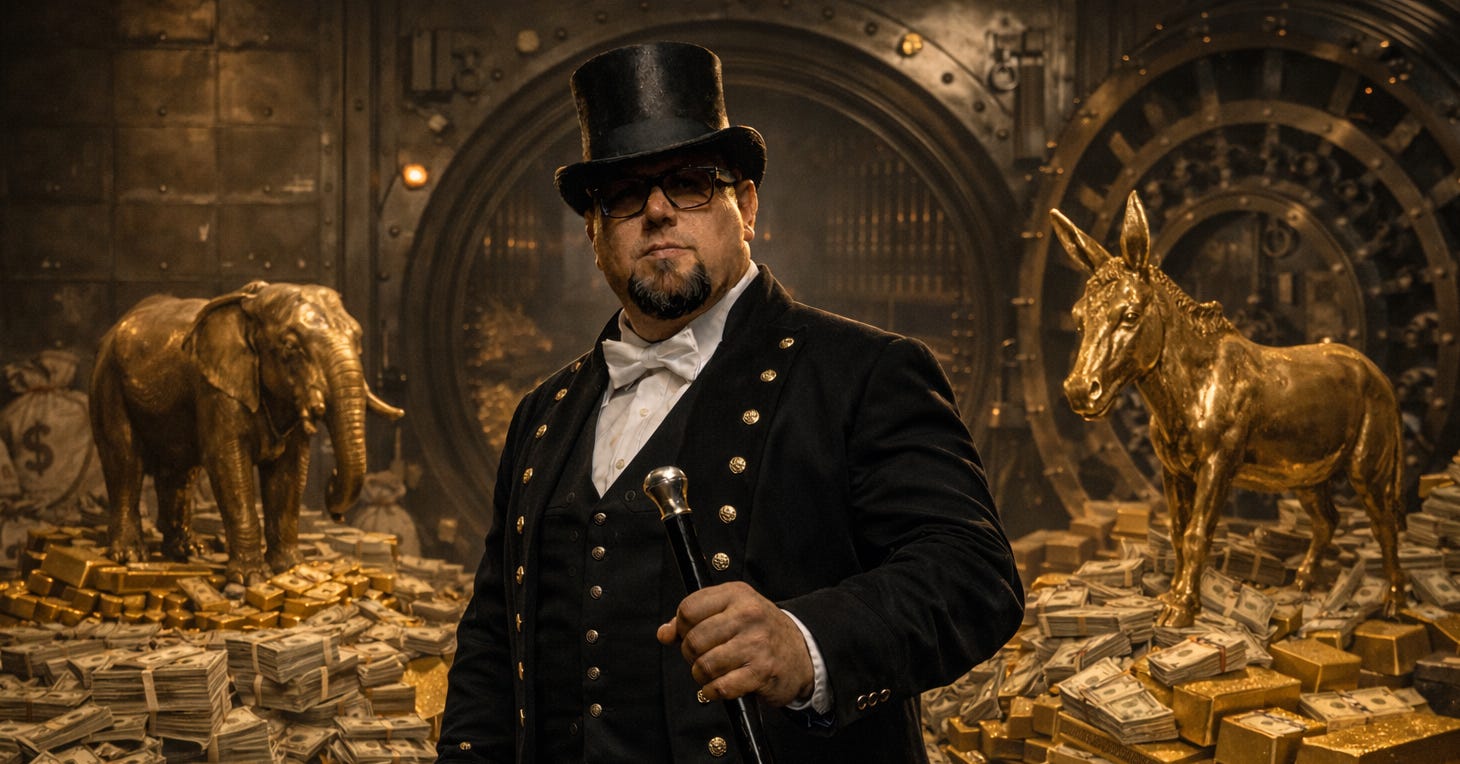
Much the same way youth sports and education have evolved into grift machines, packed with consultants, experts, advisors, fixers, and middlemen, our democratic republic has drifted into the same trap. For the level of taxation we now accept, an amount that would have been considered obscene by the Founders, any citizen should be able to viably challenge for public office.
Instead, we live inside a system that would be unrecognizable even a century ago.
Want to run for office? The first question you’ll be asked is not about ideas, experience, or character. It’s: “Show me the money.”
Jerry Maguire (1996) voice. Loud. Aggressive. No apologies.

You will need LOTS OF TREASURE, in what I can only describe as an accidentally perfect Maleficent impression.
So let’s ask a simple question.
Would you be comfortable with your representative taking money from Investor-Owned Utility companies? You know, the same companies that, through alleged negligence, have been tied to fires like the one that burned Altadena?
You’re probably paying for that, mijo — as the old tíos would say.
As Melody Petersen reported in the Los Angeles Times in her article “Eaton Fire Survivors Ask Edison for Emergency Housing Relief,” Joy
Chen of the Eaton Fire Survivors Network put it plainly:
“When a company’s fire destroys or contaminates homes, that company has a responsibility to keep families housed until they can get back home.”
They were asking Edison for up to $200,000 per family.
Hey, I have Edison.

I’m thrilled I paid for solar panels, also known as grid infrastructure, that appear to be helping them more than me at the moment. Just an opinion. What say you?
Money was always in politics. But not like this.
Many trace the modern shift back to the 2010 Supreme Court decision Citizens United v. Federal Election Commission. The Court held that corporations and unions possess First Amendment rights allowing them to spend unlimited sums on independent political advertising.
It goes something like this:
“We hold these truths to be self-evident, that all
menCorporations are created equal [to men and women], that they are endowed by their Creator with certain unalienable Rights, that among these are Life, Liberty and the pursuit of Happiness…”
This is where phrases like Super PAC and “dark money” entered everyday politics.
The Court reasoned that speech itself is not inherently corrupting — in theory. Disclosure rules were technically preserved. In practice, the ruling appears to have opened the floodgates. Political influence is now measured in dollars, not votes. Speech is “free,” but only if you can afford it.
Politics now, as the Boov said in Home (2015), it’s “mostly marketing.”

California tried to be principled. We imposed term limits on the Assembly and State Senate:
“Proposition 140 rewrote California’s rules on power and longevity in 1990. It imposed term limits on state officials, capping Assembly members at three terms (six years) and State Senators—and most constitutional officers—at two terms (eight years), with the goal of preventing career politicians from entrenching themselves in Sacramento.”
Great idea, in theory.
In practice? Exactly what my graduate professor of California history warned would happen. I’m paraphrasing, but not by much: “Term limits are a disaster. And now the lobbies will control every single one of those seats.”
This came from a liberal, by the way. And he was right.
The truth is simple: you eat what you’re served. If you’re not on the guest list, you’re on the menu.
And what does all of this produce? People who believe their vote doesn’t matter. People who believe the government doesn’t work. People who believe we live under a permanent uniparty.
Want to get people involved, local central committees? One humble view: go recruit people with community capital and convince them to run. If one of them comes to you, embrace them, guide them, cultivate them. More troubling still are the echoes growing louder every year: claims that the Constitution needs to be rewritten, that freedoms must be limited, that natural rights (understood as pre-existing government and merely protected by it) are actually the problem.
Change may be needed. But not the kind of futuristic utopia imagined by those who believe modern bureaucrats are wiser than the minds of 1776. What we actually need is far more boring, though far more difficult: a return to constitutional discipline. The Constitution, as written, with its amendments intact, minus the Sixteenth Amendment, and the collective will to follow it.
In football, it is almost never the playbook. It’s the execution. The same is true of government.
We do not need a new Constitution. We need one that is executed as written, not endlessly maneuvered around, reinterpreted beyond recognition, or deliberately circumvented. This is especially true in California, which has managed to produce not one, but two state constitutions, the latter amended heavily. Go read about the “Know-Nothings” for the ghost of political future.
I often think of a line attributed to Bruce Lee: “Simplicity is the key to brilliance.”
Whether he said it exactly that way is beside the point. The philosophy is sound, and the Founders would have understood it immediately. Ironically, Citizens United ended up limiting free speech. How? Because a citizen’s speech is now capped by how many dollars they can spend. It is difficult, borderline impossible, to argue that we do not live in a “Dollar Democracy”— I’ve tried. I failed. You try. When the decision came down in 2010, roughly 80 percent of Americans opposed unlimited corporate and union spending, with majorities across party lines favoring limits or even a constitutional amendment.
So if anyone can offer a convincing explanation for why the companies extracting from our pockets should also be allowed to pay politicians to extract even more, why dollars should determine how much free speech you’re allowed to exercise, we’re all listening.
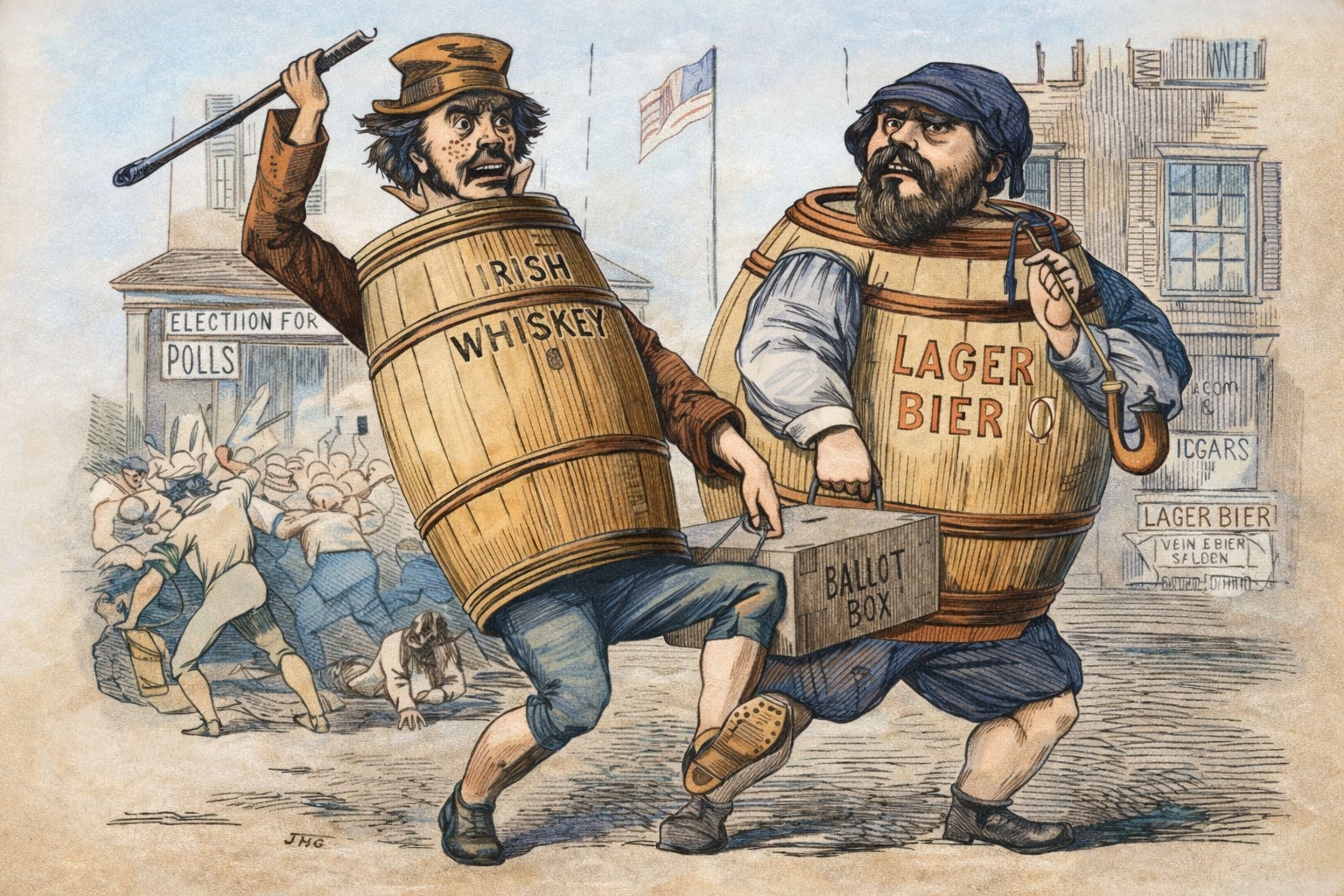
Because this industry of politics is beginning to resemble something very old, very ugly, and very familiar to anyone who has studied history: corporations working hand in hand with government to dominate labor, speech, and civic life. A bald Italian and a German with a little mustache really liked this form of government, and a lot of people died because of it.
For those unfamiliar with the term, that arrangement already has a name. Fascism. And not the TEMU version.
Bibliography | Notes
Eggen, Dan. “Poll: Large Majority Opposes Supreme Court’s Decision on Campaign Financing.” Washington Post, February 17, 2010. Accessed December 24, 2025. https://www.washingtonpost.com/wp-dyn/content/article/2010/02/17/AR2010021701151.html
Petersen, Melody. “Eaton Fire Survivors Ask Edison for Emergency Housing Relief.” Los Angeles Times, December 16, 2025. Accessed December 24, 2025. https://www.latimes.com/environment/story/2025-12-16/eaton-fire-survivors-ask-edison-for-emergency-housing-relief