


The Sonoran miners arrived among the first. Pobladores — pioneers — from what is now the state of Sonora, Mexico, they were practiced men who did three things regularly: dug gold, raised stock, and fought Indians. They had been fighting the Apache, Yaqui, Seri, and Mayo tribes of northern Mexico for generations, and the hardship of the California diggings was familiar enough to them. They followed close behind the Californios and South Americans already present, knowing the ground in ways that Anglo miners, arriving in a foreign landscape with romantic expectations, did not.
The Sonoran women came too, and they worked. Many panned for gold side by side with men. They assumed the role of “keepers of the keys” — managing provisions, organizing labor, and keeping the material life of the camps from complete dissolution. They cooked for their clans and sold food to anyone else who wanted it: frijoles and tortillas at one peso a plate, what one account described as “a national dish of meat and chile pepper, wrapped within two tortillas.”
Californio Antonio Franco Coronel noted that Sonoran women “left the diggings after three months with over 13 pounds of gold.” They tended clusters of tents that sheltered miners and worked surface diggings in their spare time while the men devoted their attention to the deeper mines and the livestock business. They had, in short, gone from the gold towns of Sonora to the gold towns of California and kept doing what they had always done, only now in a different country.
Anglo miners encountered this competence with the hostility that competence tends to produce in those who feel threatened by it. Mining-camp codes enforced by vigilance committees excluded Mexicans and Asians from the most lucrative areas of the gold rush. Makeshift courts ruled the land, with penalties including ear cropping, whipping, branding, and hanging — their aggression and intimidation were directed against foreigners and Indians alike. People made money from postcards showing lynched Mexicans.
The California legislature formalized the hostility in 1850 with a foreign miners’ license tax of $20 per month — the equivalent of roughly $600 in 2017. Of the fifteen thousand Mexicans then working the southern mines, most were unable or unwilling to pay it. Ten thousand left the region and returned to Mexico. American merchants, appalled at the loss of customers, pushed for repeal, and the law was struck down in 1851, only to be reenacted in a more moderate form. The political logic was transparent: extract the wealth of foreign labor while the labor lasted, then remove the people when they became inconvenient.
In 1855, the legislature passed what became known as the “Greaser Law,” stating that “persons commonly known as ‘greasers’ who are vagrants and who go armed may be punished.” The law provided the legal pretext to explore lands owned by Mexicans — lands that most of the law’s beneficiaries had already squatted on anyway. Another law overturned the requirement that California state law be translated into Spanish, erasing the protection the Californios had managed to extract at the Constitutional Convention only a few years before. The porcelain hierarchy of California law was revealing itself, article by article, to be exactly what it had always been.
The Californio population, which had stood at eighty-two percent of California’s non-Indian population in 1850, would fall to nineteen percent by 1880. The Federal Land Grant Act of 1851 accelerated the process, helping to strip land from the Californios in direct violation of the Treaty of Guadalupe Hidalgo. The Californio rancheros had no fences — they let their cattle roam free, as they always had, across land that had been theirs for generations.
Squatters did not distinguish public lands from Californio lands. The resulting legal disputes clogged the courts and drained the rancheros dry, with legal fees averaging 25 to 40 percent of the land-grant value. The Californios of the south fared somewhat better — the demand for food raised the price of their cattle to thirty or forty dollars a head — but the structural pressure was the same everywhere, and it moved in only one direction. Then there were the fights with the working class peoples.
On the Fourth of July, 1851, the citizens of Downieville, California, celebrated their independence. An intoxicated Australian miner named Frederick Cannon wandered door to door through the town that night, demanding that residents share a drink with him, and when they did not, he smashed through the door of José and Juana Loaiza. Cannon and José exchanged fierce words. The following morning, the Loaizas demanded payment for the damage to their door. Cannon responded by denouncing Juana as a whore and attempting to force his way into their home. Juana pulled a knife and stabbed him to death.
The following day — July 5th — a mob of two thousand gathered to watch the extralegal hanging of Juana Loaiza, convicted by a vigilance committee of murder. A physician named Cyrus Aiken, the only person who spoke in her defense, claimed she was pregnant and was beaten for his efforts. When asked to defend herself, Juana said she would not hesitate to protect her honor again.
She walked to the gallows alone, her head held high, bound her skirt around her ankles with her own hands, and straightened her hair before placing the rope around her own neck. Her last words were: “Adios, señores.” The platform underneath her was pulled. She hung lifeless in the afternoon light. Her husband was ordered to leave town within twenty-four hours or suffer the consequences.
The story of Joaquín Murieta begins much the same: with stolen gold and a violated wife, and it ends with a head in a jar. Joaquín became a hero, a Mexican Robin Hood who took from the rich — a representation of pushback against the system — though many in the Hispanic community were targeted out of fear that they were THE Joaquín!
Andrés Pico, using his prominent position in the new California order, pushed the state legislature to take action against what had become a genuine crisis of banditry in the gold country. Legislator Antonio María de la Guerra, wanting to distinguish specific individuals from the Mexican population at large, insisted that surnames be attached to the warrants — there being, in the diggings, more than one man named Joaquín.
On May 17, 1853, California passed a bill creating the California Rangers. Governor John Bigler signed it into law. Modeled after the Texas Rangers, the company was not to exceed 20 men and would serve for 3 months unless disbanded earlier. Each enlistee was paid $150 a month but was required to furnish his own horse, weapons, equipment, and provisions. The force existed for one purpose: the elimination of the Joaquín Gang. Its captain was Harry Love, a Los Angeles County deputy sheriff.
Once his rangers were assembled in late May, Love led the company into the Sierra foothills on a historic manhunt. His first notable arrest came on July 10th, when his men collared Jesús Feliz, a known confederate and relative by marriage of the gang leader. After an intensive interrogation of Feliz, Love took his prisoner fifty miles south to San Juan Bautista.
On July 20th, he came upon a deep canyon where Mexican mustang hunters were camped with a herd of several hundred horses, some of whose brands made clear that not all of the animals were wild. Without alerting the Mexicans to his presence, Love withdrew to gather reinforcements. He returned on July 24th to an empty canyon. Tracks revealed that the mustangers had moved westward. They were on the trail now. At two o’clock in the morning on July 25th, the rangers moved down the canyon to the valley below.
Dawn was breaking when they spotted smoke from a campfire three miles ahead. Love and his men rode hard, closing to within four hundred yards before they were discovered. Startled cries woke the encampment — a mixture of mustangers and Murieta gang members — as the rangers thundered in. Pandemonium. Most of the mustang hunters ran for their horses. The banditos went for their guns. The mounted rangers herded those fleeing back into the camp at gunpoint.
One man — “a handsome, long-haired, fair-complected young Mexican of about twenty-three,” standing beside his horse at the edge of a deep arroyo — stepped forward. “Talk to me,” he said. “I am the leader of this band.” Ranger Bill Byrnes reined up, took one look, and shouted: “This is Joaquín, boys! We have got him at last!”
Hearing this, one of the chieftain’s followers — later identified as Bernardino “Three-Fingered Jack” García — pulled a pistol and fired two rounds at Love. One bullet grazed the captain’s head and parted his hair. The other missed entirely. The rangers answered with nine shots from three rifles, riddling García’s body and pumping an additional round each into his head to be certain. García had lived only seconds after shooting at Love, but if his intention was to give Murieta the seconds needed to run, he succeeded.
Before the rangers could grab him, Murieta vaulted onto his horse, dropped bareback down the embankment to the creek below, and raced along the arroyo floor. The closest ranger emptied his shotgun, but his horse shied, and he missed. At full gallop, he fired his six-shooter, hitting Joaquín’s mount in the leg — but the animal ran on. A second pistol shot dropped the horse.
Murieta sprang to his feet and ran. Ranger John White rode along the rim of the arroyo, firing his rifle. The long-sought bandit chieftain finally pitched forward into the creek with three bullets in his back. His last words were: “No tira mas. Yo soy muerte.” — Don’t shoot anymore. I am dead.
Captain Love did what he had to do to prove the death of a wanted fugitive: he had his men cut off the head of Joaquín and the deformed hand of Three-Fingered Jack. The head went into a jar of spirits and was exhibited for a fee across California, becoming one of the gold rush’s more macabre commodities — proof, in the logic of the time, that the state’s Mexican problem had been properly addressed.
The line between Californio and Mexican had always been somewhat artificial, maintained by those who had invested in the distinction of sangre azul — blue Spanish blood. Anglo society had no patience for such refinements. In 1850s California, a Mexican was a Mexican, and the law was being adjusted accordingly. Mexicans were being barred from testimony in court. The statute was explicit: Indians, Chinese, and Blacks had no legal rights. The Californio families who had once leveraged their nominal whiteness to hold ground in the American political system were finding the leverage gone.
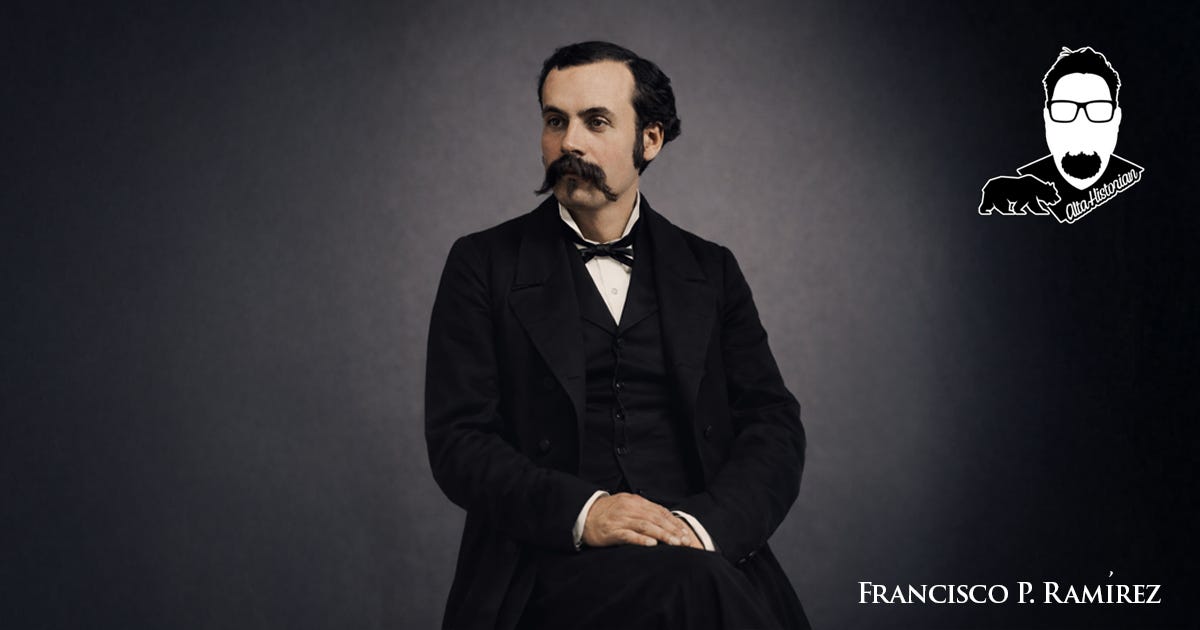
Into this deteriorating world stepped Francisco Ramírez.
Born February 9, 1837, Ramírez was the grandson of Francisco Avila, the former alcalde of Los Angeles during Spanish rule and the builder of the Avila Adobe — the oldest house in the city, still standing on Olvera Street. He grew up across the street from Jean-Louis Vignes, a French immigrant whose winery at El Aliso was the first in California. Vignes taught him French, and by the age of fourteen, Ramírez spoke Spanish, English, and French.
That same year, 1851, he began his journalistic career as a compositor for the newly launched Los Angeles Star, which carried a back-page Spanish-language section called “La Estrella de Los Ángeles.” Though only fourteen when hired, Ramírez rose quickly through the ranks and became editor of “La Estrella” by 1854. At seventeen, he left to found his own paper.
El Clamor Público — The Public Outcry — was first distributed on June 19, 1855, making it the third newspaper founded in Los Angeles and the first entirely in Spanish. The initially moderate paper evolved into something sharper. Working alongside his ally José Elías González, Ramírez transformed the weekly into an activist platform. He wrote editorials documenting the discrimination and injustice faced by Mexicans, Californios, Chinese, and Black residents.
He wrote extensively about lynchings, called out a government led by a white minority that denied the vote to non-whites, overlooked the law when it suited them, and systematically disenfranchised Spanish-speaking members of the community. In all, 233 four-page issues were published between July 1855 and August 1859, distributed as far north as San Francisco. Ramírez served as Los Angeles postmaster in 1864 and became the state translator of California in 1865. Despite having no formal education, he eventually became a well-respected lawyer in Los Angeles — which is perhaps the sharpest possible commentary on the value of formal education as understood by the institutions that controlled it.
African Americans faced similar fights with the new powers of the State of California.
Prior to 1848, the Black population of California was no more than a few dozen, many of them a blend from the pre-American period — men like Pío Pico, who represented California’s Afro-Mexican and Native heritage. By the end of 1848, many new arrivals were deserters from New England ships, whalers from Massachusetts, or Afro-Latin men coming from Mexico, Chile, and Peru. By 1850, there were 962 “persons of color” in California, with those identified as Black numbering around 600 to 700 in the gold rush counties, many of them classified as miners. Of those whose state of origin was recorded, 374 came from Virginia.
Many of them found the racial environment in California more relaxed than what they had known in New England. The Reverend Sherlock Bristol, a white antislavery man, and Isaac Isaacs, a Black man, traveled together from New York to the mines and became partners near Downieville in the village of Coyoteville. Isaacs was a well-built boxer from Philadelphia, and his reputation attracted a Kentucky boxer who badgered him into a public exhibition. The result was a disaster — for the Kentuckian. Isaacs humiliated him so thoroughly that the man drew a knife, and only Bristol’s intervention prevented the matter from turning murderous.
That relative openness had its limits, and California moved quickly to define them. Senator Gwin pushed legislation providing that slaves brought into California before it became a state might be forcibly returned to their owners — the California Fugitive Slave Act of 1851, which allowed white slave owners to reclaim Black people who had escaped, and which remained in force until it lapsed in 1855.
Some enslaved men bought their way free in the diggings. Alvin Coffey, born in 1822, paid $616 of gold mined in the High Sierra to purchase his freedom in 1852. His owner, Bassett, took him back to St. Louis in 1854 and sold him to Mary Tindall for $1,000. In 1856, Coffey paid Tindall $1,000 again for his freedom — the second time he had purchased himself. In 1857, he paid another $3,500 to secure his family's freedom. In 1858, his next child, Charles Oliver Coffey, was born free in California. In 1887, Alvin Coffey was inducted into the California Society of Pioneers — the only African American to be so honored.
The story of Mary Ellen Pleasant runs on different rails. Known as the Voodoo Queen of San Francisco, born of a Black mother and white father, she passed as white, ran a house of prostitution, accumulated political connections among San Francisco’s elite, donated $30,000 to purchase rifles for John Brown’s raid at Harpers Ferry, and quietly helped Black Americans escape from slavery. She was, by any measure, one of the more remarkable operators the gold rush produced.
California’s Black population grew from 1,000 in the 1850 census to 2,200 in 1852, with an estimated $750,000 paid by California’s Black residents to purchase the freedom of family members still enslaved. The 1855 Convention of Colored Citizens of California, meeting in San Francisco, organized to repeal local restrictive ordinances and campaigned for Black voting rights.
The California legislature refused until 1870. Legislation excluded Black testimony in court until 1863. Chinese and Indian testimony remained excluded until 1872. Five hundred southern slaves worked in the gold mines for their masters, present for a rush that promised freedom to everyone and delivered it to the ones who least needed it.
What the gold rush produced, beyond the gold, was California’s economic expansion through human capital.
California in 1850 counted 22,358 foreign-born residents; by 1860, the number had risen to 146,528 — with China, which had sent 34,935 people, remaining the largest foreign-born community a decade later. The non-Native population of California in 1852 was ninety percent male. The gender ratio did not approach balance until the late 1860s.
Gold was greater than the banking system in the early years — the dominant medium of exchange, with saloon keepers doubling as bankers in a world where formal financial institutions had not yet arrived. By 1860, drought shifted the economic center of gravity from beef to wheat, sheep raising gained importance for the production of coarse woolen cloth, and tanneries built on the abundance of cowhides anchored a leather goods industry. The rush had multiplier effects that radiated outward.
The Comstock Lode in Nevada — silver, discovered in 1859, essentially a California enterprise in terms of its capital and personnel — attracted a second great rush of fifty-niners. San Francisco bankers and thousands of small investors scrambled for shares. The silver mining was an expensive operation requiring capital and technological resources beyond the reach of individual prospectors, and an active San Francisco stock market sprang up to finance it. Misrepresentation and outright thievery ran rampant.
By the 1870s, the Comstock’s greatest boom had produced three times as much silver as the previous decade — and made conditions worse in California by drawing capital away from other fields and infecting the San Francisco exchange with a gambling mania that impoverished thousands of investors, the rich mine owners having the advantage of inside information and no apparent reluctance to use it.
William Chapman Ralston’s ring — certain officials of the Bank of California, known variously as the “Bank Ring” or “Ralston’s Ring” — foreclosed on the debt of mine owners to gain control of a major portion of the mines and mills. The town of Modesto had been intended to be named after Ralston, on the grounds that modesty was one of his prominent traits.
He overextended himself in unsound investments, completed the Palace Hotel in 1872 to find it largely unoccupied, and in 1875 was forced to resign from the Bank of California. He died shortly thereafter, reportedly while swimming in the bay. Samuel Brannan — the man who had started the whole fever with a bottle of gold dust and a shout — died penniless in Escondido, California, his body so thoroughly unclaimed that it was nearly consigned to a mass grave before someone recognized him and arranged a proper burial. It seems, as someone noted at the time, that the Lord had given him his receipt after all.

Bibliography | Notes
Carrigan, William D., and Clive Webb. Forgotten Dead: Mob Violence against Mexicans in the United States, 1848–1928. Oxford: Oxford University Press, 2013.
Chico Courant. 1866. [Specific issue date needed for full citation.]
Dearment, Robert K. “Don’t Shoot Anymore. I Am Dead.” True West Magazine, April 2019. https://truewestmagazine.com/harry-love/.
Delavan, James. Notes on California and the Placers: How to Get There, and What to Do Afterwards. New York: H. Long & Brother, 1850.
Edinger-Marshall, Susan. “Hawai’i: The California Connection.” Rangelands 22, no. 5 (2000): 15–16. http://www.jstor.org/stable/4001484.
Holliday, J. S. “Reverberations of the California Gold Rush.” California History 77, no. 1 (1998): 4–15. https://doi.org/10.2307/25462458.
Kauanui, J. Kēhaulani. “Diasporic Deracination and ‘Off-Island’ Hawaiians.” The Contemporary Pacific 19, no. 1 (2007): 138–60. http://www.jstor.org/stable/23721976.
Lapp, Rudolph M. “In the Mines.” In Blacks in Gold Rush California, 49–93. New Haven: Yale University Press, 1977. http://www.jstor.org/stable/j.ctt32bms1.9.
Levi, Werner. “The Gold Rushes.” In American-Australian Relations, 37–48. Minneapolis: University of Minnesota Press, 1947. http://www.jstor.org/stable/10.5749/j.ctttshp3.6.
Los Angeles Star.
Madley, Benjamin. An American Genocide: The United States and the California Indian Catastrophe, 1846–1873. New Haven: Yale University Press, 2016.
Roske, Ralph J. “The World Impact of the California Gold Rush 1849–1857.” Arizona and the West 5, no. 3 (1963): 187–232. http://www.jstor.org/stable/40167071.
Sacramento Daily Union.
Taylor, Bayard. Eldorado, or, Adventures in the Path of Empire. New York: G.P. Putnam, 1850.