
How Politics Found Me, Part II: California High-Speed Rail
The Republican Papers, no. 8


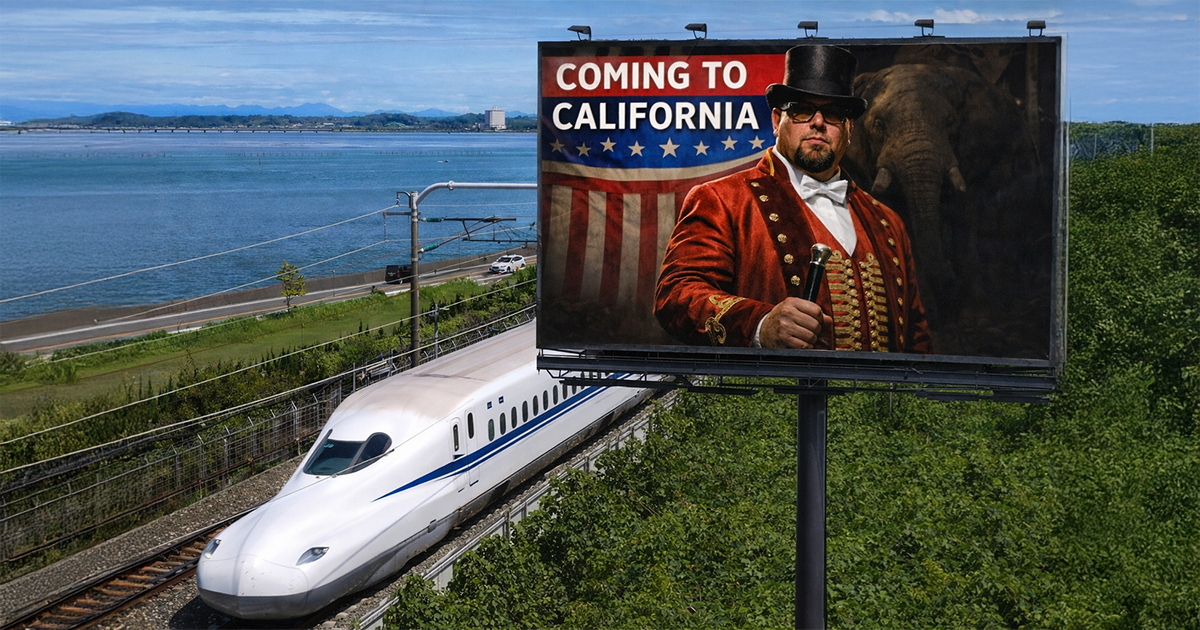
If you didn’t know, there’s good news about California High-Speed Rail. The California High-Speed Rail Authority has released the Draft Environmental Impact Report and Environmental Impact Statement for the 30-mile segment between Los Angeles and Anaheim. That alone is newsworthy. We are close.
As Lloyd Christmas would say, “So you’re telling me there’s a chance?!”

Especially now, as excitement grows around the Authority’s claim that California’s $20 billion commitment could finally secure a first-ever private investment partnership by mid-2026. That sentence has been written many times before, though hope springs eternal in California.
I first heard about the “bullet train” while driving through Los Angeles, listening to AM radio. Back then, most AM stations were fairly balanced politically. I loved the banter on The John and Ken Show on KFI 640. John Kobylt was against high-speed rail from day one. Ken Chiampou tried to bring balance, but John was mostly correct.
I’d been listening to them since the 1990s on a Sony Walkman, the tape version, my uncle Gabriel gave my twin brother and me our own Walkmans as a gift for Christmas. My Nana scolded him, saying, “They’re going to go deaf with the sound that close to their ears!”
I can still hear. My eyesight, however, is terrible. Amazing gift.
Around that same time, high-speed rail was the topic in California. Coincidentally, my wife and her cousin planned a New Year’s trip to Japan. Japan already had high-speed rail, and it worked. Before we left, I went to the Japanese consulate in Southern California and bought a JR Pass: two weeks of unlimited rail travel for about $500. I had no idea if that was a good deal. It was. Japan was a completely different culture. Organized. Respectful. Every job is taken seriously. Tipping was considered rude. A buddy of mine who had fought in Pride told me to visit Roppongi. I did. It did not disappoint.
Kyoto. Tokyo. Jigokudani Monkey Park. I stayed at the coolest hotel, ate fried chicken, listened to Elvis on an American jukebox (vinyl), photographed Mount Fuji, and ate a GIANT Fuji apple. It was an incredible trip. And the trains: glorious. To summarize my feelings on Japanese rail, I’ll borrow a line from Long Duk Dong in Sixteen Candles:
“You big tease!” I met him one time — a fun guy and really nice.

That’s when it clicked.
A trip through California on high-speed rail would be EPIC.
By 2011, I was a graduate student deep into California history, and honestly, the history of all kinds. I was living in Los Angeles, loosely involved with the LAGOP, campaigning for the few candidates they could scrape together. I only remember one because he was so damn nice, his name was Bob, a LAPD guy. We both drove FJ cruisers, and he’d personally call all his volunteers after every race, win or lose. He eventually won — as a Democrat.
The LA GOP meetings were sad.
Mostly older folks. At a car dealership. Many are probably gone now. The meetings produced very little (I’m being nice). I remember calling an older woman who ran the operation every few weeks to ask if there was anything to do. Sometimes phone banking. Occasionally canvassing. I spent a lot of time between Burbank and Malibu and met a ton of interesting people. Once, I ran into Elex Michaelson at the Burbank Library while he was covering a story on human trafficking. Dude is tall. Nice. Looks great in a suit.
Eventually, I stopped calling the LAGOP and focused on graduate school. Things like high-speed rail were going to happen anyway. Politics felt like a hobby for the elderly. They didn’t want some loudmouth Mexican kid hanging around, and the Young Republicans seemed to enjoy dinners more than governance. They told me I was too old, no graduate students allowed. I was 26. I was making six figures. And connected. For the first time in my life, I had money and time. I wanted to use both to the fullest, so I moved on. Thank God for David Hernandez and the Hispanic Republican Club showing up in Los Angeles.
I digress.
The governor at the time was Jerry Brown, deeply unpopular among graduate history students at Cal State Northridge in 2011. I enrolled in a graduate seminar on the History of the American West that was essentially a California-centric course.
One student, Gary, in his eighties, absolutely torched every pro-Brown argument made in class. Sometimes even the professor yielded. Gary claimed Brown would become “the first governor to ruin California twice,” in two separate centuries. From a historian’s lens, the 1970s were the worst legislative decade in California history. Many of the problems we face today trace directly to that era.
Legislator salaries increased. The legislature shifted from part-time to full-time. Public service became a professional political track. Staffing and committee systems expanded. The government got bigger, lazier, and slower.
That led to the 1978 tax revolt: Proposition 13, which capped property taxes at 1% of assessed value and limited annual increases to 2%.
Now there’s talk of repealing it. The argument is that it will “open up housing.” My counter is simple: you can’t afford a house now—what makes you think you’ll afford increasing property taxes every year? The other argument is homelessness funding. To that, I’ll quote Will Rogers:
“I belong to no organized political party. I’m a Democrat.”

I’m a Republican, but feel the same sentiment a century later. Going to his home in 2011 was amazing. I took a tour, and I was deep into research on William S. Hart while interning at the Natural History Museum of Los Angeles. When his home burned down, I decided to jump back into politics.
With property taxes constrained, the state leaned heavily on income, sales, and use taxes. The government grew larger and even less efficient.
Also in the 1970s: CEQA (1970). The Coastal Act (1976). Serrano v. Priest, which centralized school funding at the state level. Our education system has declined steadily since. Just like affordability. Just like our roads, infrastructure, and ability to build anything but mega warehouses, you name it, it is worse. And no, it wasn’t just Jerry Brown. Ronald Reagan deserves some blame for his time as governor. Painful, I know.
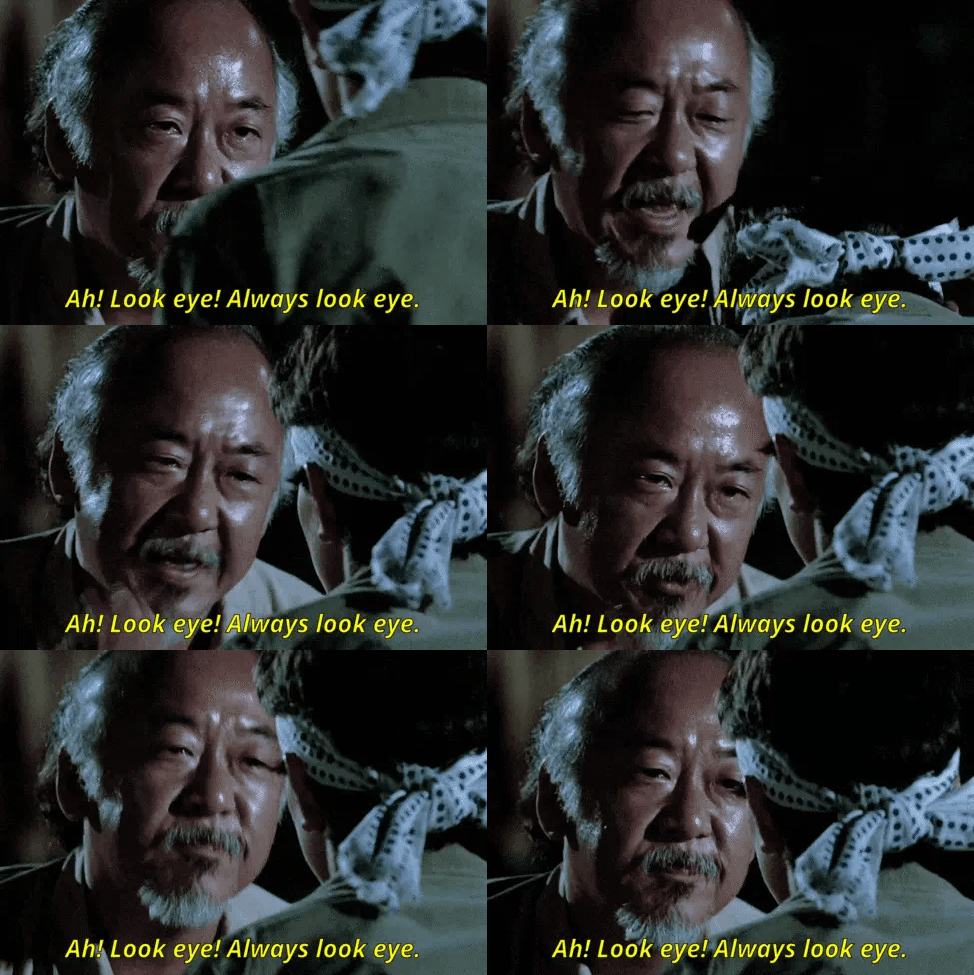
But as Mr. Miyagi said, “Look eye, Daniel-san. Always look eye.”
Reagan is remembered fondly as president. As governor, he was part of the Brown family political 💩 burger that set the table for fifty years of policy consequences. Read the Mulford Act, which Reagan signed on July 28, 1967. Reagan and the NRA were afraid of the Black Panthers.
One detail stuck with me most: the UC system used to be free for qualified California residents. If only Gary knew what was going on today. Even back in 2012, the Executive Summary promised Californians high-speed rail, but not just any old rail; they claimed it was: Better. Faster. Cheaper. Oh, the optimism.
After the 2011 Draft Plan, Governor Brown reaffirmed support for high-speed rail, while calling for cost reductions and better connectivity. Credit where due, Jerry was good with dollars sometimes, or making the date so far ahead he would never taste the consequences of his poisoned crop.
Proposition 1A was explicit: connect San Francisco to Los Angeles and Anaheim.
By 2026, we have none of that.
The Revised 2012 Business Plan shifted tone. No poetry. Just reassurance. The original vision was too expensive, too detached from reality. No, no, no! The solution was a blend, because even they knew the idea of a post-1970s policy in California would never, ever bear fruit. Shared tracks. Electrified Caltrain. Upgraded Metrolink. True high-speed rail only where it made sense. Not retreat, just logic and maturity.
Or, depending on your mood, panic management.
The promise: a $68.4 billion system delivered in phases, each with independent utility. The Initial Operating Section (a 300-mile spine from Merced to the San Fernando Valley) was supposed to cost $31 billion, with trains running by 2022.
It doesn’t exist.
Private investment was never meant to come first. It would come after trains ran, riders showed up, and revenues exceeded operating costs. Until then, funding came from bonds, federal stimulus, and cap-and-trade.
In other words, you, me, your dead grandmother, and your tía, who cut cake slices microscopic to make sure everyone got some, those people paid for this mistake.
Operating without subsidy wasn’t optional. It was required by law.
LOL. Just kidding.
I’m not into politics — but they are very into me.
Bibliography | Notes
California High-Speed Rail Authority. Revised 2012 Business Plan: Building California’s Future. April 2012. Accessed December 24, 2025. https://hsr.ca.gov/wp-content/uploads/docs/about/business_plans/BPlan_2012_rpt.pdf.
California High-Speed Rail Authority. “News Release: California High-Speed Rail Authority Releases Draft Environmental Document for Los Angeles to Anaheim Section.” December 5, 2025. https://hsr.ca.gov/2025/12/05/news-release-california-high-speed-rail-authority-releases-draft-environmental-document-for-los-angeles-to-anaheim-section/.
“California High-Speed Rail Authority Releases Draft Environmental Document for Los Angeles to Anaheim Section.” Fresno Bee (AMP).
Galicia, Erik. “Private Partnership for High-Speed Rail in California? CEO Says It’s Coming Next Year.” Fresno Bee, November 12, 2025. Accessed December 24, 2025. https://amp.fresnobee.com/news/local/high-speed-rail/article312808780.html.