

Indus Valley
World Civilizations


Estimated Date Range: c. 7000–1900 BC
India’s first great civilization emerged quietly, without epic proclamation, along the floodplains of the Indus River. Long before it entered modern historical consciousness, it had already risen, flourished, and receded — leaving behind a vast material record and an enduring interpretive problem. What archaeologists uncovered beginning in the early twentieth century was not merely another ancient society, but one of the largest and most geographically extensive civilizations of the early world, rivaling — and in sheer spatial scale surpassing — both Egypt and Mesopotamia.
Stretching across roughly half a million square miles, the Indus Valley civilization consisted of thousands of settlements arranged in a striking hierarchy. At its apex stood a small number of major cities, each covering hundreds of acres and exhibiting a level of planning that suggests careful coordination rather than organic sprawl.
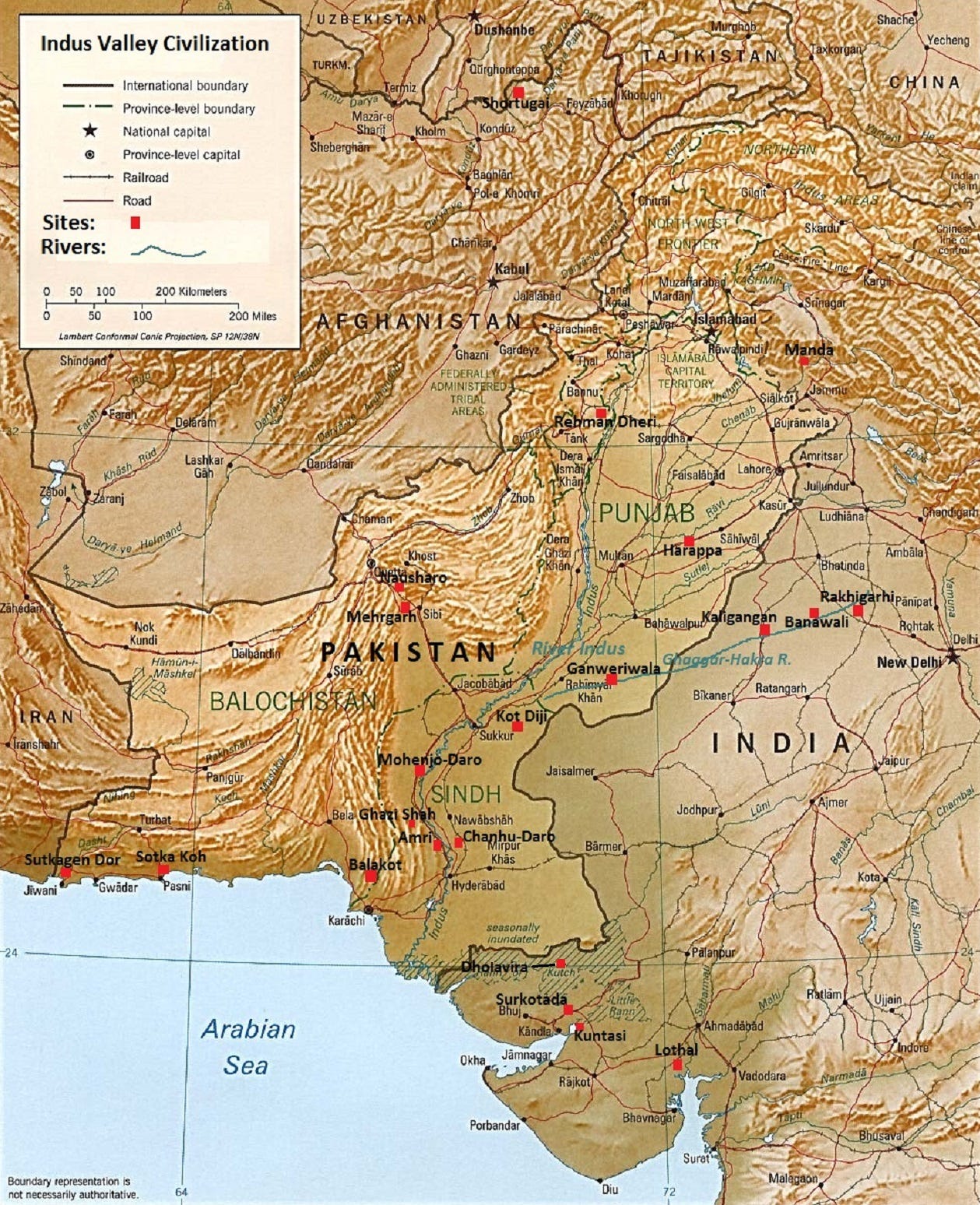
Harappa, excavated first and thus lending its name to the entire civilization, was one of these urban centers. Beneath such cities lay several tiers of towns, and at the base, a broad foundation of thousands of villages devoted to agriculture and craft production. The sheer density of this settlement network, concentrated largely in the northwestern subcontinent near the Indus and its tributaries, explains why historians speak of the Indus Valley — or Harappan — civilization as India’s first major civilizational experiment.
Like Egypt and Mesopotamia, this civilization did not spring into being suddenly. Its roots lay deep in the Neolithic past. Farming and animal domestication began on the subcontinent around 7000 BC, somewhat later than in the Fertile Crescent, but followed a familiar arc. Early villages appeared west of the Indus along the foothills of Baluchistan, where communities such as Mehrgarh practiced mixed agriculture and pastoralism, raising cattle, sheep, and goats while cultivating wheat and barley. Over the next several millennia, similar communities multiplied across northwestern India and beyond. What distinguished the Indus region, however, was the gradual but unmistakable shift from village life to town life — a transition that archaeologists trace to roughly 5000-2600 BC.
During this long threshold period, settlements grew larger, acquired street plans, and clustered near fertile land or trade routes. Artifacts spread across wide areas reveal expanding networks of exchange, binding local communities into regional systems. By 2600 BC, this process culminated in what scholars describe as the mature phase of the Indus Valley civilization. Full-scale cities now dominated the landscape, emerging several centuries after Sumerian city-states had taken shape and Egypt had unified under a single monarchy.
The mature Indus cities present a vision of urban life that feels at once familiar and disconcertingly alien. Mohenjo-Daro, situated along the lower Indus, exemplifies this world. Its location placed it amid fertile floodplains, grazing lands, and abundant water resources. The city itself rose on a series of mounds, with a central elevated area that appears to have housed public and administrative functions. Here stood massive buildings, walls, and what archaeologists call the Great Bath and Great Hall — structures whose purposes remain debated but whose scale signals collective investment.
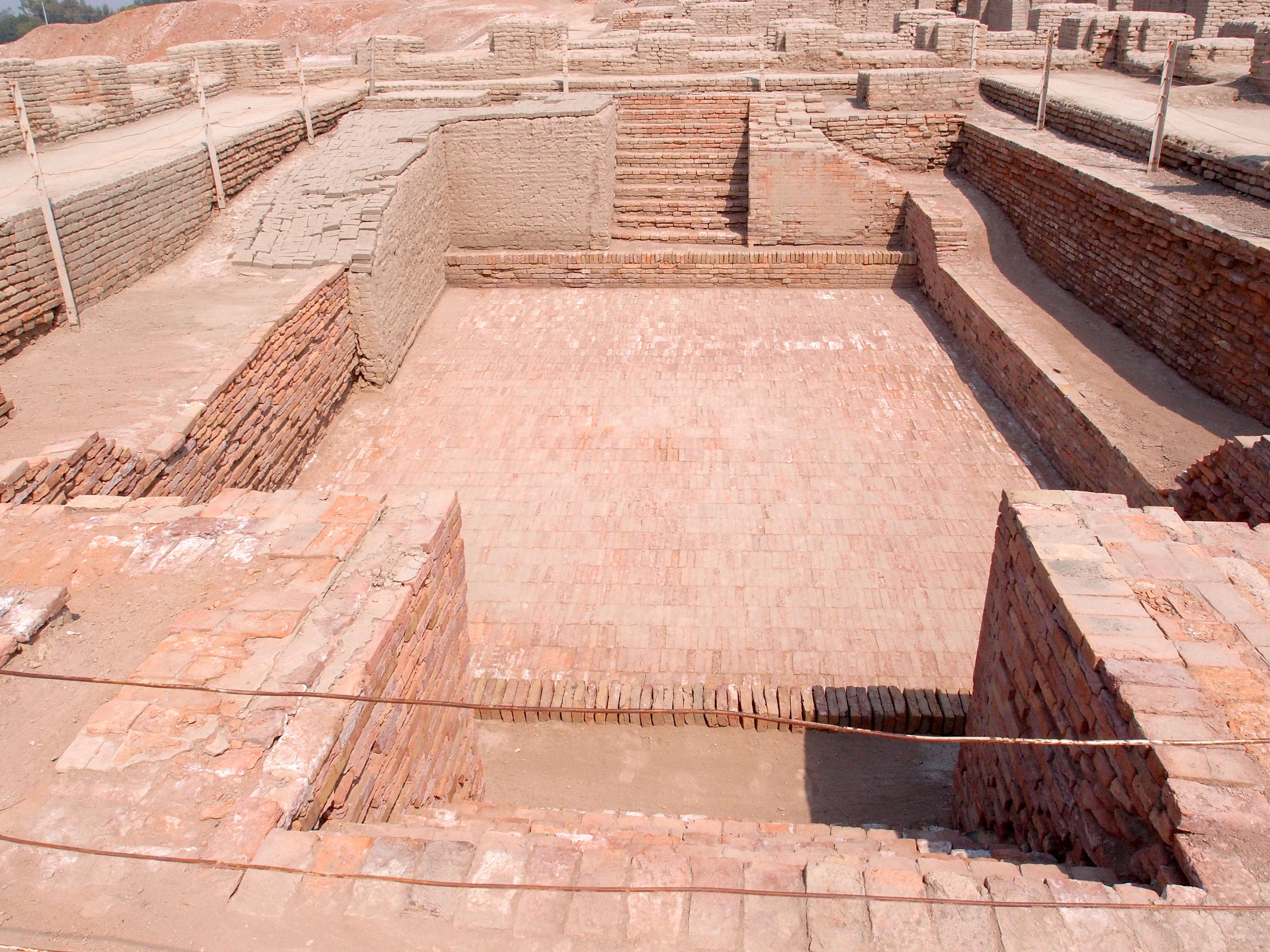
From this core, the city unfolded in a rational grid. Broad avenues intersected at right angles, dividing the city into blocks filled with multistory houses built of standardized bricks. These dwellings opened onto interior courtyards and were remarkable for their attention to sanitation. Wells, baths, toilets, and covered drainage systems were not luxuries but common features, indicating an urban culture deeply concerned with cleanliness and order.
Artifacts recovered from these cities offer glimpses into daily life. Farmers and herders brought surplus grain and livestock into urban centers for storage or exchange. Laborers maintained infrastructure, dug wells, and removed refuse. Skilled artisans produced bronze tools, ceramics, beads, and jewelry from materials ranging from copper and gold to semi-precious stones and ivory. Merchants linked cities by land and river, and coastal settlements extended these networks overseas. Goods traveled along the Arabian Sea to the Persian Gulf and Mesopotamia, where Harappan seals and beads have been found, and texts refer to a distant land called “Meluhha” — almost certainly the Indus Valley.
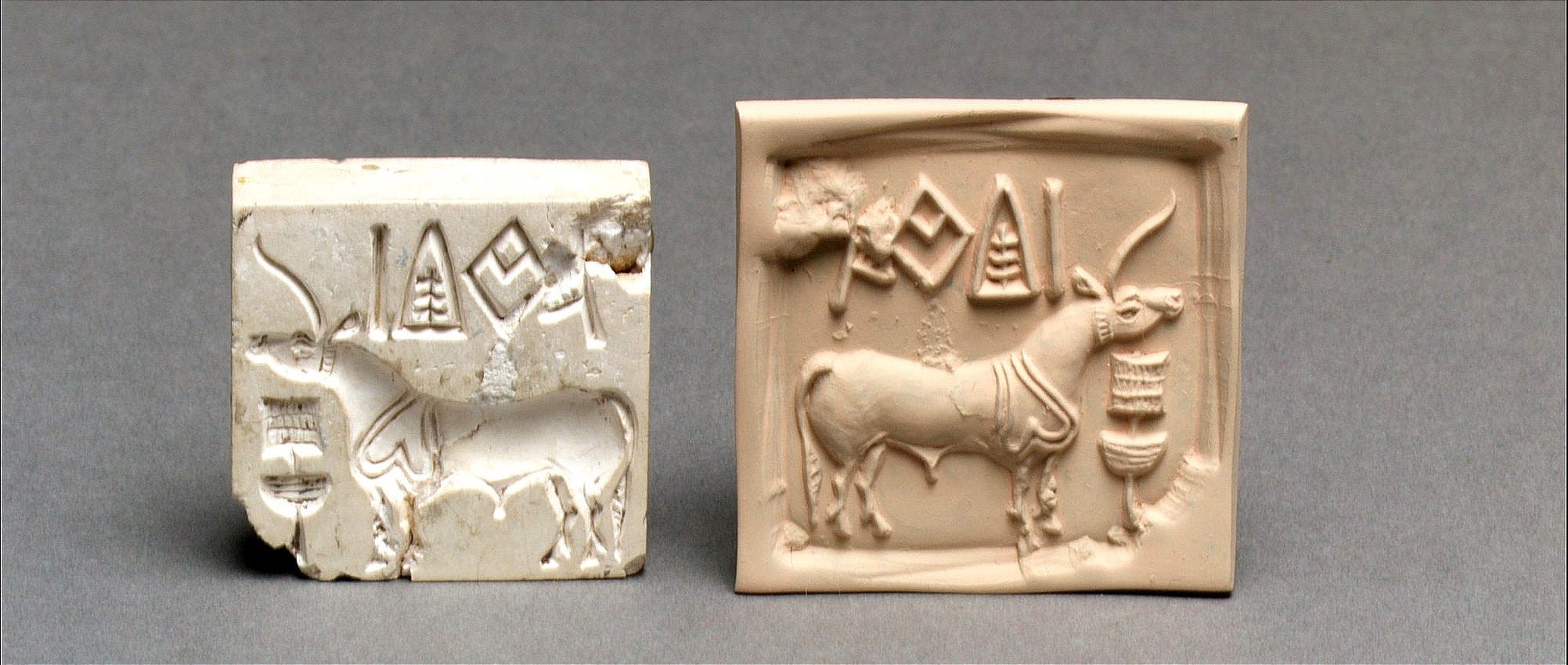
And yet, for all this activity, the civilization remains largely mute. Thousands of inscribed objects survive — seals, tablets, small artifacts bearing hundreds of recurring signs — but the script has not been deciphered. As a result, historians classify the Indus Valley civilization as proto-historic: neither fully prehistoric nor historically transparent. The absence of readable texts leaves its political institutions and religious beliefs tantalizingly out of reach.
Uniformity across the archaeological record hints at coordination: standardized bricks, weights, city layouts, and construction techniques suggest shared norms, if not centralized rule. Yet there are no unmistakable palaces, temples, or royal tombs. Power, if it existed in concentrated form, did not announce itself monumentally. A small sculpture of a dignified bearded man — sometimes labeled a priest-king — invites speculation, as do the Great Bath and assembly-like halls. But speculation remains the only option. Governance may have rested in councils of elites, merchants, or landowners rather than monarchs or divine kings.
Religious life is equally elusive. Seals depicting animals, mythical figures, and ritual scenes suggest symbolic systems now lost to us. “Unicorn” seals, female figurines, and other small objects hint at fertility cults, sacrificial practices, or deities, but no interpretation can be securely fixed. The civilization reveals itself through order and repetition, not narrative or doctrine.
After 1900 BC, this ordered world unraveled. Cities were gradually abandoned, trade networks withered, and urban life faded into a more rural pattern. Environmental pressures — shifting rivers, declining rainfall, and ecological degradation — likely undermined the agricultural base that sustained urban density. Over the course of two centuries, one of the ancient world’s most extensive civilizations quietly dissolved. By 1700 BC, the Indus Valley civilization had ceased to exist as a coherent urban system. In its place stood scattered farming and pastoral communities, not only in the northwest but across much of the subcontinent.
From this altered landscape emerged the next major chapter of Indian history: the Vedic Age. Migrating Indo-Aryan peoples entered the region, bringing with them a pastoral way of life, a ritual tradition preserved in orally transmitted hymns, and social structures that would reshape northern India. Over centuries, their language, religious ideas, and social hierarchies spread eastward, laying the foundations for states, Hindu religious traditions, and systems of social classification that would endure for millennia.
The story of early India is not one of simple succession, but of layered beginnings and endings. The Indus Valley civilization rose without known kings, governed without legible laws, and declined without a recorded catastrophe. Its disappearance did not mark the end of history on the subcontinent, but rather the closing of one civilizational experiment — an experiment whose silence continues to shape how we understand the ancient past.

Bibliography | Notes
National Geographic. Mohenjo Daro 101. YouTube video, 3:14. September 8, 2017.
OpenStax. World History, Volume 1. Houston: OpenStax, Rice University, 2018.
https://openstax.org/details/books/world-history-volume-1.
University of North Georgia Press. World History. Dahlonega, GA: University of North Georgia Press, 2017.
https://web.ung.edu/media/university-press/World%20History%20Textbook-082817.pdf.