

Native California to the Cupeño Trail of Tears
California History

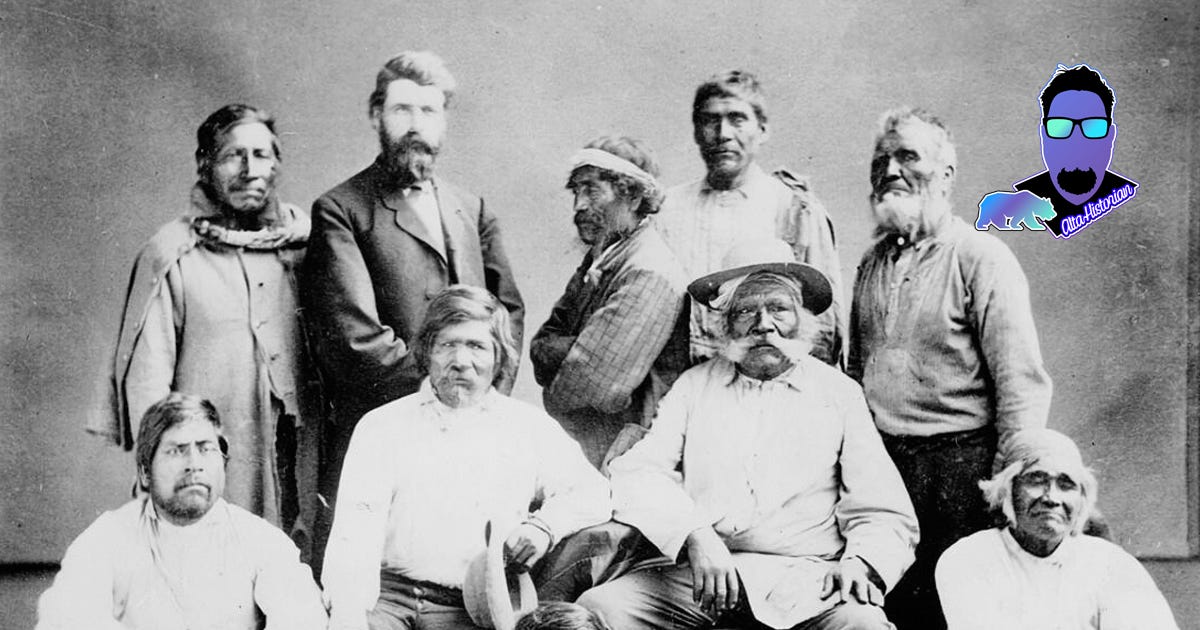
Long before Alta California came to be, people had lived here for at least 12,000 years, perhaps 15,000, and quite honestly, perhaps much longer. From the ancient to the sixteenth century, Native peoples lived in every ecological niche California offered — along fog-bound coasts and arid deserts, in oak-studded valleys and redwood forests, beside salmon rivers and tule marshes. What Europeans would later mistake for simplicity was, in fact, endurance. California Native societies represented the long survival of the Stone Age, not because they failed to advance, but because geography made certain forms of “progress” unnecessary — the land and ocean provided abundance, and development followed the terrain of Mother Nature.
California’s environmental diversity allowed for one of the densest Native populations in North America. The people were hunter-gatherers, but not wanderers. Food was plentiful — acorns, fish, shellfish, seeds, game — and it supported settled villages, intricate social systems, and a staggering linguistic mosaic. More than five hundred tribes spoke approximately 135 distinct languages, making Native California one of the most linguistically diverse regions on Earth. These were not vague cultural boundaries. They were fiercely guarded territories. Clashes erupted over fishing areas, oak groves, and water — not because resources were scarce, but because they mattered.
Food was knowledge. California Native peoples possessed what one observer called a “vast understanding of natural resources,” and they used that knowledge to shape the land itself. They burned grasslands to replenish soil, pruned trees to increase yield, culled animal and insect populations, and cultivated native tobacco, elderberry shrubs, and black walnut trees. Agriculture in California did not always mean rows and fences. It meant management.
In the southern deserts and inland valleys, groups such as the Mojave, Yuma, and Cahuilla practiced agriculture more recognizably — growing corn, beans, and squash. Elsewhere, the acorn reigned. With its high fat content and caloric value surpassing wheat, the acorn was the foundation of California life. Through the laborious process of leaching — washing acorn flour free of tannic acid — Native peoples transformed bitterness into sustenance and devised storage systems that carried villages through winter.
Fish anchored the north. Salmon surged through rivers in such abundance that they could be dried and stored. Shellfish lined the coasts. Meat and fish were preserved against lean seasons. By the time Spanish settlers arrived in 1769, more than 300,000 Native people lived in California — a population sustained by knowledge, not conquest.
And almost everywhere, there were baskets.
California Native basketry had no equal in the world — not in utility, not in beauty. Confined largely to the southern regions but practiced statewide, baskets were used for gathering, cooking, storing, and even boiling food. Some cooking baskets were sealed with pitch or tar to make them watertight. They were technology disguised as art.
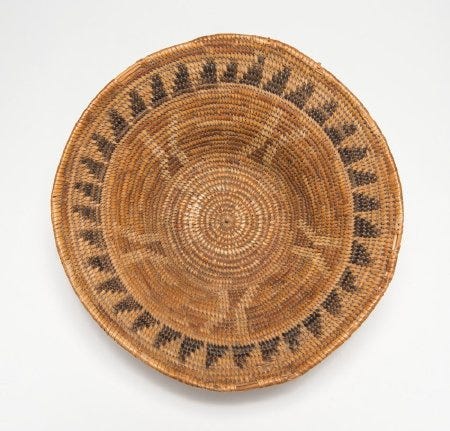
Labor followed custom, not stereotype. Men helped collect plant foods, such as acorns, and women hunted and trapped small game. Bows and arrows tipped with obsidian, knives of the same volcanic glass, were tools of survival. Villages were stable, often housing between 100 and 500 people, their locations determined by water and food. Language and diet were local, intensifying isolation and difference — also, as a prominent professor told me, the reason for linguistic diversity in California.
Along the southern coast lived the Chumash — once numbering in the tens of thousands and occupying some 7,000 square miles from Malibu to Paso Robles, and inland to the western edge of the San Joaquin Valley. They were a coastal people in intimate conversation with land and sea. Their villages endured.
Chumash dwellings were large, dome-shaped structures made of willow branches, reinforced with whalebone, and roofed with tule mats. Reed partitions hung from the ceiling, creating rooms within rooms. As many as fifty people could live beneath one roof — privacy without isolation.
Their world was connected by water. In the south, tule balsas skimmed across marshes. In the north, redwood canoes were carved from single trunks. The Chumash went further. They hauled fallen redwood logs and driftwood south, sealing plank canoes with natural tar. These tomols were marvels — sturdy, graceful vessels that carried people and trade goods between mainland villages and the Channel Islands, binding a maritime civilization together.
Ceremony marked the seasons. Fall harvests, winter storage, the renewal of balance. As food preservation improved, villages became permanent. Governance followed lineage. Elders commanded respect, but punishment was negotiable. A murderer might buy peace by compensating the victim’s family. The village — not the tribe — was the political unit. Spaniards would later call these settlements rancherías, loosely knit but sharply bounded.
Social life was vivid, even ruthless. Men gambled, sometimes risking everything — including their wives. Polygamy existed for those who could afford it. Women carried authority. Female elders passed down practical and sacred knowledge — women gathered, processed, and stored much of the food. Among the Chumash, women could rule villages and serve as spiritual leaders.
Shamans spoke with the supernatural. Even the Spanish consulted them. Priests and ritualists maintained balance, wielding political and economic power. Jimsonweed — a powerful hallucinogen — induced sacred visions during initiation rites, opening doors to worlds unseen.
Farther south, in the mountains at the headwaters of the San Luis Rey River, lived the Cupeño — the Kuupangaxwichem (koo-oo-PAHNG-gah-shwee-chem), “the people who slept here.” Their homeland, Cupa, covered barely ten square miles. They were one of the smallest Native groups in Southern California, likely never numbering more than a thousand. Small did not mean insignificant. The Cupeño story turns on a slow tightening — a pressure applied not all at once, but steadily, until resistance became inevitable and survival itself was criminalized.
As Spanish settlers, then Mexican authorities, and finally American trailblazers increased in number, the Cupeño found themselves drawn into relations that more closely resembled serfdom than coexistence. What had once been a homeland became a corridor. The southern emigrant trail cut directly through Cupeño territory, transforming villages into waystations and people into obstacles. Movement through their land was treated as a right.
Discontent spread quickly. It was fed not only by intrusion but by humiliation. American officials in San Diego, searching for revenue in the newly claimed backcountry, determined that the Indians themselves would suffice. The Cupeño were assessed a tax of six hundred dollars — an enormous sum — which the villagers eventually paid with great resentment. The payment did not buy peace.
After California passed into American hands in 1848, tensions sharpened into open resistance. A Cupeño man named Antonio Garra attempted what few had dared — to unite the Indian peoples of Southern California against all foreign powers. Garra, his son, and a rebel American sailor succeeded, briefly, in forging a coalition that spanned tribal divisions. It was an extraordinary moment, fragile and rare.
It collapsed just as quickly. On the eve of a coordinated attack, a pro-American chief named Juan Antonio of the Mountain Cahuilla withdrew from the alliance to sue for peace. The rupture proved fatal. Unity dissolved. Garra was captured, executed within days, and the village of Cupa was burned. The lesson was unmistakable.
Four years after California achieved statehood, the legal machinery of dispossession advanced. A land survey commission was formed, and cattleman Juan Jose Warner (born Jonathan Trumbull Warner of Connecticut) claimed 47,500 acres — the heart of Cupeño territory — in what is now Warner Springs. The land encompassed most of the Cupeño homeland. In 1880, the property was purchased by former California governor John Downey, who soon filed suit — a claim later pursued by his heirs — asserting ownership and demanding the Cupeño removal.
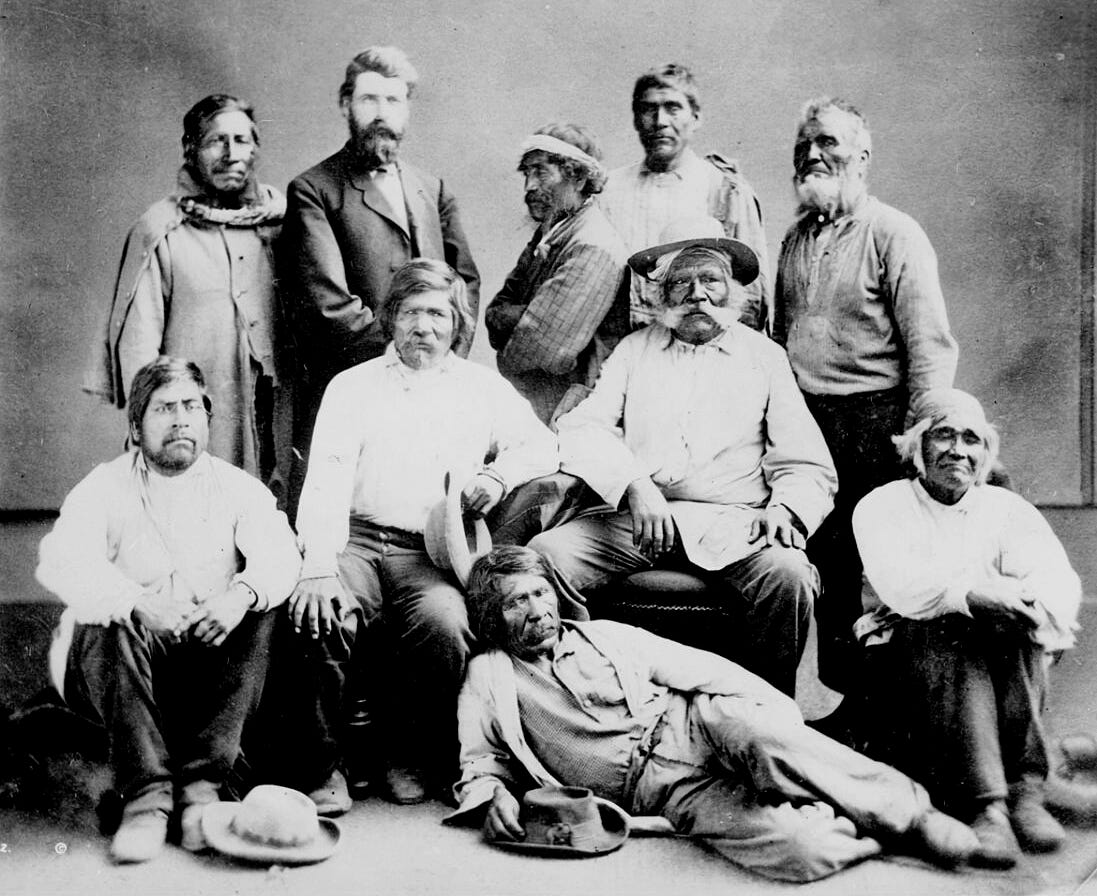
The Cupeño resisted in court. They argued that Mexican law, and the Treaty of Guadalupe Hidalgo itself, guaranteed Indian land rights and barred such a seizure. Their arguments were ignored. California courts ruled against them. In 1901, the United States Supreme Court affirmed the decision. The law had spoken.
In 1903, federal officials arrived to enforce it. Hundreds of Cupeño were forced at gunpoint to load their household goods, wagons, and livestock and abandon San Jose del Valle — their ancestral home — because a court had decided they had never owned the land they had occupied for generations. The new owner imagined a resort.
The removal became known as the “Cupeño Trail of Tears.” The people were driven around Mount Palomar on a forty-mile march to a barren site beside a Catholic mission in the San Luis Rey River Valley. Women and children were terrified. When they arrived, they found nothing but tents and a rundown mission.
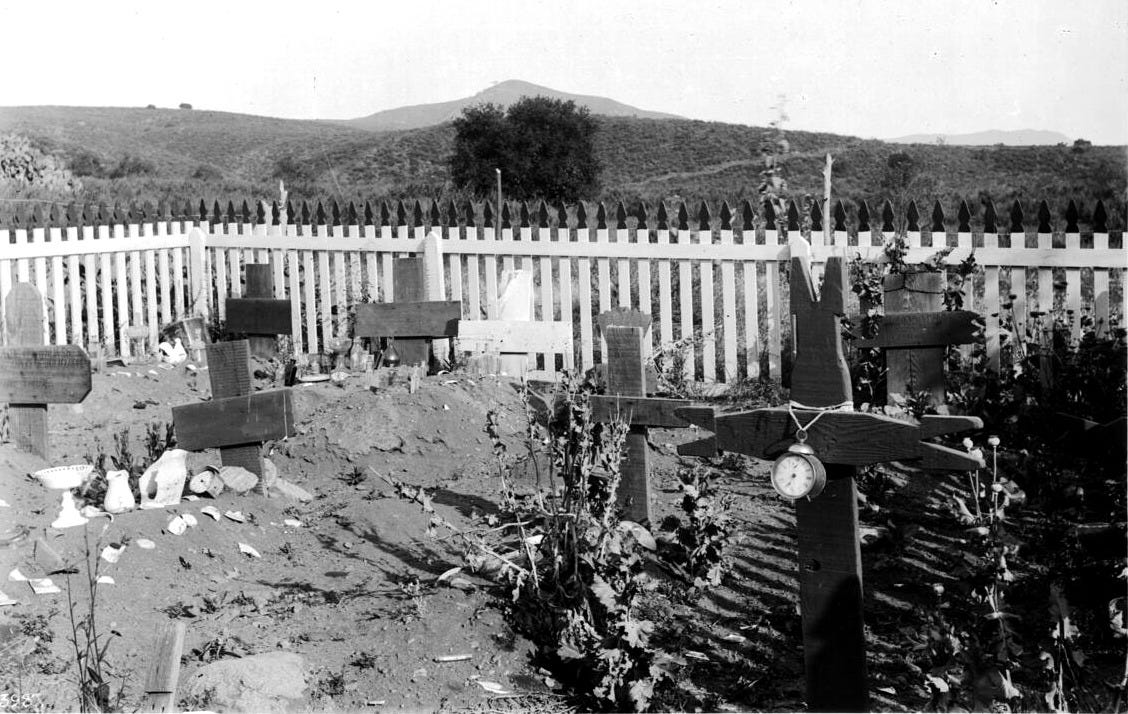
At the Bureau of Indian Affairs' insistence, the Cupeño were merged with the nearby Luiseño community, forming what is now the Pala Band of Mission Indians. The two groups lived alongside one another under federal supervision — sometimes cooperatively, sometimes uneasily. The division has never fully disappeared. Even today, descendants of the Luiseño pioneers tend to one cemetery, while descendants of the Cupeño largely choose another.
As exemplified by the story of the Cupeño, California’s Native past is not a single story. It is a thousand local worlds — north and south, coast, valley, mountain, and desert — bound together by land, language, and labor. When the Spanish arrived in 1769 under Junípero Serra and Gaspar de Portolá, they brought missions rather than settlements, and coercion rather than coexistence. Despite romantic portraits, the missions were labor camps. Soldiers intimidated. Livestock devoured native foods. Disease followed.
Smallpox, measles, diphtheria, pneumonia — epidemics tore through communities that had no immunity. Children were separated from their parents and confined in filthy barracks. Labor was relentless. Demographer Sherburne F. Cook later concluded that perhaps sixty percent of the mission population decline resulted from disease alone. Resistance took many forms — flight, sabotage, assassination, revolt. The Kumeyaay destroyed Mission San Diego in 1775. The Chumash rose in 1824. Others fled inland, forming guerrilla bands.
By the time the missions collapsed, nearly a third of California’s Native population was dead.

Bibliography | Notes
Pala Band of Mission Indians. “History.” Pala Tribe. http://www.palatribe.com/visitors/history/.
Rawls, James J., and Walton Bean. California: An Interpretive History. 10th ed. New York: McGraw-Hill, 2011.
Rolle, Andrew, and Arthur C. Verge. California: A History. 8th ed. Hoboken, NJ: Wiley, 2015.
Perry, Tony. “The Cupeños’ Own Trail of Tears.” Los Angeles Times, March 17, 2012. https://www.latimes.com/local/la-xpm-2012-mar-17-la-me-pala-dispute-side-20120317-story.html.
Wooden crosses in cemetery at Mission Assistencia of San Antonio at Pala, ca. 1898.” Photograph. California Historical Society Collection, 1860-1960. Title Insurance and Trust, and C.C. Pierce Photography Collection, 1860-1960. University of Southern California Libraries. https://doi.org/10.25549/chs-m4420.