

On Gov't: Confucius
The Jefferson Club | Where Eastern politics intersect with the West

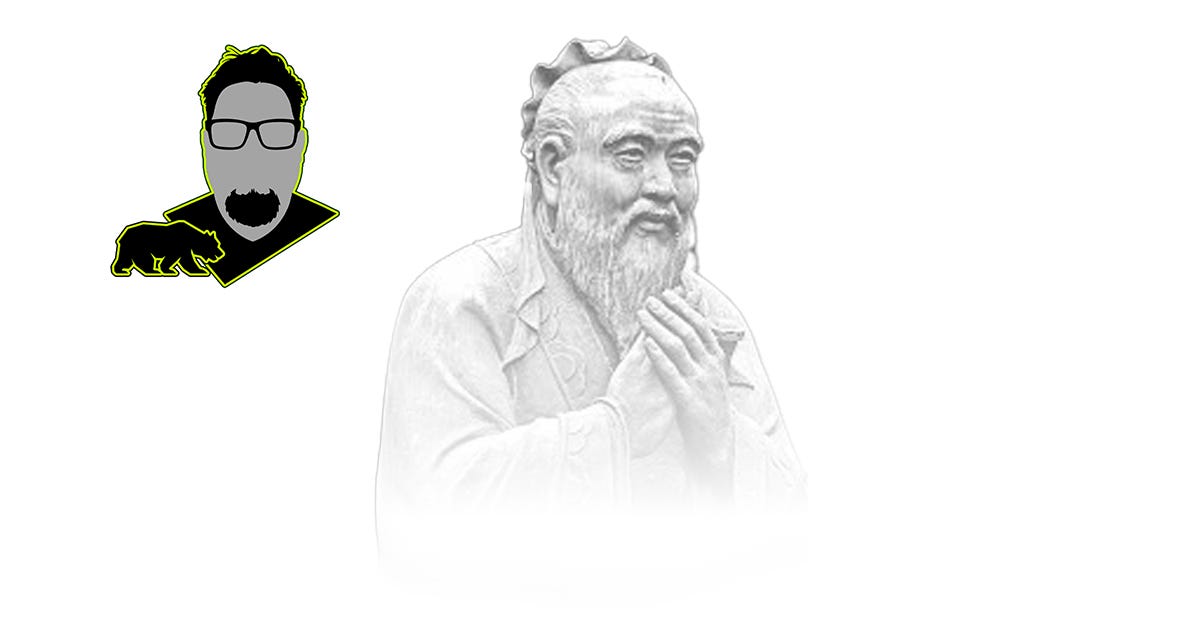
Confucius had no single successor — yet his teaching did not dissipate with his death — instead, his work embedded itself in the moral vocabulary of a civilization, shaping the habits of rulers, fathers, and officials across centuries. Its endurance lies precisely here: in the persistence of a question rather than the imposition of a system — what does it mean to govern well?
He opens the Analects with disposition — and not merely a disposition of mind, but of conduct. The inquiry proceeds from the man to the state: what kind of person must the ruler first become? This is foundational. It establishes the moral architecture upon which any legitimate account of government must rest. For without a cultivated self, there can be no ordered polity. Confucius answers, with characteristic economy and consequence, that to govern is to rectify — and that this rectification begins, always, with oneself.
From this premise unfolds an entire vision of political life — one grounded not in law alone, but in the exemplary force of character, in the descending influence of virtue. The relationship between ruler and ruled is rendered in organic terms — that of wind and grass. The leader does not rely upon statute or coercion as primary instruments — rather, he shapes the people through the moral gravity of his own example. Government, in this sense, is not separate from self-cultivation. It is its public consequence.
Were Confucius to survey the modern world, it is not surprise that would mark his judgment, but grief. He would still maintain that “the requisites of government are sufficiency of food, sufficiency of military equipment, and the confidence of the people in their ruler” — and that of these three, the last is indispensable. Where this confidence is forfeited, the state loses its very ground of legitimacy.
By the thirteenth book of the Analects, his conception sharpens into something diagnostic: “to govern means to rectify.” The phrase, austere in form, carries extraordinary weight. For Confucius, the condition of the state reflects, without mediation, the condition of the man who governs — “if you lead on the people with correctness, who will dare not to be correct?” The corruption of political order begins, invariably, in the corruption of the self.
Yet here lies the tension at the center of his thought. The answer is not law — at least not in its mechanical or externalized form — but virtue. And virtue, in this framework, is not sentiment but discipline enacted: sustained by men who “covet what is good,” so that the people, in turn, are drawn toward the good. The ruler is not the abstract source of authority — he is its living embodiment — present not to compel, but to transform, as wind transforms grass: invisibly, but with inevitability.
It is at this juncture that Confucius’s thought acquires its enduring political force. He does not begin with constitutions or formal arrangements of power. He begins with the junzi — the superior man — whose defining qualities are neither birth nor office, but moral seriousness: one who is “solid and straightforward, and loves righteousness,” who “examines people’s words and looks at their countenances,” and who is “anxious to humble himself to others.” Such a man — and only such a man — may properly govern, for he alone governs in the interest of those beneath him.
Central to this vision is the insistence upon the rectification of names. When roles are named correctly and inhabited accordingly — when the ruler is a ruler, the minister a minister, the father a father — order follows with a kind of natural coherence. Disorder arises when titles persist, but their substance erodes. It is then that propriety collapses, punishments lose their measure, and the people are left without orientation. The decay of governance, for Confucius, follows a pattern at once predictable and preventable: the ruler ceases to rectify himself, names become hollow, rites disintegrate, and the people lose their footing entirely.
Primary Source
The Analects of Confucius, trans. James Legge; and from Comprising the Analects of Confucius, the Sayings of Mencius, the Shi-King, the Travels of Fâ-Hien, and the Sorrows of Han, trans. James Legge (Project Gutenberg).
Book I — On Learning and the Root of Government
Confucius does not begin the Analects with a theory of the state. He begins with a question about the self. Before asking who should rule, he asks what kind of person is fit to rule — and his answer begins not in office, but in formation:
“Let young people show filial piety at home, respectfulness towards their elders when away from home; let them be circumspect, be truthful; their love going out freely towards all, cultivating good-will to men.”
And from the Scholar Yu, on the root of right conduct between men:
“Filial piety and friendly subordination among brothers — are not these the root of that right feeling which is owing generally from man to man?”
Rule, then, begins not in the throne room but in the household. The virtues that qualify a man to govern are inseparable from those that make him a son, a brother, a neighbor.
Book II — Government by Virtue
Having established the moral precondition of rule, Confucius turns to its public expression. He does not ask what laws should govern the people. He asks what the ruler must become:
“He who exercises government by means of his virtue may be compared to the north polar star, which keeps its place and all the stars turn towards it.”
And his most decisive contrast — between governance by punishment and governance by virtue:
“If the people be led by laws, and uniformity sought to be given them by punishments, they will try to avoid the punishment, but have no sense of shame. If they be led by virtue, and uniformity sought to be given them by the rules of propriety, they will have the sense of shame, and moreover will become good.”
Book XII & XIII — Rectification, Rectitude, and the Superior Man
What is the first task of government? Confucius answers with a phrase that has puzzled and instructed readers for millennia: rectify names. When asked what he would do first if given charge of the state:
“What is necessary is to rectify names. If names be not correct, language is not in accordance with the truth of things. If language be not in accordance with the truth of things, affairs cannot be carried on to success. When affairs cannot be carried on to success, proprieties and music will not flourish. When proprieties and music do not flourish, punishments will not be properly awarded. When punishments are not properly awarded, the people do not know how to move hand or foot.”
On the relationship between the ruler’s character and the conduct of the people — perhaps his most famous image:
“The relation between superiors and inferiors is like that between the wind and the grass. The grass must bend, when the wind blows across it.”
And on the rejection of capital punishment as an instrument of good government:
“Sir, in carrying on your government, why should you use killing at all? Let your evinced desires be for what is good, and the people will be good.”
Book XX — The Five Excellences and the Four Evils
Confucius’s most systematic account of the qualities required of those in authority, given when asked directly what is essential for proper government:
“Let the ruler hold in high estimation the five excellences, and eschew the four evils.”
The five excellences: bounty without extravagance. Burden without discontent. Desire without covetousness. Dignity without haughtiness. Majesty without fierceness.
The four evils: cruel tyranny, oppression, robbery, and the behavior of a mere commissioner — each arising from the absence of genuine care for the people.
And his final portrait of the sage’s rule — the standard against which all governance is measured:
“He would plant the people, and forthwith they would be established; he would lead them on, and forthwith they would follow him; he would make them happy, and forthwith multitudes would resort to his dominions; he would stimulate them, and forthwith they would be harmonious. While he lived, he would be glorious. When he died, he would be bitterly lamented.”

Bibliography | Notes
The Analects of Confucius (from The Chinese Classics), trans. James Legge. Project Gutenberg, eBook #3330. https://www.gutenberg.org/ebooks/3330
Comprising the Analects of Confucius, the Sayings of Mencius, the Shi-King, the Travels of Fâ-Hien, and the Sorrows of Han, trans. James Legge. Project Gutenberg. https://www.gutenberg.org/ebooks/10056