

On Gov't: Mencius
The Jefferson Club | Where Eastern politics intersect with the West

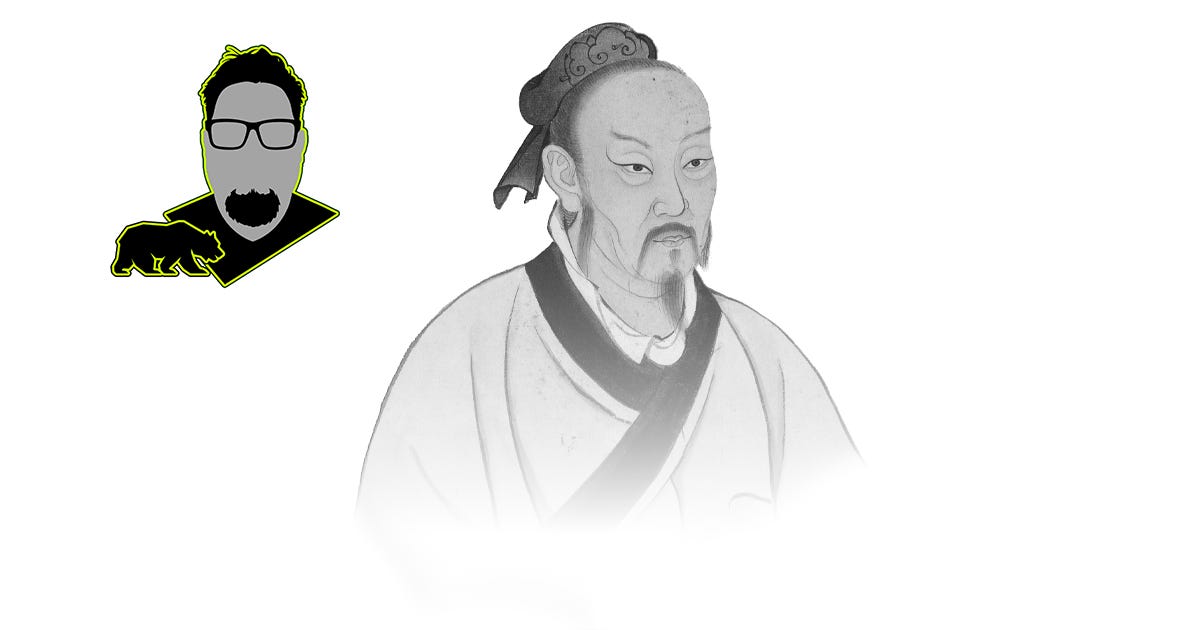
Mencius was not a student of Confucius — he lived over a century after Confucius. He was said to have been a student of a pupil (or possibly a disciple) of Zisi (Kong Ji), who was Confucius’s grandson. Yet what he inherited, he did not merely preserve. He amplified. He became, in the fullest sense, its most forceful and unguarded voice, presenting himself — as later accounts would have it — almost in the manner of a prophetic figure, moving from court to court, rebuking kings and princes with a boldness that bordered on defiance.
He opens his political teaching not with theory, but with confrontation — and not merely of conduct, but of motive. What does the king place first? The question is not rhetorical. It is diagnostic. It cuts directly to the foundation of legitimate rule. For where ends are disordered — where profit precedes benevolence and righteousness — no structure of power, however imposing, can long endure. Mencius answers with a severity that admits no ambiguity: the moment a ruler asks what will profit his kingdom, he has already set it on the path to ruin.
From this premise unfolds an entire vision of political order — one grounded not in institutional design, but in the moral condition of the ruler’s own heart — not in external arrangement, but in the inseparable connection between inner disposition and public consequence. Central to this vision is the claim that Heaven’s mandate is neither permanent nor unconditional. It is contingent — sustained only so long as the ruler serves the people. Sovereignty, in this framework, is not secured by birth or force, but by benevolence — and only by benevolence. Governance, then, is not merely the execution of policy. It is the heart, made visible in action.
Were Mencius to survey the modern world, it is not surprise that would define his response, but recognition. He had already observed its essential pattern: rulers with abundance at hand and deprivation at their doorstep — men capable of pity in private who fail to translate that feeling into public responsibility. His well-known exchange concerning the sparing of an ox — often rendered as a king moved to compassion for a trembling animal — serves as an indictment. The failure of governance lies precisely in this gap between sentiment and application.
By the opening book of his teachings, his diagnosis acquires an almost surgical clarity: if a ruler puts profit before benevolence and righteousness, superiors and inferiors will contend with one another for gain, and the state will be endangered. The formulation is ancient, but its relevance is perennial. For Mencius, the danger is not that rulers lack moral capacity, but that they refuse to act upon it. Human nature, as he insists elsewhere, contains the beginnings of goodness; political failure is, therefore, abdication.
Here, then, lies the most radical element of his thought. The remedy is not structural reform alone, but moral extension. Benevolence is not to be constructed — it is to be carried outward. The ruler who could not bear the suffering of the ox already possessed the capacity for humane governance — he had simply failed to extend that feeling to his people. “Your Majesty’s not attaining to the Royal sway is because you do not do it,” Mencius declares, “and not because you are not able to do it.” The limitation is will.
It is at this juncture that Mencius passes beyond instruction and into judgment. The king who governs with benevolence draws the people to him as water flows downward — with a force that requires no coercion. The ruler who does not — who exhausts his people, disrupts their livelihoods, and subjects them to deprivation — forfeits, in Mencius’s framework, the mandate of Heaven itself. Legitimacy is not a possession fixed in time. It is a living relationship, sustained only through genuine concern for the well-being of the governed.
Central to this vision is the condition he describes as the “fixed heart.” The people, he observes, require stability of livelihood before they can sustain moral order. A ruler who understands this secures their material foundation first. Punishing crimes arising from desperation — desperation produced by the failures of governance itself — is not justice. It is, in Mencius’s uncompromising phrase, to entrap the people. No truly benevolent ruler can permit such a condition to stand.
From this foundation arises the only durable form of political stability: a people who are sustained, who are not stripped of their time or means, who are able to cultivate filial and social duties, will adhere to their ruler with a loyalty no instrument of force can replicate. And yet, even here, Mencius offers a warning. The decline of states follows a path as intelligible as it is avoidable. Rulers turn toward conquest, toward accumulation, toward domination — they “climb the tree to look for fish,” seeking ends through means that cannot secure them. In doing so, they invite precisely the disorder they seek to escape. “The benevolent has no enemy,” Mencius observes — and its unspoken counterpart follows with equal force: the unbenevolent has no ally.
Primary Source
The Works of Mencius, trans. James Legge, in The Chinese Classics, Vol. 2 (Oxford: Clarendon Press, 1895), Book I, Part I — King Hui of Liang, Part I, Chapters 1–7.
Book I, Part I, Chapter 1 — Benevolence and Righteousness as the Only Counsel
Mencius begins with a correction. When the King of Lëang greets him by asking what counsel he brings to profit the kingdom, Mencius dismantles the question:
“Why must your Majesty use that word ‘profit’? What I am likewise provided with are counsels to benevolence and righteousness, and these are my only topics.”
He then traces the logic of a profit-driven government to its inevitable end: superiors and inferiors will try to snatch from one another, and the kingdom will be endangered. In a kingdom of ten thousand chariots, the murderer of the sovereign will be the chief of a family of a thousand chariots — in a kingdom of a thousand chariots, the murderer of his prince will be the chief of a family of a hundred chariots.
For when righteousness is put behind and profit put before, men will not be satisfied without snatching from others. The conclusion? There has never been a man trained to benevolence who neglected his parents, nor a man trained to righteousness who made his ruler an afterthought. Benevolence and righteousness are not ideals imposed from outside — they are the only stable foundation of any lasting political order.
Book I, Part I, Chapter 6 — The Ruler Who Does Not Kill
Asked which ruler can unite all under Heaven, Mencius gives the shortest and most radical answer in the entire tradition of Chinese political thought:
“He who has no pleasure in killing men can so unite it.”
And when pressed on whether such a ruler could actually attract the people of a fragmented and warring world, the people, he says, would go to him as water flows downward with a rush which no one can repress. Benevolence is not merely a moral virtue — it is, in Mencius’s political philosophy, the single most powerful force in human affairs. The ruler who withholds it does not merely fail morally — he fails practically, and catastrophically, and in the end, irrevocably.
Book I, Part I, Chapter 7 — The Heart Sufficient for the Royal Sway
When King Seuen of Ts’e asks what virtue is required to attain the Royal sway, Mencius answers with disarming simplicity: love and protect the people, and nothing can prevent it. He then draws out of the king’s own memory an episode the king had nearly forgotten — his compassion for a bull led to slaughter, its frightened eyes like those of an innocent man going to his death — and uses it as evidence against the king’s own despair about his fitness to rule:
“The heart seen in this is sufficient to carry you to the Royal sway.”
The king’s failure is not incapacity. It is the failure to extend inward feeling outward into action. Kindness sufficient to reach animals, yet extended to no benefit for the people — this, Mencius presses, is not inability. It is a choice. And it is the choice, made daily, that separates a true king from a mere occupant of the throne.
Book I, Part I, Chapter 7 — Benevolent Government and the People’s Livelihood
When pressed on how benevolent government is actually to be instituted, Mencius descends from principle to practice with remarkable precision. Light taxes, deep plowing, the cultivation of filial piety and fraternal duty in seasons of leisure — these are structural requirements. A people with a certain livelihood maintains a fixed heart — a people without it loses all moral anchor. The ruler who then punishes the resulting disorder has done nothing but set a trap:
“How can such a thing as entrapping the people be done under the rule of a benevolent man?”
An intelligent ruler, by contrast, ensures that his people have enough above, to serve their parents, and below, to support their wives and children. This is not generosity as sentiment — it is governance as architecture. From this foundation, the people become capable of virtue, loyalty, and even military sacrifice — because the cause is genuinely their own.

Bibliography | Notes
Mencius, The Works of Mencius, trans. James Legge, in The Chinese Classics, Vol. 2 (Oxford: Clarendon Press, 1895), Book I, Part I — King Hui of Liang, Part I, Chapters 1–7.