

Part I: The Atlantic Slave Trade
United States | The Origins of how the Atlantic slave trade got started.

The Portuguese first traded for African slaves in 1441. They did not invent slavery, nor did they create the slave trade itself. Long before Europeans entered the market, African societies already possessed institutions through which captives were held, exchanged, and incorporated into established political and social systems. Throughout much of West Africa, prisoners taken in warfare were absorbed into communities as dependent laborers. In that earlier context, slavery existed — but it existed in a form fundamentally different from what would later take shape across the Atlantic.
African slaves were not regarded merely as property. They existed within social frameworks that recognized them as persons, however subordinate their condition. Their status was rarely fixed for life, and it was not ordinarily hereditary. The children of slaves were born free. Bondage might endure for years, yet it did not necessarily define an entire lifetime, and in many cases the enslaved could eventually become integrated into the broader social structure of the community itself. This was the case in Western civilizations for much of documented history.
The rise of the Trans-Atlantic slave trade transformed these older patterns of servitude with devastating clarity. The colonization of the New World produced an immense and expanding demand for labor — a demand that reshaped the rhythms of commerce and the fate of millions of human lives. Europeans initially attempted to seize slaves by force, yet such ventures proved both unsustainable and impractical on a large scale. African polities controlled the interior of the continent, and European traders were therefore compelled to participate in existing African commercial networks rather than dominate them outright.
For this reason, Europeans were largely confined to coastal trading posts known as feitorias. There, at these feitorias, African merchants delivered captives to fortified compounds where they were processed not as individuals but as cargo. Within the feitorias, slaves were confined in small, crowded rooms and separated according to sex and age. Those judged too small or physically weak for immediate transport were sometimes “fattened up” in order to increase their market value.
Branding followed — and often followed more than once. Marks indicated the merchant who had purchased the slave, confirmed that the necessary taxes had been paid, and even signaled that the captive had been baptized as a Christian. The grim mortality associated with the Atlantic slave trade began long before any ship left the African coast. Death occurred during the forced marches that carried captives from the interior toward the sea, and it continued during the weeks or months of imprisonment inside the feitorias. Yet the greatest ordeal still lay ahead in the next stage of the journey — the Middle Passage.
The Middle Passage was the transatlantic voyage from Africa to the Americas. It constituted the central leg of what historians call the Atlantic Triangle Trade — a commercial system that bound Europe, Africa, and the Americas into a single, interdependent network of exchange. European merchants transported manufactured goods — beads, mirrors, textiles, and firearms — to the African coast, where these commodities were exchanged for enslaved people.
Those captives were then carried across the Atlantic to the plantations of the Americas. Their labor would produce the commodities that completed the final leg of the triangle: sugar, rum, molasses, indigo, cotton, and rice.
The Middle Passage itself was a scene of relentless brutality and calculated dehumanization. Enslaved Africans were segregated by sex, frequently stripped naked, chained together, and confined in spaces so cramped that movement became nearly impossible. For as many as twenty-three hours each day they remained in these conditions. Between twelve and thirteen percent died before reaching the Americas. Although historians may never determine the precise number of individuals who endured the passage, the total unquestionably exceeds ten million.
As it is seen throught history, industry fuels empire — and often, empires are built upon the expansion of industry. The Kingdom of Dahomey and the political economy of the slave trade was no different.
The Age of Discovery reshaped the political landscape of West Africa as surely as it transformed the Atlantic world itself. In some regions the slave trade destabilized established societies and weakened long-standing institutions. In others it strengthened emerging states that adapted with ruthless efficiency to the new commercial realities.
Among the societies most deeply affected were the Yoruba states. By the early nineteenth century the once-powerful Yoruba confederation began to fragment under the strain of civil wars. These conflicts intensified as rival factions sold captives to European traders in exchange for firearms. The weapons thus obtained were then turned against neighboring communities in further campaigns of warfare and slave-raiding — creating a self-perpetuating cycle in which violence and commerce reinforced one another.
Yet while some societies fractured under these pressures, others rose precisely because they embraced the new economy. The most striking example was the Kingdom of Dahomey.
Dahomey emerged during the 1720s and soon developed into one of the most formidable states in West Africa. Its rulers constructed the foundations of their power upon the slave trade itself. Revenue generated from the sale of captives enabled Dahomean kings to acquire firearms, and those firearms made possible further campaigns of conquest. Smaller neighboring states were subdued and absorbed into the expanding kingdom.
Most captives were acquired either through trade with inland regions or through organized raiding expeditions directed north and west into what is today Nigeria. Dahomey also took advantage of the instability created by the Yoruba civil wars, which supplied a steady stream of prisoners who could be sold to European merchants along the coast.
European traders, however, operated under strict limitations within Dahomey’s political order. Foreign agents were confined largely to the coastal trading port of Whydah. Only a small number were ever permitted to travel inland and seek an audience with the king. Consequently, only a handful of contemporary sources describe Dahomey from direct observation.
The political organization of Dahomey bore striking resemblance to the centralized monarchies of early modern Europe. The king ruled as an absolute monarch at the center of a highly structured state. All commerce with European traders existed as a royal monopoly — carefully guarded and rigorously enforced by the crown. Europeans were never permitted to conduct business directly with the general population. Every transaction passed through the authority of the king, ensuring that the profits of the trade flowed directly into the royal treasury.
Through this monopoly the state accumulated immense wealth and sustained a highly militarized society — one capable not only of defending its authority but of extending it through continual expansion. And in the same breath, they feed the incessant need for labor in the ever-expanding plantation economy of the New World.
Let look at a primary source! Slave ships carried between eleven and twelve million Africans across the Atlantic to the Americas. Yet for most of this vast enterprise, there existed almost no regulation. Only at the close of the eighteenth century did authorities attempt to impose limits upon the trade.
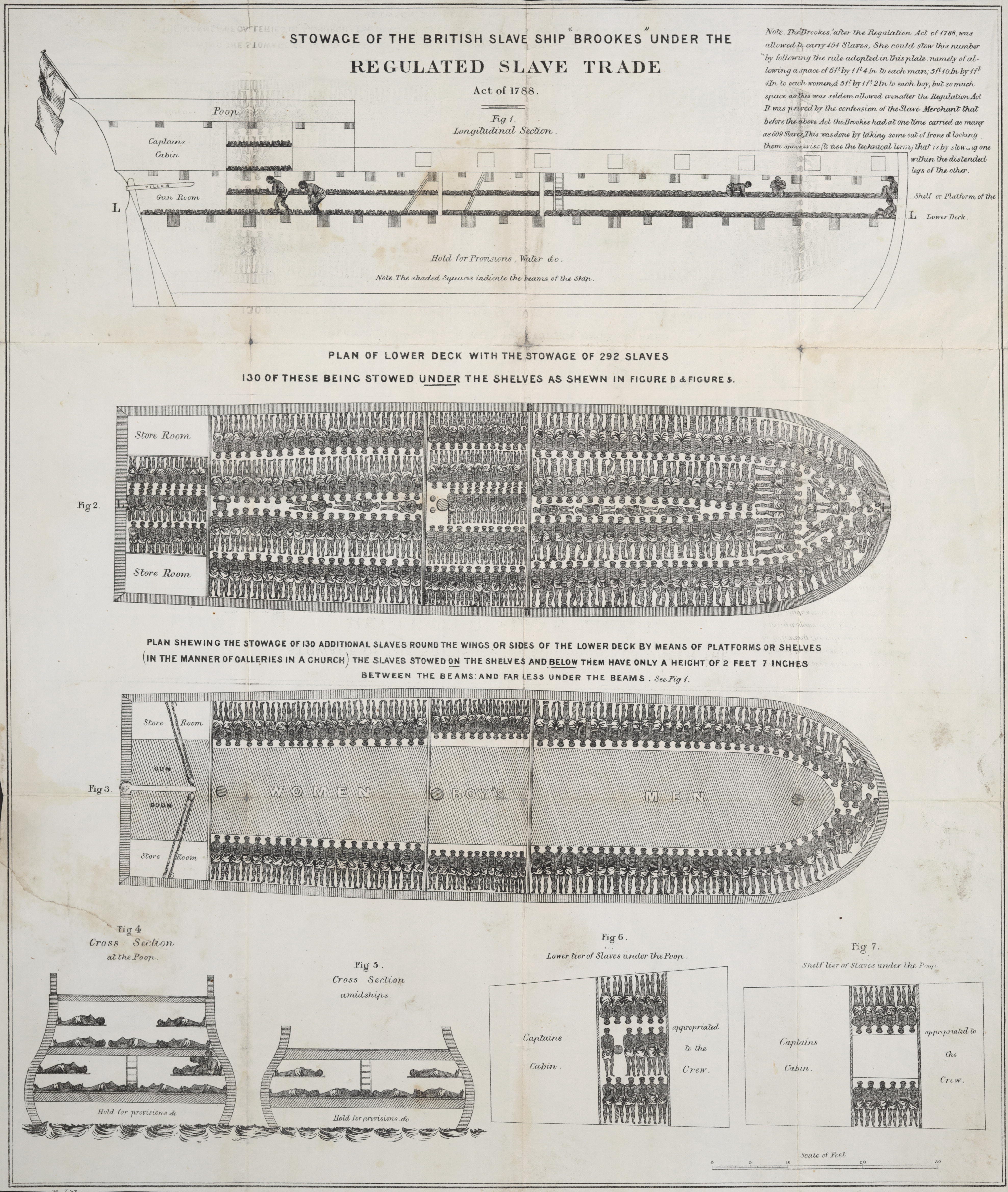
The well-known print (above) of the slave ship Brookes, produced after the Regulated Slave Trade Act of 1788, illustrates the cold arithmetic by which such regulation was measured. The image depicts enslaved Africans arranged in rows, their bodies fastened in place with iron leg shackles.
Brookes was permitted to carry up to 454 enslaved people. Space was allotted with disturbing precision: six feet by one foot four inches for each man. Five feet ten inches by one foot four inches for each woman. Five feet by one foot, two inches for each child. Even these measurements were supposed to represent a reform. One slave trader later alleged that before 1788, the vessel had carried as many as 609 enslaved Africans.

Bibliography | Notes
Locks, Catherine; Mergel, Sarah; Roseman, Pamela; Spike, Tamara; and Lasseter, Marie, "History in the Making: A History of the People of the United States of America to 1877" (2013). History Open Textbooks.
Locke, Joseph L., and Ben Wright, eds. The American Yawp: A Massively Collaborative Open U.S. History Textbook. Stanford, CA: Stanford University Press, 2019.
Gallagher, Brendan. “Africans: Virginia’s First,” Encyclopedia Virginia.