

Part IV: Slavery in the Middle Colonies and Georgia
United States | Labor, Resistance, and Cultural Survival

In the northern colonies, enslaved people were most often found in or near coastal urban centers. Their labor supported the commercial life of these cities. Enslaved men and women worked as domestic servants, laundresses, and dockworkers. Others labored as field hands or as iron workers in small industrial enterprises.
Unlike the large plantations of the southern colonies, slavery in the middle colonies often placed enslaved individuals in close proximity to their masters. Many lived in the same household and worked alongside them.
This proximity sometimes produced relationships that appeared less overtly brutal than those found in plantation systems. Slavery in the middle colonies did not always exhibit the same extreme physical severity that characterized slavery in the southern colonies or on the Caribbean islands.
Yet the fundamental realities of slavery remained unchanged. Enslaved individuals still endured the loss of freedom and the degradation of being treated as property.
The structure of northern slavery created particular challenges for family life. Because slaveholders owned relatively small numbers of enslaved people, and because turnover rates were high, it was difficult for enslaved individuals to establish stable families. Men outnumbered women within many enslaved populations, further complicating the formation of households.
For many of the enslaved, the desire to build a family became a powerful motivation to escape. Some attempted to run away — some succeeded. Living so closely with their masters could foster mutual familiarity, but it could also produce deep tensions. Acts of resistance occurred in various forms. Enslaved individuals sometimes attacked their masters’ property and, in rare cases, attacked their masters themselves.
More dramatic expressions of resistance occurred in New York City. In 1712, enslaved Africans and Indigenous people organized a revolt against the city’s white population. They set fire to a building in order to lure whites into the street and then attacked those who arrived to extinguish the flames. The rebellion was quickly suppressed. In response, the colonial governor imposed new restrictions upon both free and enslaved blacks.
A second crisis emerged in 1741 when a series of mysterious fires spread across New York City. The city was already struggling with a surge in thefts. Officials soon suspected that the fires formed part of a larger conspiracy. Their suspicions hardened after a sixteen-year-old Irish servant provided testimony supporting the theory of a coordinated plot. In exchange for her testimony, she was granted her freedom.
Authorities began arresting suspects and conducting trials. Both blacks and whites were accused of participating in the conspiracy. Many were convicted and executed. Despite the hardships of slavery, enslaved communities in the northern colonies also created cultural traditions that reflected both African heritage and adaptation to the New World. Because northern slaves often lived among Europeans, their cultural blending with Euro-American society occurred more rapidly than in the South. Yet they simultaneously developed a distinct African-American culture.
One example of this cultural creativity was the festival known as Pinkster, celebrated in New York and New Jersey during May or June. The festival sometimes lasted as long as a week. During Pinkster celebrations, enslaved people crowned an African-born “slave king” and gathered together to eat, drink, gamble, and dance. Participants dressed in their finest clothing, occasionally borrowing garments and supplies from their masters for the occasion.
Historian Shane White described northern slavery as “hard, unforgiving, and often soul-destroying.” Yet the Pinkster festival demonstrated what he called the “creative response of black people to those situations.” For a brief moment each year, enslaved individuals could exercise a measure of control over their own lives and interact freely with others without white supervision.
But even as enslaved people in the northern colonies found brief moments of autonomy through cultural traditions like Pinkster, British reformers were attempting something far more radical in the South — the creation of a new colony built on carefully controlled social principles.
From 1732 to 1752, the colony of Georgia operated under a unique system of governance. Rather than being administered like the other British colonies in North America, Georgia was governed by a Board of Trustees in London. The colony had neither a royal governor nor a representative legislative assembly.
The Trustees themselves were prohibited from holding office within the colony or owning land there. Their authority was meant to guide what they envisioned as a social experiment. Through the provisions of the Georgia charter, they hoped to create a society built upon small landholdings and industrious free labor.
The colony's population reflected these ambitions. Although relatively few settlers were the imprisoned debtors once imagined by reformers such as James Oglethorpe, many colonists did belong to what contemporaries called the “deserving poor.” Yet the promise of economic independence often proved illusory. Instead of escaping debt, many colonists found themselves further indebted for the cost of their passage to Georgia.
In most cases, these debts were owed directly to the Georgia Trust itself. Adults commonly served five-year terms of indentured servitude to the Trust, while children were often bound for much longer periods. Some young colonists faced obligations lasting seventeen or even twenty-one years.
Under these circumstances, many servants attempted to escape their contracts. This occurred particularly in the northern portions of the colony, where perhaps as many as three-fourths of the indentured servants fled.
Despite these economic hardships, the Georgia charter included important social provisions. It guaranteed religious liberty to all settlers, though Catholics were explicitly excluded. As a result, the colony attracted religious refugees from across Europe, including immigrants from Switzerland, Scotland, and Germany.
In 1733, when a group of Jewish settlers arrived, Oglethorpe allowed them to remain despite objections from the Trustees in London. Their presence established Savannah as the home of one of the oldest Jewish congregations in what would later become the United States.
The Trustees also attempted to regulate other aspects of colonial life. Hard alcohol was banned, and the colony sought to prevent neighboring South Carolina from transporting rum through Georgia. These restrictions generated friction between the colonies, and many Georgia settlers nonetheless participated in the Indian trade — including the rum trade.
One of the most important centers of this commerce was the town of Augusta, which developed rapidly into one of the largest Indian trading hubs in the southern colonies. Perhaps the most controversial feature of the Trustee system was the prohibition of slavery. For two decades, the Trustees refused to allow enslaved labor in Georgia. Their reasons were practical rather than humanitarian.
Oglethorpe believed that a society of smallholding farmers would collapse if plantation slavery dominated the labor system. In addition, Spanish Florida posed a persistent threat to British settlements. Spanish authorities offered freedom to any runaway slave who reached Florida and accepted Catholicism. A large enslaved population in Georgia might therefore undermine the colony’s stability.
Finally, Georgia served as a military buffer between South Carolina and Spanish Florida. Enslaved people could not serve in the militia, and the Trustees feared that slavery would weaken the colony’s defensive capabilities. None of these concerns reflected abolitionist convictions. The Trustees opposed slavery because they believed it threatened their political and economic experiment.
In practice, governing the colony proved increasingly difficult. From the beginning, Oglethorpe had been the only Trustee residing in Georgia and effectively served as the colony’s leading authority. The Trustees in London frequently complained about his irregular correspondence and his tendency to make decisions without consulting them.
In 1741, the Trustees attempted to reorganize colonial administration. Georgia was divided into two counties: Savannah in the north and Frederica in the south. William Stephens was appointed president of Savannah, while Oglethorpe was asked to recommend a president for Frederica. Oglethorpe never responded. Shortly thereafter, he departed Georgia in 1743. The Trustees eventually appointed Stephens as president of the entire colony.
Under Stephens’s leadership, the colony gradually moved away from its original mission as a refuge for the “deserving poor.” The Trustees authorized Stephens to grant land more freely, and immigration patterns quickly shifted. Wealthier settlers began acquiring large plantations through generous land grants.
As the social composition of the colony changed, pressure mounted to legalize slavery. South Carolina planters eager to expand their holdings pushed strongly for the change. Within Georgia itself, a faction known as the “Malcontents” campaigned vigorously to overturn the ban. Not all colonists supported this movement. Many free laborers feared that slavery would reduce wages and eliminate employment opportunities. Some groups, particularly Protestant immigrants from Salzburg, opposed slavery on religious grounds.
Although the Trustees formally maintained the prohibition for another decade, enforcement gradually weakened. Stephens and his council made little effort to prevent illegal slaveholding. In 1750, the ban finally ended. Slavery was legalized in Georgia by legal decree — a decision that dealt a severe blow to the already weakening Trustee system.
Stephens soon linked land ownership directly to slaveholding. The more slaves a person possessed, the more land that individual could claim. The transformation of Georgia into a plantation society accelerated rapidly.
By the early 1750s, the Trustees in London had largely ceased meeting to govern the colony. Economic problems compounded the political crisis. From its founding, Georgia had relied heavily on subsidies from the British Parliament because it was created as a colony for the poor.
In 1733, Parliament provided £10,000 to support the settlement. Additional funds followed in later years. Georgia thus became the only one of the original thirteen colonies dependent upon annual financial assistance from the British government.
In 1751, Parliament refused to provide further support. Without funding and without effective leadership, the Trustee system collapsed.
The following year, in 1752, Georgia was transformed into a royal colony governed by officials appointed by the British Crown. From that point until the American Revolution, royal governors ruled the colony on behalf of the king.
With Georgia firmly under royal authority, the colony became increasingly integrated into the economic structures that defined the eighteenth-century Atlantic world — including the expanding marketplace of slavery.
Primary Source
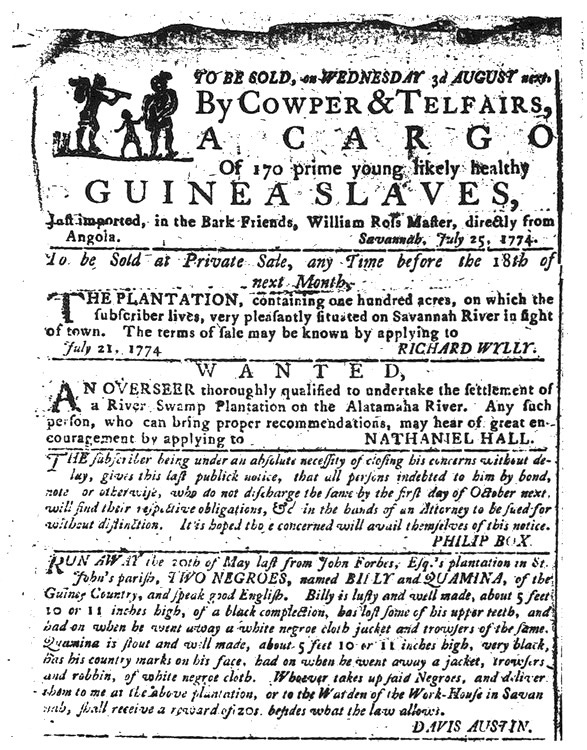
Within the Atlantic world, enslaved Africans were ultimately transformed into commodities. They were bought and sold in markets much like livestock or manufactured goods. Advertisements for slave auctions appeared frequently in colonial newspapers and broadsides.
Captured Africans were sold as “chattel,” a legal term that placed them in the same category as movable property or animals. Many formerly enslaved individuals later described the profound humiliation and degradation they experienced when they were treated as if they were cattle. A surviving broadside from 1774 illustrates the commercial reality of this system. Such advertisements appeared throughout both the northern and southern colonies prior to the Civil War.
The broadside announces the sale of enslaved Africans alongside land and other property. It also advertises employment for an overseer, demands repayment of outstanding debts, and offers a reward for the capture of two runaway slaves.
The enslaved individuals listed for sale were Angolan Africans scheduled to be auctioned in Savannah, Georgia. The advertisement describes them in terms meant to attract buyers, calling them “prime, young, likely healthy.”
On the same broadside appears a separate notice describing two runaway men. The description includes details of their height, complexion, physical build, and clothing — information intended to aid their capture and return.
Such documents reveal the brutal logic of the slave economy. Human beings were reduced to items of commerce, cataloged by their physical characteristics and potential economic value.

Bibliography | Notes
Locks, Catherine; Mergel, Sarah; Roseman, Pamela; Spike, Tamara; and Lasseter, Marie, “History in the Making: A History of the People of the United States of America to 1877“ (2013). History Open Textbooks.
Locke, Joseph L., and Ben Wright, eds. The American Yawp: A Massively Collaborative Open U.S. History Textbook. Stanford, CA: Stanford University Press, 2019.
Gallagher, Brendan. “Africans: Virginia’s First,” Encyclopedia Virginia.