

Pontiac & Aftermath of War
United States | How debt helped to drive the colonies to revolt

A Delaware religious leader, the prophet Neolin, urged Native peoples to return to traditional customs and reject the influence of whites. At the same time, British forces began occupying the forts the French had abandoned across the Great Lakes and Ohio Valley.
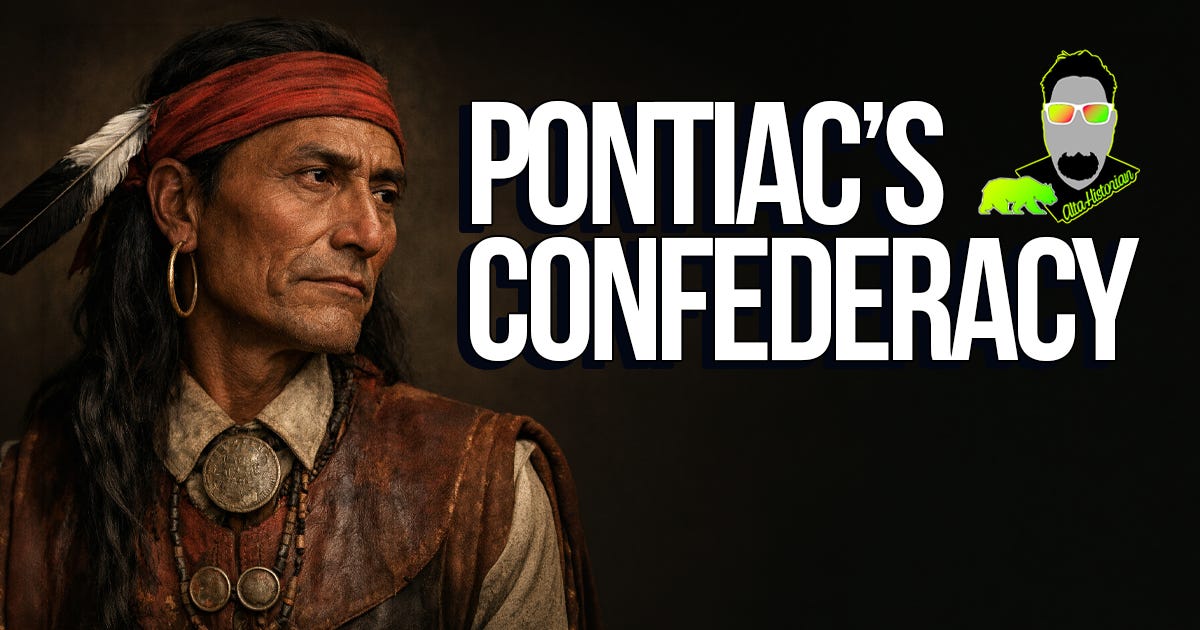
Native leaders grew increasingly alarmed. The British expanded Fort Duquesne and renamed it Fort Pitt, and American settlers quickly began clustering around the post. Pontiac, who had fought alongside the French, believed the British presence threatened all Native nations. According to tradition, extraordinary signs accompanied his birth — lightning, thunder, and shooting stars filling the sky — and many believed he was destined for greatness.
Pontiac concluded that Native nations must set aside their differences and unite against the British. Through diplomacy, he organized a coalition sometimes called Pontiac’s Confederacy. His aim, he explained, was to “cut off the passage, so they could not come back.”
Several nations joined the effort and focused their attention on Fort Detroit. Native forces captured several British forts and, for a time, seemed close to complete victory. French residents encouraged Pontiac, promising that if the British were driven out toward French territory, France would rejoin the struggle.
At the height of Pontiac’s success, however, word arrived of the Treaty of Paris. The great powers had negotiated peace without including Native nations in the discussions. Pontiac suddenly realized that France would not return.
Native leaders also noticed an important cultural difference between their former and new European partners. The French had long used gifts as symbols of honor and obligation in diplomatic relationships. The British largely ignored this practice, misunderstanding its importance within Native culture.
British commander Jeffrey Amherst adopted a far harsher policy. He placed a bounty on Pontiac’s head and (knowingly or not) engaged in biological warfare by distributing smallpox-infected blankets among Native communities. Entire families died from the disease and, in turn, helped to pacify Native resistance.
When Pontiac confirmed that the French were finished in North America, he lifted the siege of Detroit. His moment had passed. Pontiac was murdered in 1769.
During the uprising, Native warriors attacked British forts across the Ohio Valley and Great Lakes region, killing more than four hundred British soldiers and capturing or killing another two thousand colonists. The rebellion gradually faded in early 1764 under the new British commander Thomas Gage.
Even as the frontier burned, British leaders attempted to stabilize the empire through new policies. Before 1763, most colonists had accepted Parliament’s authority to regulate imperial trade. Earlier legislation — particularly the Navigation Acts — had focused largely on commerce. Colonists sometimes complained about these regulations, but they rarely regarded them as oppressive.
After the Seven Years’ War, however, Parliament’s policies increasingly clashed with colonial interests. Britain now controlled nearly two-thirds of eastern North America after France surrendered Canada and much of the Ohio and Mississippi valleys. Many colonists saw these lands as a providential opportunity for expansion.
Instead, the British government issued the Proclamation of 1763. The decree reserved lands west of the Appalachian Mountains for Native nations and forbade white settlement beyond the line. Private purchases of Native lands were also prohibited, and Indian trade was restricted to traders licensed by British authorities.
For the first time, authority over western expansion rested firmly in the hands of imperial officials rather than colonial settlers. The ministry hoped the measure would prevent costly Indian wars, protect the lucrative fur trade, and keep western land speculation under Crown control. To enforce the policy, Britain stationed nearly 10,000 troops along the frontier at an annual cost of £250,000.
Colonists reacted angrily. Many believed the policy threatened their future prosperity. If they were confined to the Atlantic seaboard, they feared that overcrowded cities and rigid social hierarchies would follow. In practice, the proclamation proved difficult to enforce. Settlers had already crossed the line, and land speculators had no intention of surrendering their investments.
At the same time, British leaders began searching for ways to raise revenue from the colonies. Before the war, Britain had governed the empire under the principles of mercantilism — the economic theory that trade generated wealth and should be encouraged through protectionist policies designed to maintain favorable balances.
The Navigation Acts restricted colonial trade to British ships and markets, while royal governors appointed by the Crown oversaw administration in nine colonies. Yet colonial assemblies had gradually expanded their own authority. By 1720, these assemblies had won the power to initiate legislation.
After the war, Prime Minister George Grenville sought new revenue to help pay Britain’s enormous national debt. Grenville tightened enforcement of customs duties, demanding stricter accounting and reducing the bribery that had long softened imperial regulations.
The most difficult duty to enforce had been the Molasses Act of 1733, which attempted to tax French Caribbean molasses imported into the colonies. In 1764, Parliament replaced it with the Revenue Act, commonly known as the Sugar Act. The measure actually lowered the duty on French molasses but sought to discourage trade with the French islands by making the legal tax easier to collect. Officials hoped colonial merchants would find it more attractive to obey the law than to smuggle.
The policy instead intensified tension between British officials and American shippers. Many colonists saw the measure as a troubling intrusion into the long-standing colonial practice of self-taxation through their elected assemblies.
In 1765, Parliament introduced an even more controversial measure: the Stamp Act. The law imposed a direct tax on paper used for legal documents, newspapers, licenses, and other printed materials. Each item required an official stamp showing that the tax had been paid.
The issue raised a fundamental constitutional question. According to English tradition, taxes were considered a gift from the people to their monarch, granted through representatives in the House of Commons. Citizens were entitled to enjoy their property without fear that the king might confiscate it by decree.
Grenville responded with the theory of “virtual representation.” Parliament, he argued, represented all British subjects everywhere in the empire, whether they voted for members of Parliament or not. Colonists, therefore, consented to taxation through this indirect representation.
Colonial leaders rejected the argument. Virtual representation, they insisted, could not stretch across the Atlantic Ocean. Protests spread throughout the colonies, often erupting into crowd violence. Groups calling themselves the Sons of Liberty appeared in nearly fifty towns.
In October 1765, twenty-seven delegates representing nine colonial assemblies gathered in New York City for the Stamp Act Congress. The delegates affirmed their loyalty to the Crown and acknowledged Parliament’s authority, but they rejected virtual representation and insisted that only their own assemblies could tax them. The Congress introduced the radical possibility of coordinated political action among the colonies.
The protest movement adopted the rallying cry “Liberty and Property.” Some colonists began speaking openly of a conspiracy by British leaders to enslave them. Demonstrations in America alarmed British merchants, who soon pressured Parliament to repeal the Stamp Act. Parliament did so in March 1766 but simultaneously passed the Declaratory Act, asserting its right to legislate for the colonies “in all cases whatsoever.”
The conflict soon resumed. In 1767, Parliament enacted the Townshend duties, new import taxes on tea, glass, lead, paper, and painters’ colors. Although the duties were paid by importers, they were passed on to consumers through higher retail prices.
What angered colonists most was not the amount of the taxes but their purpose. Part of the revenue would pay the salaries of royal governors and officials, freeing them from dependence on colonial assemblies. Charles Townshend believed this policy would strengthen imperial authority and weaken the growing independence of colonial governments.
Colonial assemblies protested vigorously. Massachusetts circulated a letter of grievances written by Samuel Adams, arguing that parliamentary taxation was unjust because colonists lacked representation. When the Massachusetts assembly refused to withdraw the letter, royal officials ordered Governor Francis Bernard to dissolve it.
Colonists responded with nonconsumption and nonimportation agreements — boycotts of British goods intended to pressure London merchants. Such boycotts required real sacrifice. Some merchants secretly continued importing goods, hoping to profit once the boycott ended or by selling to customers who ignored it. In Boston, merchants who violated the agreements were publicly blacklisted.
Women played an important role in the movement. Because many boycotted goods were household items traditionally managed by women, patriotic households emphasized the production of homespun cloth and organized spinning bees across dozens of New England towns. The “Daughters of Liberty” became a symbol of women’s participation in the resistance, though their activities differed from the public demonstrations staged by the Sons of Liberty. Overall, the boycotts proved effective, reducing imports by more than forty percent.
In 1768, Britain responded by sending three thousand troops to occupy Boston. Soldiers drilled on the town common, and their constant presence heightened tensions with the local population.
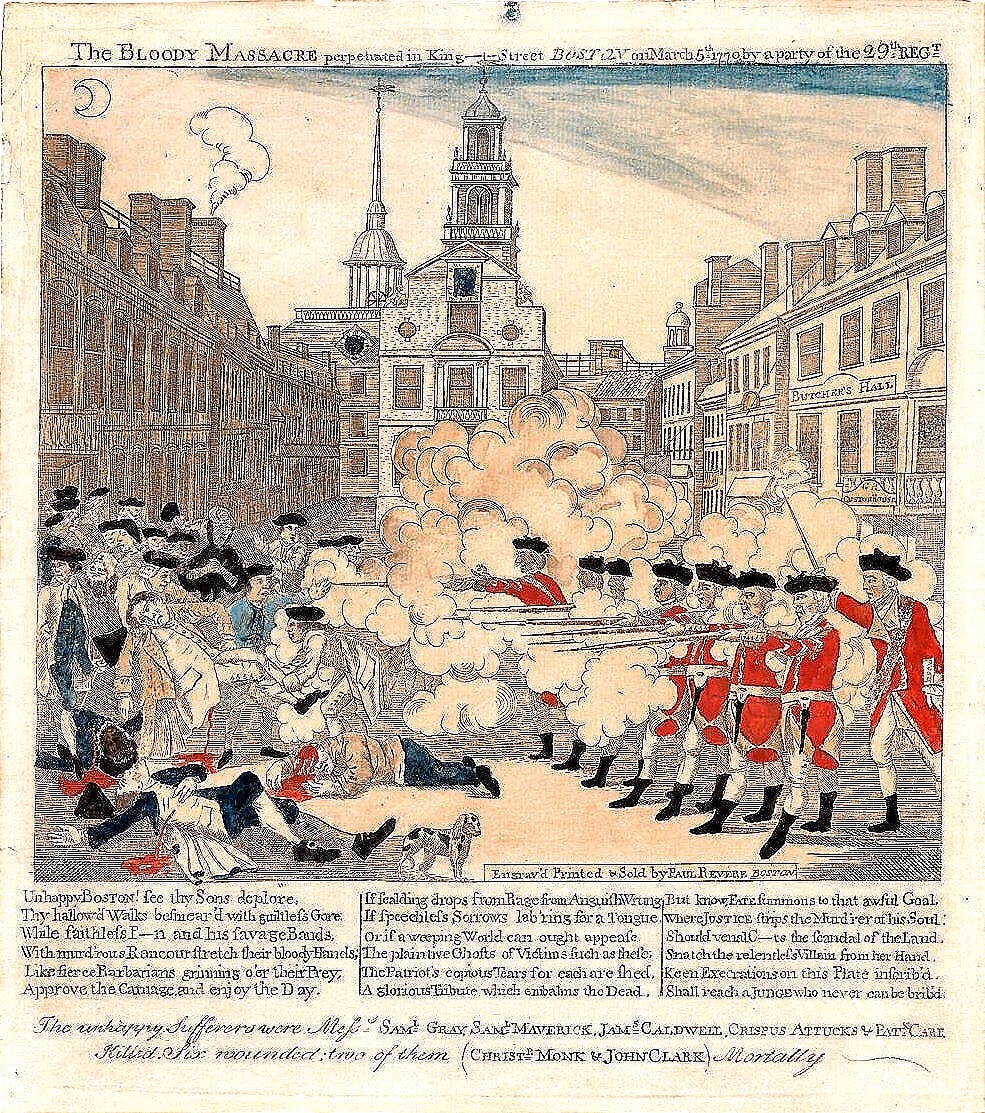
Those tensions exploded on March 5, 1770. A crowd gathered outside the customs house and taunted British soldiers standing guard. Amid confusion and anger, the soldiers fired into the crowd, killing five colonists in what became known as the Boston Massacre.
Patriot leaders transformed the victims into symbols of British tyranny. The Sons of Liberty organized elaborate funerals for the dead, including Crispus Attucks, an African American sailor often remembered as the first casualty of the American Revolution.
Eight British soldiers were arrested along with their captain, Thomas Preston. They were defended in court by John Adams and Josiah Quincy, who believed that even unpopular defendants deserved a fair trial. Preston and six of the soldiers were acquitted. Two others were convicted of manslaughter, branded on their thumbs, and released.
Patriot propagandists nevertheless shaped the public narrative. In a famous engraving, Paul Revere portrayed the massacre as a deliberate act of British brutality. The image suggested that the British commander had ordered his soldiers to fire on defenseless colonists, who appeared to make no effort to fight back. Such imagery reinforced the growing belief that British authorities tormented the colonies and strengthened support for the cause of liberty.
In 1771, Parliament repealed most of the Townshend duties, and trade revived. For a time, the protest movement appeared to lose momentum; Samuel Adams even lost an election for a minor local office.
Events soon revived the crisis. In 1772, colonists in Rhode Island burned the British naval vessel Gaspée after it ran aground while pursuing suspected smugglers. When British authorities announced that suspects might be sent to England for trial on charges of treason, colonists protested that such actions violated the English right to trial by a jury of one’s peers.
Leaders in Virginia responded by establishing committees of correspondence. Patrick Henry, Thomas Jefferson, and Richard Henry Lee proposed a network linking colonial assemblies so that news and political developments could circulate rapidly throughout the colonies.
The next spark came in 1773 with the Tea Act. Although Americans had resumed purchasing British tea, many continued to smuggle cheaper Dutch tea, cutting into the East India Company's profits. Parliament attempted to rescue the company by allowing it to sell tea directly to selected merchants in four colonial cities. These agents would resell the tea and collect the tax, lowering the final price of British tea while preserving the duty.
Colonists suspected the measure was a trap designed to make them accept parliamentary taxation. Sons of Liberty groups pressured tea agents to resign, and in several colonies, tea shipments were either returned or landed without paying duties.
Boston became the focal point of the confrontation. Three ships carrying tea arrived in the harbor in late 1773. Governor Thomas Hutchinson insisted that the cargo could not be returned to England until the duty had been paid. For twenty days, the ships remained anchored while tensions escalated throughout the town.
On December 16, 1773, between one hundred and one hundred fifty men disguised as Indians boarded the ships and dumped thousands of pounds of tea into Boston Harbor while a crowd of roughly two thousand spectators watched. The event became known as the Boston Tea Party — or, in contemporary language, the “Destruction of the Tea.”
Britain responded with a series of punitive measures known in Britain as the Coercive Acts and in America as the Intolerable Acts. The Boston Port Act closed the harbor until the destroyed tea was paid for. The Massachusetts Government Act expanded the royal governor's authority. The Impartial Administration of Justice Act allowed royal officials accused of crimes to be tried in Britain. A revised Quartering Act permitted military commanders to house soldiers in private homes.
Parliament also passed the Quebec Act, which reorganized governance in Canada. The act confirmed the continuation of French civil law, preserved the Catholic religion, and extended Quebec’s territory into lands claimed by Pennsylvania, Virginia, and several Native nations. Although unrelated to the other acts, it heightened colonial fears.
Across the colonies, many people believed their liberties were under direct assault. Through the committees of correspondence, colonial leaders called for a meeting in Philadelphia to coordinate a response to the crisis.
Meanwhile, events in Massachusetts moved steadily toward open confrontation. British troops occupying Boston shifted revolutionary energy away from urban radicals toward the countryside. In nearly every county, armed crowds prevented the opening of courts staffed by royal judges, forcing many officials to resign.
Throughout New England, ordinary citizens began preparing for conflict. Local militias stockpiled gunpowder, increased their drilling, and diverted tax revenues toward military supplies.
On September 1, 1774, British commander General Thomas Gage sent troops to seize a store of gunpowder outside Boston. Rumors quickly spread that the soldiers had killed six colonists. Within twenty-four hours, several thousand armed men marched toward Boston, ready to avenge the supposed attack. The crisis subsided once the rumor proved false, but the episode — remembered as the Powder Alarm — demonstrated how quickly Massachusetts could mobilize for war.
The empire now stood on the brink of open insurrection.

Bibliography | Notes
Anderson, Fred. Crucible of War: The Seven Years’ War and the Fate of Empire in British North America, 1754–1766.
Foner, Eric, and John A. Garraty, eds. The Reader’s Companion to American History. Boston: Houghton Mifflin Harcourt Publishing Company, 1991.
Locke, Joseph L., and Ben Wright, eds. The American Yawp: A Massively Collaborative Open U.S. History Textbook. Vol. 1, To 1877. January 2019.
Roark, James L., Michael P. Johnson, Patricia Cline Cohen, Sarah Stage, and Susan M. Hartmann. The American Promise, Value Edition, Volume 1: To 1877. Bedford/St. Martin’s, 2014.
Schweikart, Larry, and Michael Allen. A Patriot’s History of the United States: From Columbus’s Great Discovery to the War on Terror. New York: Sentinel, 2004.
Zinn, Howard. A People’s History of the United States. New York: Harper & Row, 1980.Luther, Martin. Protestant Reformation, sixteenth century.