

Santa Anna's Women
Latin America

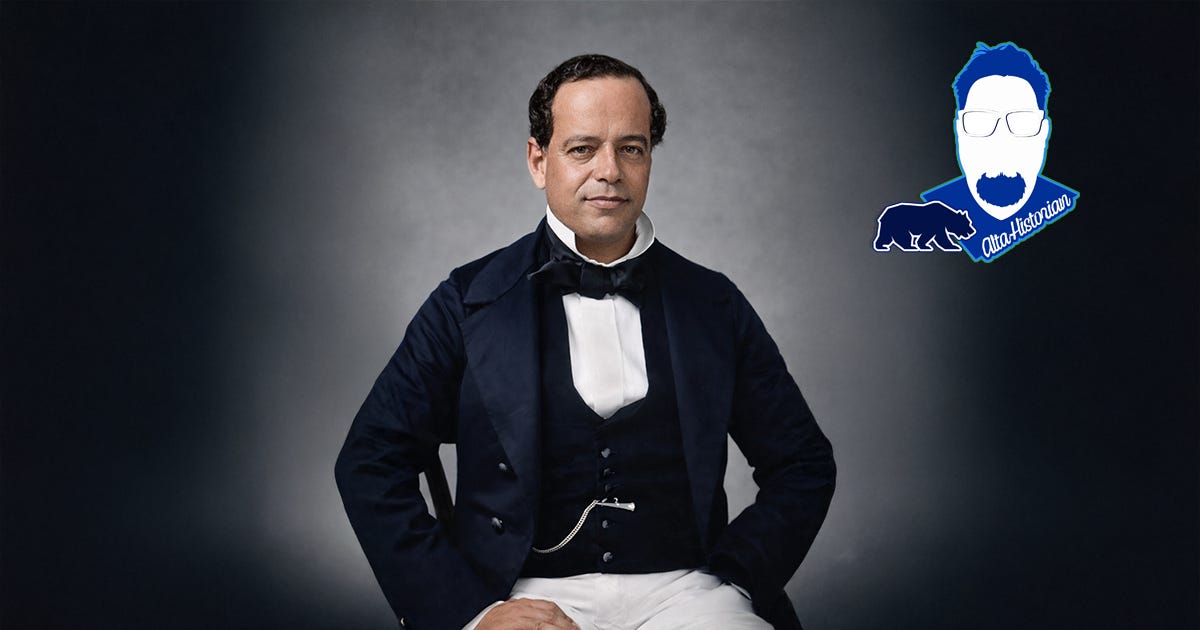
Whenever I do historical research, I am always fascinated by the people who surround these prominent leaders — their children, their wives, friends, and enemies. This is especially true when it comes to a character like Antonio López de Santa Anna — soldier, president (then dictator), exile, hero, villain — we are talking about a guy who lost his leg to a French cannonball in 1838 during the Pastry War. As a historian, you can’t make this up. He would later have a cork-and-wood prosthetic leg — he would lose that leg in 1847 during the Battle of Cerro Gordo — a leg the Mexican government has asked to be repatriated from the Illinois State Military Museum. The State of Illinois refuses. He is the only world leader I know who has lost the same leg twice.
Now imagine living with such a person — the women of Santa Anna’s life most assuredly dealt with much. He was restless: on the battlefield, in government, or among the men he led. The women in his life dealt with an equal amount of restlessness at home — often alone for long stretches of time. George Washington’s wife, Martha, dealt with it — so too did Thomas Jefferson’s Martha. For Santa Anna, he was a compulsive womanizer, which was not odd for the time period, but we are talking about some next-level behavior here.
Santa Anna married twice. He married Maria Ines de la Paz Garcia (1811-44) and Maria Dolores Tosta (1828-86) — both of the women were under 15 and of prominent families. The Catholic Church had, at the time, allowed girls of 12 and boys of 14 to marry. I think we can all come to grips with that’s the way it was — where I am talking next-level is that Santa Anna did not show up for either of his weddings. At his first wedding in Alvarado, Mexico, he empowered Juan Manuel Garcia, his future father-in-law, to stand in his place in 1825. At his second wedding, Juan de Dios Canedo stood in for Santa Anna in Mexico City on October 3, 1844. I think society has made some progress.
Born in Xalapa, Veracruz, Mexico, on February 21, 1794, Santa Anna was a teenager in 1810. Santa Anna, like Simón Bolívar, was a creole—a military officer who embraced the ideals of freedom and independence. Following the 1821 Plan of Iguala, he helped liberate Veracruz. In his early years, he consistently advocated republicanism, opposing the Spanish Crown (1821) and Emperor Agustín de Iturbide (1822). Then, he fought against the very republican government he helped install against President Guadalupe Victoria (1828) and again against President Anastasio Bustamante (1832). In his career, he fought as a royalist, an imperialist ally, a republican, and, later, a centralist—the most consistent part of Santa Anna's record was his consistent support for rebellion. Unlike Bolívar, he was the embodiment of caudillismo — power came before ideology, and force was his modus operandi.
He then served as President on six occasions, and, as with everything else in his life, he was an opportunist. In his marriage to Inés García, it was no different than his political endeavors. She was the daughter of wealthy Spanish parents; she helped in his rise in status and property, including the acquisition of the Manga de Clavo hacienda. For Inés, her role was to remain largely isolated on Santa Anna’s estates in Veracruz—she did not follow her husband on his crusades, battlefields, revolts, or campaigns; she was not part of the political theater. Her role as an administrator of household affairs was not unusual for the time, and when political backlash prevented her from performing her duty, the hacienda deteriorated.
It was clear that, in situations when Inés was away from the hacienda, the value of her work was most evident. When she passed in 1844, Santa Anna’s estates fell into disrepair — though it is a clear testament to the love the public had for Inés that when she fell gravely ill, it was reported thousands marched in public prayer for her recovery. And upon her death, public mourning ceremonies were held across Mexico. Processions, masses, and public tributes praised her virtue and maternal devotion. She clearly served as the symbolic counterweight to Santa Anna’s volatility and brashness in the political culture defined by the rebellion he led at its forefront; it was Inés who embodied the moral endurance of Mexico’s political culture.
Less than a month after Inés’ death, Santa Anna married María Dolores de Tosta — young, wealthy, and abruptly thrust into the role of first lady to the turbulent Santa Anna. To the public and Catholic contemporaries, Santa Anna’s marriage to Dolores shocked the country, as many were still in mourning. But Dolores filled the same archetype as her predecessor — stability for the volatile leader. Dolores’ approach differed: she preferred life in Mexico City, was more independent of her husband, and, when Santa Anna went into exile, she remained in the capital. She used the wealth of the Santa Anna estate to maintain herself — she had no obligation to the estate or to raise the heirs of Santa Anna — she had no children of her own.
Dolores’ experience was almost as if outside of the spectacle of Santa Anna’s circus, one of exile and banishments, renewed dictatorships, great decline, and final disgrace. At times, Dolores stood beside him, worked on his behalf (as she did in her appeal to Benito Juárez), while accompanying him during moments of public reckoning. But she did have boundaries — when Santa Anna returned from exile late in life, disgraced and impoverished, and seeking financial refuge, Dolores held firm, unwilling to sacrifice her comfort and security for her husband. She allowed him to live in her home, but not with the extravagance of previous years. When Santa Anna died in 1876, she lived for another decade.
What Santa Anna’s story tells us is that the levers of power are not always what or who they seem. Viewed through the eyes of Santa Anna’s wives, the story presents a holistic balance of life; when personal ambition is left to run rampant, it fractures domestic stability and, in turn, fractures the bond between public duty and private stability through management, restraint, adaptation, and refusal.

Bibliography | Notes
Callcott, Wilfred H. “Santa Anna, Antonio López de.” Handbook of Texas Online. Accessed January 31, 2026. https://www.tshaonline.org/handbook/entries/santa-anna-antonio-lopez-de.
Fowler, Will. “All the President’s Women: The Wives of General Antonio López de Santa Anna in 19th-Century Mexico.” Feminist Review, no. 79 (2005): 52–68.
“Santa Anna, Antonio López de.” US–Mexico War Digital Archive, University of Texas at Arlington Libraries. Accessed February 2, 2026. https://sites.libraries.uta.edu/usmexicowar/node/4883