

Slavery in the Pre-Columbian Americas
World Civ | Americas | Kinship, Crisis, and Commerce

Long before Europeans crossed the Atlantic, slavery existed throughout the Americas. It did not arrive with conquest — it was already present — embedded in warfare, kinship, ritual, and survival. As Andrés Reséndez observes, “Indigenous slavery long predated the arrival of Europeans in the Americas.” From “pre-Contact monuments, codices, and archaeological evidence as well as the earliest European accounts,” we learn that Indigenous Americans enslaved one another.
The Maya and Aztec “took captives to use as sacrificial victims.” The Iroquois waged “mourning wars” to avenge the dead and replace them. Along the North Pacific Coast, elite marriages were finalized “by exchanging enslaved people.” These forms of bondage were not identical — they were “embedded in specific cultural contexts.” Yet their very embeddedness reveals normalization. Slavery was not marginal to these societies. It was interwoven with ritual, diplomacy, and social regeneration.
European colonizers did not invent Indigenous slavery — they “tapped into” it. What they did was commodify and expand it “in ways that would have been unimaginable in earlier times.” Over centuries, systems of bondage shifted — from culturally specific practices to imperial labor drafts such as encomiendas and repartimientos, and eventually to “more economic-based forms of bondage such as debt peonage.”
These arrangements “came to resemble the kinds of human trafficking recognizable to us today.” But throughout these transformations, Native slavery “in its many guises coexisted with African slavery all along and proved nearly impossible to eradicate.” It was not an early colonial anomaly. It was persistent.
Unlike African slavery, which often targeted adult males, most enslaved Indigenous Americans were “women and children.” The preference was explicit and economic: “Native women could be worth 50 or 60 percent more than men.” Sexual exploitation and reproductive capacity contributed to this premium, which “remained in place from the sixteenth through the nineteenth centuries.”
Masters valued “docile women” and preferred children because they were “more adaptable than grownups, learned languages more easily, and could even come to identify with their captors.” Slavery here intersected with assimilation. Enslaved Indigenous people could, over time, “join their captors’ societies.” Their condition was “more fluid.” Some could “attain some independence and a higher status, even over the course of a lifespan.” Bondage, though real, did not always constitute permanent hereditary exclusion.
This fluidity appears vividly at Cahokia. Organized around hierarchical chiefdoms, the city relied upon warfare to sustain “social stratification.” “War captives were enslaved, and these captives formed an important part of the economy in the North American Southeast.” Yet Native American slavery “was not based on holding people as property.”
Instead, the enslaved were understood as individuals who “lacked kinship networks.” Slavery was therefore “not always a permanent condition.” Through “adoption or marriage,” a captive could enter a kinship network and “become a fully integrated member of the community.” Captive trading allowed communities to “regrow and gain or maintain power.” Here again, slavery functioned as a social mechanism — harsh, yes, but structured.
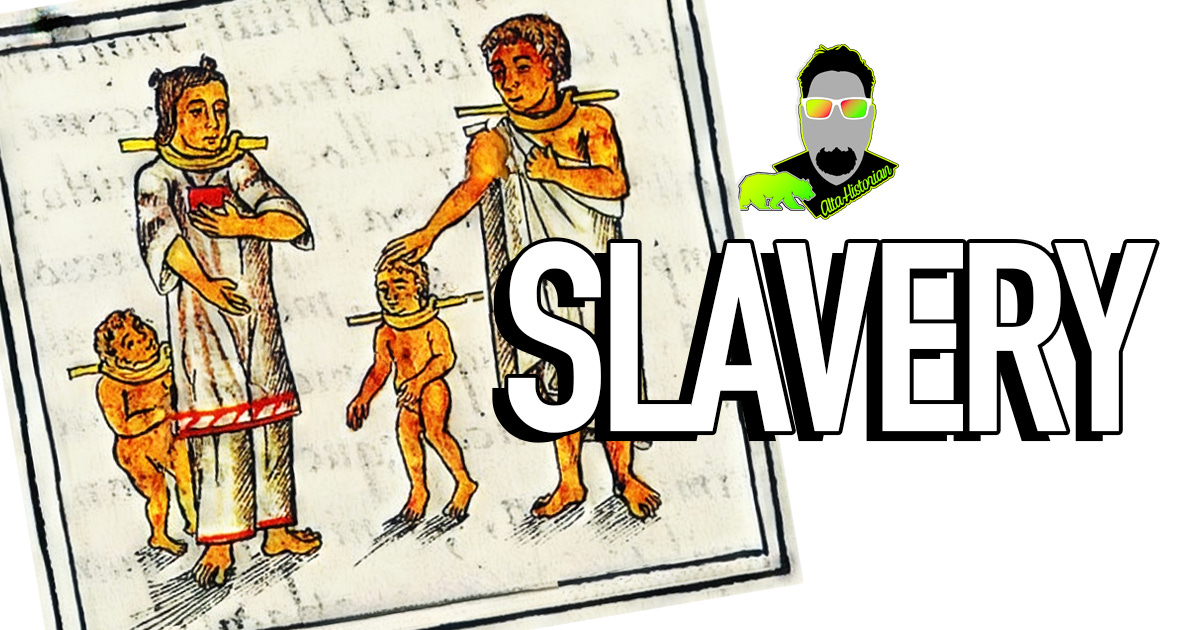
Among the Aztecs, slavery occupied the bottom rung of a clearly articulated hierarchy. The tlacotin “were not a large social category,” and slavery “was not hereditary.” People became slaves through “debt or punishment, but not through birth.” Slaves could “marry, have children (who were free) and even own property.” Anyone could own a slave, though most owners were nobles. Markets specialized in the trade. Some pochteca merchants “specialized in trading slaves,” and slaves for sale were marked with “large wooden collars.”
Diego Durán described the scene:
“The masters took the slaves to the [market]: some took men, others women, others boys or girls, so that there would be variety from which to choose. So that they would be identified as slaves, they wore on their necks wooden or metal collars with small rings through which passed rods about one yard long…”
The language is commercial — “variety from which to choose.” In times of famine, Durán notes, “a man and wife could agree… They could sell one another… or they sold one of their children if they had more than four or five.” Redemption remained possible: “These could be redeemed later by returning their price.” War captives, however, occupied a different status: “It was certain and sure that such captives were to serve as victims in sacrifice… because they had been brought exclusively to be sacrificed to the gods…”
Aztec legal traditions confirm the normalization. Individuals could sell themselves or their children “to pay back a debt.” The status change was “an official act” witnessed formally. Slaveowners were “responsible for housing and feeding their slaves,” and slaves generally “could not be resold.” They were often freed upon the owner’s death or by marriage. “Aztecs were not born slaves and could not inherit this status from their parents.” Slavery existed, but it was bound.
The Maya reveal similar patterns. There was “an active slave trade in the Maya region,” and both “commoners and elites were permitted to own slaves.” Enslavement followed “punishment for certain crimes,” failure to repay debts, or capture in war. Impoverished individuals sometimes “sold themselves or family members.” Slavery was “not passed on to the children of slaves.” Yet captives might be sacrificed, and slaves were “usually sacrificed when their owners died so that they could continue in their service after death.” Marriage could alter status — even reverse it. “If a man married a slave woman, he became a slave of the woman’s owner.”
Across these societies — Cahokian, Aztec, Maya — slavery was not invisible. It was legislated, ritualized, traded, and recorded. It intersected with famine, warfare, taxation, kinship, and religion. It could be temporary or terminal, assimilative or sacrificial. It could be redeemed or inherited through marriage, but not through birth alone.
The ancients of the Americas, like those of the Mediterranean and Near East, did not conceptualize slavery as an aberration from social order. They understood it as one of its instruments — a way to avenge the dead, to survive famine, to repay debt, to supply labor, to mark hierarchy, to feed gods, to rebuild communities. Europeans would expand and commodify these systems, but they did not create the underlying assumption that human bondage could be woven into ordinary life.
Slavery in the pre-Columbian Americas was not a singular institution. It was a constellation of practices. Yet across that constellation, one fact endures: bondage was familiar. It was regulated. It was exchanged in markets and sanctified in ritual. It was, in its varied forms, part of normal life.

Bibliography | Notes
Blancard, L., ed. Documents Inédits sur le Commerce de Marseille au Moyen Age. Vol. II. Marseilles: Barlatier-Feissat, Pere et Fils, 1884. Reprinted in Roy C. Cave and Herbert H. Coulson, A Source Book for Medieval Economic History. Milwaukee: The Bruce Publishing Co., 1936; reprint ed., New York: Biblo & Tannen, 1965.
Durán, Diego. Historia de las Indias de Nueva España e Islas de Tierra Firme.
Reséndez, Andrés. “Perspective: The Other Slavery.” Smithsonian (2021).
Smith, Michael. The Aztecs. (Excerpt as provided in notes.)
“Aztec Debt Slavery.” UT Tarlton Law Library (2022).
“Aztec Slavery.” Guggenheim Museum (2004).
“Aztec Social Structure.” UT Tarlton Law Library (2022).
“Maya Social Structure.” UT Tarlton Law Library (2022).
“Cahokia Slavery.” The American Yawp.