

Slavery in the Roman and Medieval Imagination
World Civ. | Markets, Revolts, and Manumission

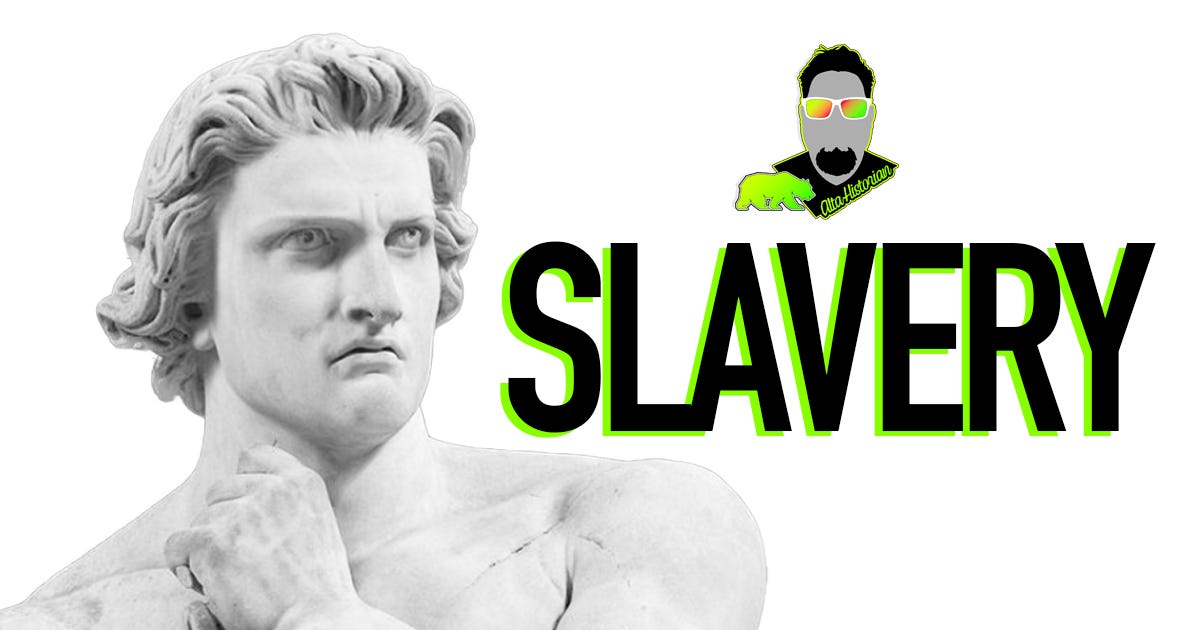
If slavery in the ancient world was structural, it was also transactional. Nowhere is this clearer than in Rome, where bondage permeated daily life so thoroughly that slaves were called “Speaking Tools.” The phrase, recorded in connection with the revolt of 73 BC, captures both intimacy and reduction. Slaves were animate — yet instrumental.
“Slavery was a fundamental part of Roman daily life.” Enslaved people “came from many parts of the large empire and had been enslaved in many different ways.” Some were prisoners of war, others were victims of piracy or kidnapping. The children of enslaved women “were considered the property of the household in which the mother lived.” Some sold themselves into slavery to pay debts. Markets sustained the system — most notably at Delos, where “upwards of ten thousand enslaved people might be sold in a single day.” A single day. The scale suggests commerce, not crisis.
And yet Rome also normalized release. Manumission “was an expected practice,” formalized before a magistrate or in a will. Some enslaved people saved earnings to purchase freedom. Freed people “formed a substantial class in Rome,” though they faced restrictions and obligations to former masters. Their children, however, “were considered full citizens.” Slavery, then, did not mark a permanent metaphysical category. It was a status within a functioning civic order.
But the sources do not romanticize the condition. Apuleius, in The Golden Ass, offers a visceral image:
“The pale welts from chains crossed every patch of their skin like brush-strokes. Their flogged-up backs under sparse patchwork were no better covered than stretches of ground that shade falls on… Their foreheads were inscribed with brands, their hair half-shaved, their ankles braceleted with fetters, their pallor hideous…”
This is not philosophical abstraction. It is physical degradation. Yet the passage functions as description, not denunciation. The brutality coexists with normalcy.
Petronius’s Satyricon reveals another dimension — the casual cruelty of power:
“Quick, off with your own head, since you are so stupid.”
The boy begs. Trimalchio mocks him. Only the intervention of others spares punishment. The scene is domestic. It unfolds at dinner. Slavery here is not about battlefield capture or legal code — it is about the household’s atmosphere.
The great rupture came in 73 BC, when Spartacus led what became known as the Third Servile War. The introduction to that episode describes how the “Speaking Tools… burst loose in a terrible insurrection,” one that “taxed the whole power of the government.” Yet even sympathetic narration frames their success as unthinkable: “An army of such brutalized wretches could only destroy; they could never have erected a firm and tolerable government.” The revolt is alarming not because slavery exists, but because slaves disrupt order. Afterward, “out of sheer fear,” Romans “seem to have begun to treat their slaves less harshly than before.” Reform emerges from prudence, not moral awakening.
The normalization of slavery extends beyond antiquity into medieval Europe. The thirteenth-century bills of sale for the Saracen maid Aissa are stark in their simplicity. On May 19, 1248:
We… have sold jointly in good faith and without guile to you… a certain Saracen maid of ours, commonly called Aissa, for a price of nine pounds and fifteen solidi…
On July 2:
I… sell and transfer to you… a certain Saracen maid of ours, commonly called Aissa, for a price of ten pounds…
The language is commercial, precise, and unembellished. “In good faith and without guile.” The transaction resembles the sale of land or livestock. The note that “there was a profit of five solidi on the second sale” underscores the point. Human life is accounted in margins.
Across Rome and into the medieval Mediterranean, slavery persists as a practice — regulated, taxed, bought, freed, revolted against, and resumed. Even rebellion confirms its centrality. Spartacus’s uprising was the “third such in fifty years.” A system repeatedly challenged yet continually restored reveals its embeddedness.
To read these sources is to confront a difficult truth. The ancients did not experience slavery as a contradiction within their civilization. They experienced it as one of its conditions. Law codified it. Philosophy justified it. Markets distributed it. Literature depicted it. Revolts strained it but did not dissolve it.
Slavery, for the ancient world, was not hidden in the shadows of society. It stood in the open — branded on foreheads, recorded in codes, sold in markets, debated in treatises, and inscribed in contracts. It was not perceived as the collapse of order. It was, rather, one of the ways order was made.

Apuleius. The Golden Ass. Excerpt provided in course materials.
Berger, Eugene; Israel, George; Miller, Charlotte; Parkinson, Brian; Reeves, Andrew; and Williams, Nadejda, “World History: Cultures, States, and Societies to 1500” (2016). History Open Textbooks.
Blancard, L., ed. Documents Inédits sur le Commerce de Marseille au Moyen Age. Vol. 2. Marseilles: Barlatier-Feissat, Pere et Fils, 1884. Reprinted in Roy C. Cave and Herbert H. Coulson, A Source Book for Medieval Economic History. Milwaukee: The Bruce Publishing Co., 1936; reprint ed., New York: Biblo & Tannen, 1965.
Davis, William Stearns, ed. Readings in Ancient History: Illustrative Extracts from the Sources. 2 vols. Boston: Allyn and Bacon, 1912–13. Vol. 2, Rome and the West, 90–97.
Fordham University. Internet Ancient History Sourcebook: The Third Servile War (Spartacus), 73–71 BCE. Edited by Paul Halsall.
Petronius. Satyricon. Excerpt provided in course materials.