

The Indus Valley Civilization (South Asia)
World Civilizations

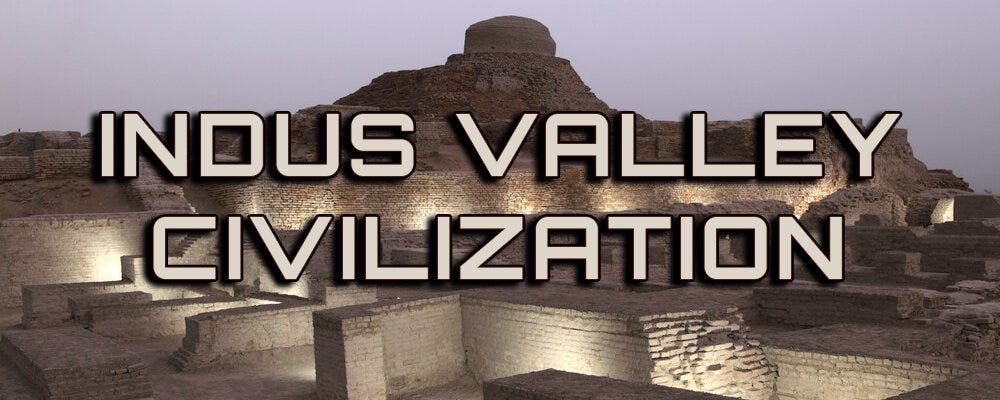
📍Place: South Asia | Time: 3300 and 1300 BCE

One of the most remarkable ancient societies, the Indus Valley Civilization, flourished in South Asia between 3300 and 1300 BCE, primarily along the Indus and Ghaggar-Hakra river systems. Its carefully planned cities, advanced infrastructure, and enigmatic script stand as a testament to humanity’s capacity for innovation and adaptation. Although its ruins were only rediscovered in the early twentieth century, scholars have since uncovered an astonishing picture of its achievements, offering a lens into the earliest urban culture of the Indian subcontinent.
The twin cities of Mohenjo-daro and Harappa are perhaps the most iconic examples of the Indus Valley's sophistication. Unlike many other early civilizations, the people of the Indus built their cities with meticulous planning, adhering to a grid-like layout that suggests a strong central authority or collective governance. Streets were wide and well-paved, often lined with structures of baked bricks. This technological innovation allowed their cities to withstand floods. The uniformity of the bricks across settlements suggests standardization, which could indicate that the civilization’s leaders imposed consistent construction methods, possibly to ensure equality or efficiency.
At the heart of these cities were complex water management systems that demonstrated ingenuity and an understanding of their environment. Mohenjo-daro’s Great Bath, a massive public water tank, reveals how integral water was to their spiritual and social life. The civilization’s drainage systems, considered some of the finest of the ancient world, featured covered sewers that carried waste away from homes, preserving sanitation within densely populated areas. Archaeologists have speculated that this commitment to cleanliness was deeply ingrained in their culture, perhaps reflecting early notions of public health or ritual purity.
Commerce and trade played a central role in the Indus Valley economy. Seals discovered at archaeological sites depict animals, symbols, and scripts—evidence of a thriving trade network. These seals, often used to mark goods or possessions, have been unearthed in regions as distant as Mesopotamia, underscoring the civilization’s extensive reach. Resources such as lapis lazuli, carnelian, and precious metals further highlight the prosperity of the Indus Valley traders, who likely exchanged these goods for textiles and grains. The weights and measures used in their trade were astonishingly consistent, showcasing their commitment to fairness and reliability in economic exchanges.
Although the material remains of the Indus Valley provide compelling evidence of their achievements, one of its most intriguing aspects remains (if you can unlock their scripts, you can win $1 million!). Unlike the hieroglyphs of Egypt or the cuneiform of Mesopotamia, the symbols of the Indus script, found on seals and pottery, have defied translation. Scholars believe this script may have been used for administrative or religious purposes, but until it is deciphered, the voices of the Indus people remain shrouded in mystery. This enduring enigma underscores the limits of our knowledge and highlights the challenges of reconstructing the past without written records.
The cultural life of the Indus Valley is equally fascinating. Figurines of women adorned with elaborate jewelry suggest a society that valued artistry and possibly revered female deities. The discovery of terracotta toys and game pieces indicates the presence of leisure activities and a concern for the well-being of children. Furthermore, the uniformity of their settlements, with no discernible palaces or prominent temples, suggests a society where power and wealth may have been more equitably distributed compared to their contemporaries in Mesopotamia or Egypt.
Though speculative, the religious practices of the Indus Valley people hint at a connection to later South Asian traditions. Seals depicting a figure seated in a yogic posture surrounded by animals have led some scholars to draw parallels to Shiva, a prominent deity in Hinduism. Similarly, evidence of fire altars and offerings suggests ritual practices that may have laid the groundwork for Vedic religious traditions. While these connections remain speculative, they underscore the Indus Valley's lasting legacy in shaping South Asia's cultural and spiritual foundations.
However, the decline of the Indus Valley Civilization around 1900 BCE presents another tantalizing mystery. Environmental changes, including the drying of the Ghaggar-Hakra river system, may have forced its people to migrate or adapt to less hospitable conditions. Evidence of flooding and shifts in trade routes may have further strained their economy. While the exact causes remain debated, what is clear is that this once-thriving civilization left a profound imprint on the region, influencing subsequent cultures in ways that still resonate today.
The Indus Valley Civilization was a marvel of the ancient world, embodying the shared elements of civilization: urban planning, trade, governance, and cultural expression. Yet, it was also distinctive in its egalitarian tendencies, advanced engineering, and enigmatic script. By examining the ruins of Harappa and Mohenjo-daro, we glimpse the ingenuity and resilience of a people who forged a thriving society in one of the world’s earliest cradles of civilization. Their achievements remind us not only of the universality of human innovation but also of the enduring mysteries that make the study of history so captivating.
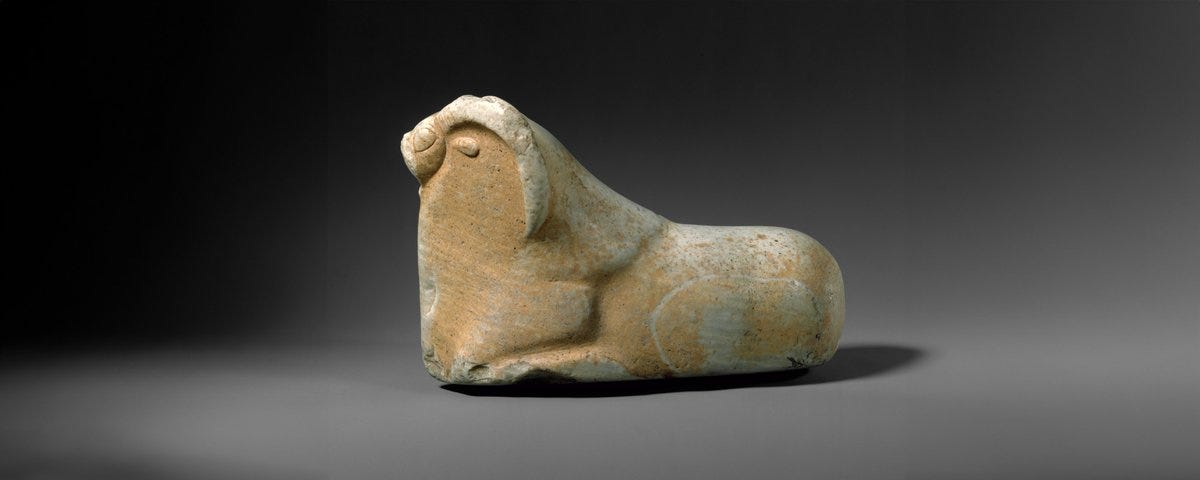
This powerful sculpture represents a mouflon, a type of wild sheep native to the highland regions of the Near East. The animal's head, now partially broken away, is held upward and is twisted to the right, creating an impression of alertness. The artist has achieved a realistic rendering of an animal at rest, its weight thrown fully onto its left haunch, and its left hind leg tucked under its body. The bottom of the statue has been worn away, but it is likely that the hidden leg was originally indicated there. The entire body is contained within a single unbroken outline. The horns, ears, tail, and muscles were modeled in relief, although time and secondary use have flattened the contours on the right side. This combination of closed outline with broadly modeled masses and a minimum of incised detail is characteristic of animal sculpture from the Harappan-period levels at the site of Mohenjo Daro in the lower reaches of the Indus River. The function of these animal sculptures is unknown.
BIBLIOGRAPHY
Berger, Eugene, et al.World History: Cultures, States, and Societies to 1500. University System of Georgia, 2016.
Marich, Melanie. "Unlock This Ancient Mystery—and Earn $1 Million." New York Post, January 24, 2025.
OpenStax. World History, Volume 1: To 1500. OpenStax, Rice University, 2018.
"Indus Valley Civilization." World History Encyclopedia.
Banner Photo: Maitre, P. (2009). Retrieved from Archaeological Ruins at Moenjodaro [Photograph]. CRA-terre.