

The Life and Ledger of José María Estudillo
California | Dawn to Dusk of the Californio Sun

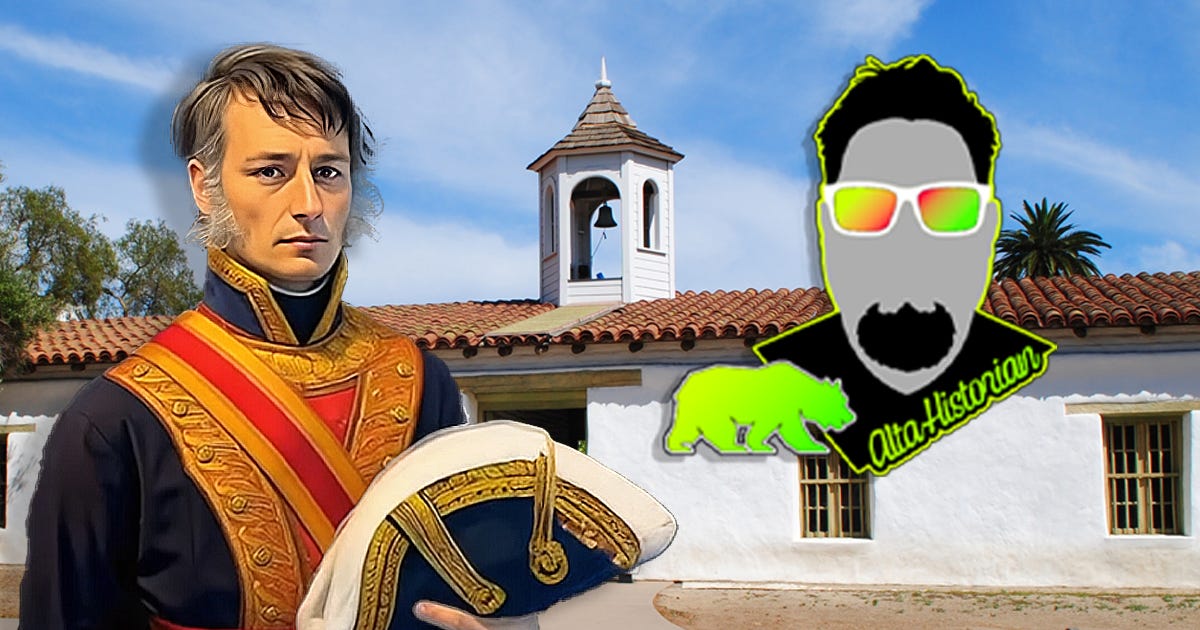
José María Estudillo was born in Andalucía, one of Spain’s story-rich and emotionally evocative regions. The region feels like a crossroads because it is. Africa is visible across the Strait of Gibraltar on a clear day. The Mediterranean region in southern Spain feels like California: warm, sunny, sometimes harsh, and breathtakingly beautiful. The city was also in the orbit of Al-Andalus, where scholars, astronomers, poets, and philosophers shaped medieval thought.
The echoes of empire mingled with the scent of olive groves, and it was in this world that José María Estudillo was born in 1772. It remains unknown why Estudillo found his way to the New World. Still, at just fifteen years of age, in 1787, he likely sailed the treacherous Atlantic via Cuba, tethered to his father’s military shadow, stepping into the layered chaos of New Spain. From Cuba, he found his way to the valleys south of Mexico City in Tlayacapan, where he forged a foothold amid the rigid hierarchies of race and rank.
He wed María Gertrudis Horcasitas—a woman of Mexican birth—in 1795. This match wove together the threads of Español prestige and the imperatives of alliance in a society obsessed with bloodlines. The following year, 1796, thrust him into the ranks as a soldier in Loreto, Baja California, before the inexorable pull of the north drew him and his family to the Presidio of Monterey in Alta California by 1797, where the Spanish Crown’s desperate bid to fortify its Pacific frontier against encroaching rivals demanded men like him to plant flags in unforgiving soil.
Beneath the veneer of martial duty lay the intimate fractures of a life divided. Gertrudis, that quiet force of resilience, shouldered the burdens of his absences, her hands steering the household through the tempests of separation that scarred their bond with discord. Together, they nurtured six children—three daughters and three sons—and in time, twelve grandchildren. However, it was she who anchored their world, managing the intricate web of social ties and economic survival in a land where scarcity gnawed at every ambition. Her labor, often erased from the narratives of conquest, mirrored the unseen toil that propped up empires, a testament to the women who held the fragile center. At the same time, men like Estudillo performed the rituals of order on the periphery of the Empire. In this dance of duty and domesticity, one glimpses the human cost of colonial expansion, where personal stories intersect with the vast machinery of power, race, and place.
By 1806, the discerning eye of Governor José Darío Argüello elevated Estudillo to the rank of cadet, a nod to his emerging stature in a hierarchy built on loyalty and adaptability. The following year, 1807, saw him ascend to Lieutenant-Commander of Monterey, inheriting from Raimundo Carrillo a labyrinth of grievances, chief among them the soldiers’ disenfranchised voices in San José’s political fray. As Carrillo had lamented in 1802, the alcalde’s betrayals—broken vows and illicit deeds—had soured the pueblo’s spirit, prompting calls for invalidos, those weathered retired soldiers, to helm the ship of self-governance in a community straining against imperial reins.
El Pueblo de San José de Guadalupe, etched into the landscape in 1777 as Alta California’s inaugural civilian outpost, swelled to 125 souls by 1810—a mosaic of Indian (even one Apache), Spanish, mestizo, and mulatto lives, men, women, and children alike. By 1820, it had nearly doubled in size, blossoming into an agrarian powerhouse that produced grain, livestock, and hemp, eclipsing its rivals across the territory. But prosperity bred predators. Missions, the fourth arm of the Spanish Empire’s colonial government, clashed with pueblos over vines and orchards, peaches twisted into forbidden brandy, their rivalries etching deep scars into the ecological and social fabric of the frontier. Here, in this verdant yet volatile valley, the land itself bore witness to the collisions of cultures, where indigenous knowledge of the soil met the extractive gaze of empire, foreshadowing the environmental reckonings to come.
San José’s daily grind remained a testament to endurance: adobe dwellings rose from the earth like modest fortresses against the elements, supplanting earlier ramshackle huts, though comforts like stoves and hearths eluded most. Estudillo, echoing Carrillo’s pragmatic ethos, wove through these tensions, molding a society’s identity on the anvil of adaptation. In the imposed strata of colonial rule, resentment festered like an untended wound, pitting friars against soldiers in a perpetual scramble for resources, their deceptions a survival tactic in a Pacific world where global currents—Russian furs, American sails—lapped at Spain’s weakening shores, demanding diplomacy laced with defiance.
The frontier was never quiet. It was always humming with the low thunder of competing claims: land, grain, souls. In October 1809, José María Estudillo’s quill scratched out an order that cut through the haze of harvest season like a saber through tule fog: Francisco Castro and every man with a cornfield were to dry, sort, and haul their yield to Monterey by the 26th — “without fail or excuses whatsoever.”
Reimbursement would follow, but obedience was non-negotiable. Two weeks later, on the chill morning of November 12, he confronted Father Narciso Durán over cattle grazing at the Place of Skulls, a name that already carried the scent of old violence. “Go immediately,” he wrote, “with enough townspeople to swap out the mission’s livestock for the settlers’. Do all you can to ensure success.” These were not polite requests, as they were the terse commands of a man balancing a colony on the edge of a knife.
Between those two dates lay the daily choreography of scarcity. Soldiers and mission Indians shared the same thin rations, the same cracked adobe walls, the same resentment toward a Crown that paid in promises and extracted in blood. Estudillo’s first bold stroke as Lieutenant-Commander had been to grant San José’s resident troops a voice in pueblo assemblies. This act appeared generous but was actually a matter of survival: enfranchise the men who held the muskets, or risk the whole edifice crumbling. It was a page torn from the Spanish Cortes’ distant playbook, but on Alta California soil, it felt revolutionary, a whisper of self-rule in a land where every kernel of corn was a bargaining chip.
Yet power always exacted a price. On May 3, 1809, Estudillo reported the capture of Secundino, a Mission Santa Clara neophyte accused of theft and the attempted rape of a militiaman’s wife. The fugitive’s trial shuttled north to Monterey, and with it came the thornier question of who fed the prisoners. “It is the Mission’s duty,” Estudillo insisted, “but if the Mission fails, no one else will, and they will starve in chains until they die. God keep you many years.” The salutation was formal, but the subtext was acid. Missions hoarded grain while soldiers guarded empty storehouses, and neophytes fled into the tulares while padres tallied souls. The ledger of the empire never balanced.
By 1810, the ledger had turned crimson. Three California Indians stood accused of murder, and Estudillo—soldier, magistrate, reluctant ethnographer—defended them in words that still sting across two centuries:
“Everyone knows that generally these Indians in their heathendom do not have the least scruple against robbery, kidnapping women from each other, having four, five, six and even more concubines at one time, or even murder. … These [neophytes] cannot divest themselves so easily of the customs of their barbarism. … It took many years to bring more highly civilized Indians to perfect instruction in our Religion; how much less can be accomplished with a people who know no more than they can retain in their minds from day to day.”
Read closely and the passage fractures. On one side stands the colonial gaze, cataloguing polygamy and theft as proof of savagery, and on the other, the unspoken indictment of a mission system that had, in two generations, unspooled millennia of indigenous social fabric. To the American Indian mind, monogamy was not persuasion, but coercion. Land was not shared, but seized. And the violence Estudillo condemned was the violence the missions had authored, then blamed on its victims. Alta California’s Indians, caught between the friars’ bells and the soldiers’ bayonets, retained only the daily miracle of memory — “from day to day” — because everything else had been stripped away.
Estudillo saw the fracture but was unable to identify it. He saw neophytes whipped for dancing, women taken as concubines by soldiers, children dying of measles in dormitories that smelled of tallow and despair. He saw, too, the soldiers’ own desperation: pay in arrears, uniforms in tatters, families left to Gertrudis’s improvised ledger of favors and debts. The 1812 decree from the Spanish Cortes — allowing pueblos with fewer than 200 souls to petition for an ayuntamiento — dangled like a mirage. San José’s regidores began to dream in Spanish the way their Yokuts neighbors dreamed in whistles and signal fires: of councils, of alcaldes, of a world where the mission bell did not dictate the dawn.
Estudillo stood at the hinge. He enforced the king’s law with one hand and, with the other, brokered the fragile peace that kept corn moving from field to presidio, cattle from mission to pueblo, and runaway neophytes — alive or dead — back to the friars’ tallies. In the Pacific world beyond the coastal ridges, Russian baidarkas already skimmed the otter grounds, American ships bartered rum for hides, and the old Spanish Pacific was fraying thread by thread. Estudillo’s orders, his letters, his silences — all of it was the sound of an empire trying to hold the tide with a sieve.
Pacific Fur Trade (1810–1816)
The Pacific was never Spain’s alone, but rather a commons of blood and barter, where empires collided, and indigenous worlds were ground between them. By the fall season of 1810, the coast bristled with foreign sails: the American brig O’Cain nosing south from the Columbia, the Russian Isabella anchored at Bodega by October, her decks alive with Aleut hunters in sealskin parkas. On the beaches below the bluffs, Russians and Yankees pitched tents, their campfires flickering like signal flares across a darkening Spanish frontier. Twenty bidarkas skimmed the estuaries of San Mateo and San Bruno that season. Thirteen canoes threaded the tule marshes at dawn. Sea otters — those sleek, whiskered coins of empire — were the prize, and every pelt stitched another thread into the unraveling tapestry of Alta California.
The Aleuts were the finest hunters alive, and everyone knew it. Lieutenant Alexis Lazarev, wintering at Bodega in 1820, confessed with the blunt honesty of a man who had seen too much: “If the company should somehow lose the Aleuts, then it will completely forfeit the hunting of sea animals, because not one Russian knows how to hunt the animals.” The Russians had learned the hard way. From Kodiak to Unalaska, populations had been halved in four decades by smallpox, overwork, and violence. The Aleuts’ “innate passion for hunting sea otter,” as Cyril Khlebnikov noted, was the only engine keeping the fur machine turning. Promises of reward — such as glass beads, tobacco, or a blanket, depending on the season — were most certainly part of the negotiation. More importantly, the Aleuts hunted most fiercely to free their families at home from their Russian captors, who held them captive for leverage on the promise of maximum profit. The Aleuts hunted, the Russians tallied, and the otters vanished from California’s waters.
Southward, the missions tried to compete. In 1810, Father José Señán stared at a warehouse stuffed with 450 sea-otter pelts worth 4,000 pesos and a mountain of hemp that no Spanish ship could carry away. The hemp had been a Crown obsession since 1801, coaxed from the soils of San Luis Obispo, Purísima, Santa Inés, and San José by neophyte hands that never saw a real of profit. When the official trade route to San Blas collapsed under its own bureaucracy, the surplus spilled into the black market: otter pelts for Chinese silk, hemp rope for Yankee rum, all bartered beneath the presidio’s blind eye.
Into this breach stepped the Hawaiians — Sandwich Islanders, Kanakas — watermen whose skill with a canoe rivaled the Aleuts’. In five months, they stripped 30,000 seal skins from the Farallones. In three days, they took sixty prime otters off Point St. Quintin, then added 1,600 more in a single fevered week. Their presence turned the Pacific into a single, lethal circuit: Alaskan Aleuts paddling south, California neophytes pressing hemp, Hawaiian sailors sealing the coast. Indigenous labor, indigenous knowledge, indigenous bodies — extracted, relocated, exhausted — became the invisible scaffolding of three empires’ dreams.
Spain watched from the cliffs, powerless and furious. The missions slaughtered 350 to 400 cattle weekly — 19,000 head a year — to feed the neophytes and render the hides and tallow that bought iron from New England and cloth from Lima. Each arroba of tallow fetched four to six reales, and the annual yield could have purchased a frigate if anyone in Mexico City had bothered to pay. Instead, the Albatross sailed north in November 1810 with 4,000 seal skins, the Mercury hunted on, and the presidial commanders counted canoes they could not stop.
Estudillo stood on the ramparts of Monterey, squinting into the glare. He saw the bidarkas glide past the point like black needles stitching the sea to foreign profit. He saw the missions’ warehouses bulge while his soldiers mended uniforms with burlap. He saw the land itself — those oak-dotted valleys, those tule-choked estuaries — slipping from Spanish grasp into a Pacific marketplace where otter pelts were currency and indigenous lives the cost of doing business. The frontier was no longer a line on a map; it was a ledger, and the balance was bleeding red.
Russians and Bouchard’s Raid (1816–1818)
The Russians came not as missionaries or settlers but as shareholders. In 1811, Ivan Kuskov sailed the Chirikov into Bodega Bay, paid the local Pomo for permission with a few strings of beads, and raised the flag of the Russian-American Company. By the following spring, Fort Ross stood eighteen miles north, with ten cannons on the palisade, wheat fields terraced above the surf, and warehouses already smelling of otter blood. The Spanish called it an outrage, but the Russians called it commerce. Estudillo called it Tuesday.
He met the challenge the way a frontier officer meets any threat: with paperwork and powder. In July 1814, Aleut hunters capsized in the restricted waters off San Francisco, and Governor Argüello clapped them in irons. Kuskov protested with the wounded dignity of a man whose employees had merely been trying not to drown. Estudillo backed the governor: the bay was Spanish, the otters were Spanish, the surf was Spanish. The prisoners were freed, but the message lingered like gunsmoke: cross the line and the line bites back.
Still, the line was fraying. American captains, such as William Heath Davis, offered Argüello 3,000 pesos for exclusive trading rights. Estudillo, however, urged rejection, and the bribe was spurned. Loyalty to a bankrupt Crown felt noble until the soldiers’ pay stopped arriving. Then it felt like hunger. The missions, meanwhile, bled cattle and prayed for rain. Father Vicente de Sarriá, president of the California Franciscans, fired off letters that read like indictments: taxes, forced levies, troops quartered in the refectories, and neophytes marched off to build presidio walls. “Slavery at least feeds its victims,” he wrote in 1817. “Your Excellency’s demands leave them nothing.”
The soldiers answered that the missions were the only storehouses still standing. The argument circled like buzzards over a carcass. Then, in the autumn of 1818, the buzzards turned into pirates. Hipólito Bouchard — Frenchman, Argentine privateer, self-styled scourge of Spain — dropped anchor off Monterey with two ships, Argentina and Santa Rosa, flying the colors of a revolution Spain refused to recognize. A year earlier, he had posed as a British explorer; Estudillo and Governor Solá had hosted his officers, passed the brandy, counted the lies. On November 20, the masks came off. Cannonballs thudded into the presidio at dawn. Estudillo commanded the battery on the hill, answered shot for shot until the Santa Rosa struck her colors, and five of her crew lay bleeding on the sand.
Solá demanded surrender, but Bouchard demanded ransom. Neither blinked. The next day, four hundred insurgents stormed ashore. Estudillo had fifty-five Indian archers, a handful of padres with muskets, and whatever courage the night had left. Corporal Vallejo’s squad killed thirty before the tide of boarders overwhelmed them. Solá ordered the powder magazine fired; the explosion bought time but not victory. By dusk, the presidio was a smoking ruin, orchards slashed, cattle throats cut for sport. Bouchard spared the cathedral and Carmel mission — perhaps out of piety, possibly because churches do not burn as brightly as ranchos. Families fled inland to Soledad and San Antonio, clutching rosaries and whatever silver they could carry. Mariano Guadalupe Vallejo, seventeen and already tasting destiny, remembered his mother’s face in the firelight: “We left everything but our names.” Estudillo rode escort, carbine across his saddle, counting the cost in scorched earth and shattered illusions.
Bouchard sailed south, sacked the Ortega rancho near Santa Bárbara, tried for San Juan Capistrano, and thought better of it when Argüello’s thirty men appeared on the bluff. By December, he was gone, leaving behind a California suddenly aware of its own nakedness. The raid lasted six days; the reckoning lasted a lifetime. In the ashes, Estudillo found a strange clarity. The missions had fed the pirates’ bonfires with their own timbers; the soldiers had fought with arrows because muskets were rusted; the Indians had died defending a flag that had never been theirs. Empire, he saw, was a house of cards built on indigenous backs, and the wind was rising.
Inland Expeditions (1819–1822)
The interior of Alta California was never empty of human souls, as some may believe. It was a palimpsest of Yokuts trails, Mojave raids, and Spanish ambition written in dust and blood. In 1819, Governor Solá dispatched three expeditions to remind the Tulares and the people of the Colorado River that the king still claimed what the missions could not hold. Sergeant José Sánchez rode south from San Francisco and left twenty-seven Moquelumnan Miwok dead near the future site of Stockton. Lieutenant Gabriel Moraga marched 150 miles inland with cavalry, Mazatlán infantry, and four cannon to punish the Mojave for the scalps of seven mission Indians found bleaching on the desert floor. The Mojave melted into the dunes, and Moraga returned with empty hands and a fuller ledger of grievances.
Estudillo drew the third assignment: forty men, October’s early morning frost on the saddles, and orders to retrieve runaway neophytes and stray livestock from the Tulare Valley. What he brought back was not captives but a field notebook that reads like a reluctant love letter to a world Spain was losing. At the Yokuts village of Chiuta, he counted 2,500 souls under a single captain — autonomous, prosperous, trading fish, turtles, elk, asphaltum, obsidian, abalone. He watched Tachi divers surface with catfish clenched in their fists, their lungs burning from five minutes underwater. He tasted roasted dog at a Wowol feast and did not spit it out.
He listened to bowstrings plucked in the dark — warning whistles that rippled across the marshes faster than any courier. “They signal the enemy burning,” he wrote, “or some other accident in the silence of the night.” The expedition failed to recapture a single neophyte, but it mapped a California that refused to be converted to Christianity. Back in Monterey, the soldiers’ rage turned inward. Pay was a rumor; uniforms were rags. On July 20, 1819, Solá issued a decree that landed like a slap: no corporal could lash an Indian without a missionary’s signature. Estudillo forwarded the order to Father Sarriá with the weary note that both sides were guilty of the same sin—subjugation dressed as salvation.
The missions were plantations now, the neophytes half-naked after taxes, the soldiers jealous of friars who still had cattle to slaughter. The ledger of empire had become a suicide note. By 1821, the note was signed in Mexico City. On September 27, the news reached San Diego: Spain’s American empire had fallen to Iturbide’s trigarante army. Estudillo stood in the presidio plaza with Lieutenant Francisco María Ruiz and watched the ritual that severed three centuries of habit. Outside the guardhouse, a cannon faced the sea. A soldier held the Spanish flag in one fist, the Mexican tricolor in the other. At the command, the old banner dropped; the new one rose. Cannon fire rolled across the bay.
Then came the braids—long black queues, the proud insignia of the soldado de cuera, severed with kitchen scissors and bound in silk ribbons like relics of a dead faith. Juana de Dios Machado never forgot her parents’ tears over her father’s shorn lock, cradled as tenderly as a severed limb. Estudillo had never worn the braid himself, yet in that plaza, he felt the same amputation: dignity, loyalty, the last thread of an empire, snipped away with every soldier who watched the old flag fall.
In May 1822, the new regime asked for loyalty oaths and elected deputies to the Mexican Cortes. Estudillo’s name went forward alongside Solá, Estrada, and five Indian representatives — one from each presidio district. The soldier who had once chased otters and neophytes now carried California’s future in a leather portfolio. The frontier had become a republic, and the republic was broke.
Soldier’s Eclipse (1823–1830)
The soldier’s dignity was the first casualty. The second was the soldier’s pride. By 1823, the presidios were ghost towns of unpaid men in threadbare jackets, their pensions worth less than the paper they were written on. Estudillo, now comandante at San Diego, watched his comrades drift toward the ranchos or the bottle. “Whoever pays the arrears (uh-REERZ),” he wrote in 1824, “is their master.” The missions still had cattle, but the soldiers had only grievances. Captain José Romero’s 1823 expedition to Tucson — eleven men, one priest, a string of half-starved mules — limped home in January 1824 after Mojave arrows and desert thirst had done their work. Estudillo met the survivors at San Gabriel with water and silence.
Yet the land itself refused to die. Lieutenant Ruiz planted “Rose’s Garden” at the presidio’s edge: pear, olive, pomegranate trees that outlasted empires. From Honolulu came Francisco de Paula Marín’s boxes—coconuts, mint, lemon balm, borage, rue—slips of green against the brown hills. In 1826, Marín wrote, “The rosemary will have to come from Santa Barbara, the olive trees Dane will take in another box.” Auguste Duhaut-Cilly, arriving in 1827, found the presidio “the saddest in California except San Pedro, which is deserted,” but praised the harbor and recoiled at the mission’s “musty smell” and the fathers tearing meat with dirty fingers. Estudillo succeeded the aging Ruiz that same year and held the post until his own death.
In 1827 Governor Echeandía granted him and his son-in-law Juan Bandini a 100-vara lot on the plaza. There rose the Estudillo House—adobe walls five feet thick, plank floors, Spanish tiles, a mansion by any frontier measure. It became the social heart of Old Town: Alfred Robinson toasted there, Echeandía danced there, fur traders like Jedidiah Smith and the doomed Sylvester Pattie (who died in the presidio jail) passed through its doors. The house was a bridge — a bridge between Spanish past, Mexican present, and American future — and the family that built it was the keystone.
Estudillo died on April 8, 1830, and was buried the next day in the Presidio Chapel. Santiago Argüello took command.
Legacy (1830–1852 and Beyond)
The soldier was gone, but the family endured. Three daughters carried the name forward: María de Jesús wed the Yankee trader William Heath Davis; Magdalena took title to the Otay Ranch in 1829; and a third married Lieutenant Manuel Gómez. The sons split the compass. José Joaquín rode north to San Leandro, stitching his grants to the Peralta holdings and planting the seeds of Californio power in the East Bay.
José Antonio stayed rooted in San Diego, marrying María Victoria Domínguez in 1824 beneath the presidio chapel’s cracked bells. Their union — a soldier’s son and a sergeant’s daughter — became the social axis of Old Town. In 1827, José Antonio and his brother-in-law, Juan Bandini, claimed the plaza lot beside his father’s grant. By 1828, the Estudillo House stood complete: adobe walls five feet thick, wide verandas, floors of hand-hewn pine, a roof of curved Spanish tiles that caught the sun like polished copper. It was the finest residence south of Monterey.
Secularization came like a fever in the 1830s. José Antonio served as revenue collector, treasurer, alcalde, and juez (hwehth) — offices that allowed him to steer mission lands into family hands. The Domínguez rancho at San Pedro, Janal, in 1829, and Temecula in 1835, as well as the vast San Jacinto grants to his daughter María Antonio and son-in-law Miguel de Pedrorena; each title was a brick in the new Californio order.
In 1840, he administered Mission San Luis Rey, a task even Father Oliva trusted him to manage, overseeing San Diego’s ruins. Integrity, in a decade of land grabs, was its own currency. Death circled the family like dust devils. José Antonio died in 1852 at forty-seven, carried off by the same cholera that took his daughter and son-in-law. María Victoria — now the “Lady of Cajón Rancho” — raised the orphans, dispensed charity, and kept the big house open until her own death in 1873.
The Estudillo name lived on in the Agüirres, the Pendletons, and the adobe walls that refused to crumble. Later generations turned the house into myth: “Ramona’s Marriage Place,” a fiction grafted onto fact. Yet the real story was sturdier. The Estudillos had threaded a family through three empires. The soldier’s life had ended at dawn on April 8, 1830, but the family’s California was beginning to rise with the Californio sun.

Bibliography | Notes
Bancroft, Hubert Howe. California Pastoral, 1769–1848. Vol. 34 of The Works of Hubert Howe Bancroft. San Francisco: The History Company, 1888.
Bancroft, Hubert Howe. Essays and Miscellany. Vol. 38 of The Works of Hubert Howe Bancroft. San Francisco: The History Company, 1890.
Bancroft, Hubert Howe. History of California, Vol. 2, 1801–1824. Vol. 19 of The Works of Hubert Howe Bancroft. San Francisco: The History Company, 1885.
Bancroft, Hubert Howe. History of California, Vol. 3, 1825–1840. Vol. 20 of The Works of Hubert Howe Bancroft. San Francisco: The History Company, 1885.
Engelhardt, Zephyrin. The Missions and Missionaries of California. Vol. 3, part 2. San Francisco: James H. Barry Company, 1883.
Engelhardt, Zephyrin. The Missions and Missionaries of California. Vol. 3, part 2. San Francisco: James H. Barry Company, 1915.
Gibson, James R. “The Russian Fur Trade.” In Old Trails and New Directions, edited by Carol M. Judd and Arthur J. Ray, 217. Toronto: University of Toronto Press, 1980.
Helmich, Mary A., and Frances McMeeken. “Estudillo Adobe to Ramona’s Marriage Place Chart.” Old Town San Diego State Historic Park. California: California State Parks, 2012. https://www.parks.ca.gov/pages/663/files/estudillo_ramonasmarriageplace.pdf.
MacFarland, Grace. Monterey, Cradle of California’s Romance: The Story of a Lost Port that was Found Again and a Dream that Came True. Monterey, CA: Press of Weybret-Lee Co., 1914.
Munro-Fraser, J. P. History of Marin County, California. San Francisco: Alley, Bowen, 1880.
Ogden, Adele. “Russian Sea-Otter and Seal Hunting on the California Coast, 1803–1841.” California Historical Society Quarterly 12, no. 3 (1933): 217–239.Robert Archibald. “The Economy of the Alta California Mission, 1803–1811.” Southern California Quarterly 58, no. 2 (Summer 1976): 228–232.
Thompson, Robert Allen. The Russian Settlement in California: Fort Ross. California: Fort Ross Interpretive Association, 1882.
Winther, Oscar Osburn. “The Story of San José, 1777–1869, California’s First Pueblo.” California Historical Society Quarterly 14, no. 1 (March 1935): 6–10.