

The Mayans
World Civilizations | Latin America

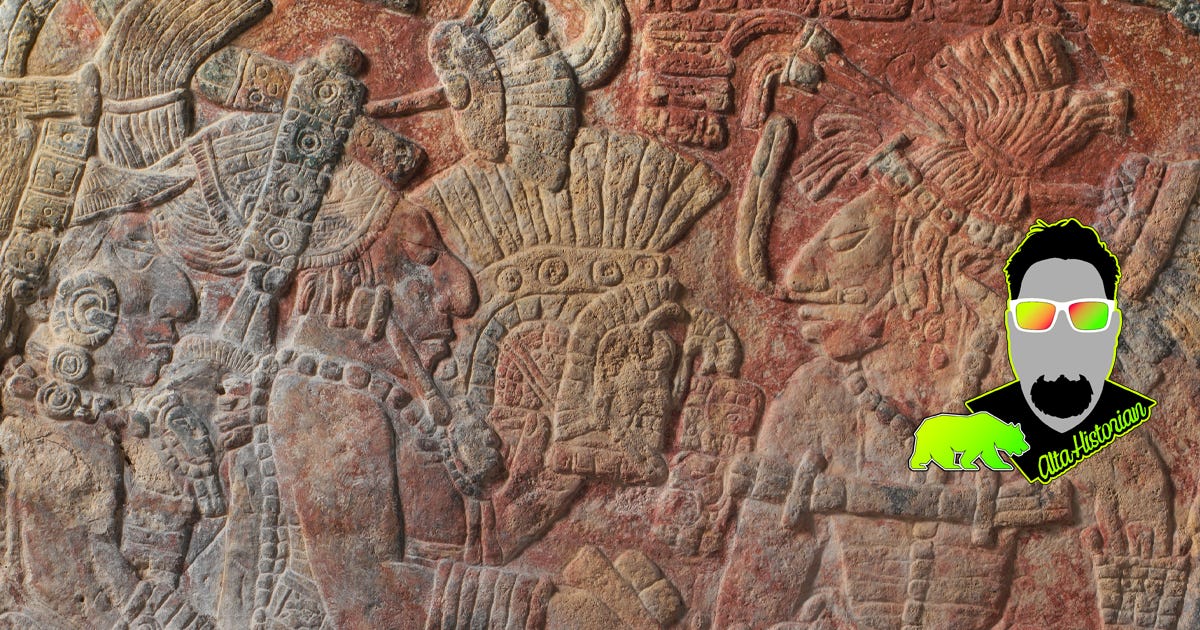
Estimated Date Range: c. 2600 BC – AD 1697
The rise of Maya civilization unfolded alongside other great Mesoamerican powers — contemporaneously with Teotihuacan, the Maya world gradually took shape, rooted in agriculture long before monumental cities dominated the lowlands. By the first millennium BC, Maya communities were already cultivating corn, yams, and manioc, laying the subsistence foundation for what would become one of the most intellectually and architecturally sophisticated civilizations of the ancient Americas.
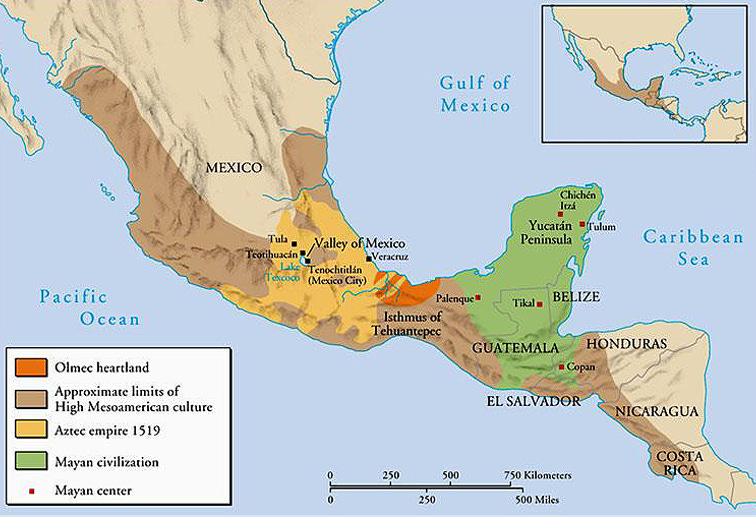
Agriculture was not merely sustenance — it was strategy. The Maya mastered the difficult environments of the lowlands through adaptive farming techniques, supporting dense populations across the Yucatán Peninsula and beyond. Cacao trees thrived in this system, and cacao beans became one of the most prized commodities in Maya society. Chocolate, consumed as a beverage by elites, was both a ritual and a luxury, while cacao beans themselves served as currency. The fruit of cacao was even fermented into beer, reinforcing its economic and ceremonial value. Obsidian, sourced through long-distance trade, was equally vital, supplying blades, tools, and weapons that the Maya could not produce locally — but also expanded their geopolitical footprint.
Maya society was overwhelmingly agrarian. Most people were farmers, while political and religious authority was concentrated in the hands of rulers who claimed divine lineage. Maya religion was polytheistic, its deities often sharing traits with gods venerated across Mesoamerica. These beliefs were inscribed into the urban form itself. Maya cities were organized around ceremonial cores dominated by pyramids, each surmounted by shrines that linked earthly space with the divine realm.
Writing distinguished the Maya sharply from many of their contemporaries. Their hieroglyphic script recorded dynasties, rituals, wars, and cosmic events. A specialized class of scribes maintained these records on deerskin and bark-paper codices. Tragically, most of these texts were destroyed during the Spanish conquest, burned as heretical remnants of a pagan past — leaving stone inscriptions and architecture as the primary voices of Maya history.
By around 600 BC, the central and northern Maya lowlands experienced dramatic population growth. Hundreds of settlements — from Palenque in the west to Altun Há in the east, and from Uxmal (ooSH-MAHL) in the north to Copán in the south — filled the landscape. More than sixty independent kingdoms emerged, each ruled by a k’uhul ajaw (KOO-hool ah-HOW), a “divine lord” whose authority fused political power with sacred obligation.
Competition between these kingdoms was relentless. Rivalry over land, trade routes, tribute, and prestige fueled both warfare and diplomacy. Yet this competition also produced an extraordinary flowering of art and architecture. Regional styles multiplied, monuments proliferated, and Maya cities became visual declarations of power, legitimacy, and cosmic order.
Maya architectural ambition is perhaps best exemplified at Tikal. Between roughly 200 BC and AD 200, Maya architects across the northern Petén constructed broad, low temples with expansive staircases flanked by massive stucco masks. These masks — built from plaster made of burned limestone and modeled over stone frameworks — represented deities and mythological forces, transforming architecture into cosmology made visible.
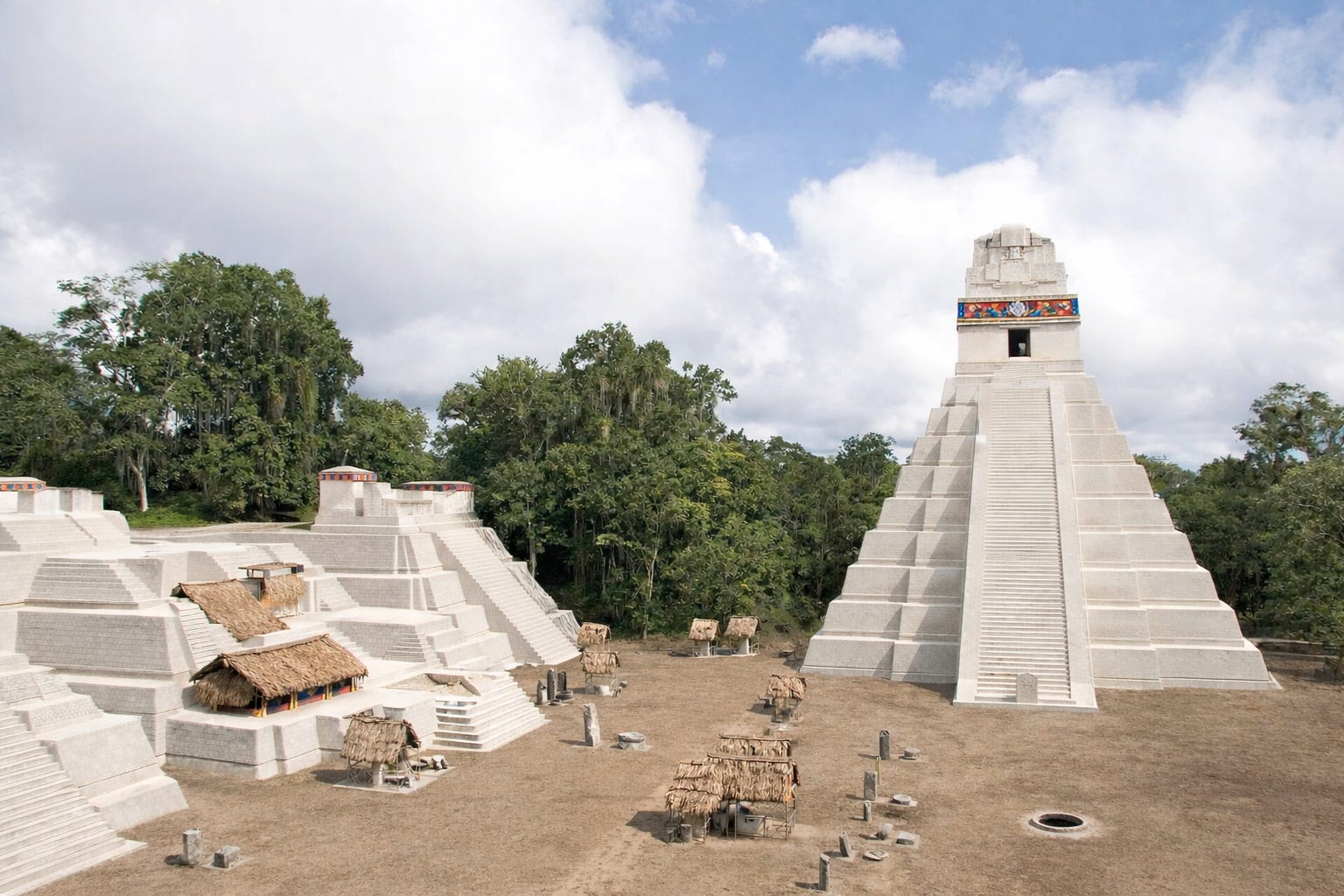
At nearby Uaxactún (wah-shahk-TOON), the pyramid known as Temple E-VII-Sub featured four stairways, each flanked by monumental stucco masks. Together with three adjacent pyramids, it formed a deliberate architectural pattern, likely tied to astronomical observation. Maya architecture was never arbitrary; orientation, repetition, and alignment encoded time, ritual, and cosmic movement.
The North Acropolis of Tikal grew over the centuries into a dense complex of more than 100 temples, layered atop vast stone platforms. As generations passed, temples became taller and more massive, their sacred precincts increasingly remote and imposing. Within this architectural heart, Maya rulers were buried in vaulted tombs adorned with murals and filled with grave goods — jade ornaments, elegant ceramics, and objects of bone, shell, obsidian, and pearl. Architecture thus served both the living and the dead, binding dynastic memory to sacred space.
Among the most renowned Maya rulers was Pakal the Great, who ruled Palenque from AD 615 to 683. Ascending the throne at a young age, Pakal reigned for nearly seven decades, overseeing monumental construction and political stabilization. Upon his death, he was interred in the Temple of the Inscriptions, his tomb among the most spectacular ever uncovered in the ancient Americas — a testament to the fusion of rulership, architecture, and cosmic symbolism.
Maya society was rigidly stratified. Nobles inherited status through lineage, were literate, and occupied positions as rulers, priests, administrators, military leaders, tribute collectors, cacao plantation managers, and trade expedition leaders. Commoners farmed, labored, and served, generally living outside ceremonial centers. Though upward mobility was possible — particularly through military service or skilled craftsmanship — commoners were barred from noble dress and luxury goods.
Below them were serfs and slaves. Slavery in Maya society was complex and widespread. Individuals could become enslaved through debt, crime, warfare, or even marriage. Slaves were bought, sold, sacrificed, or buried alongside elite owners to continue service in the afterlife. Yet slavery was not hereditary — the children of slaves were born free, a distinction that complicates modern assumptions about ancient servitude.
By the early ninth century AD, the political order of the southern lowlands began to unravel. Warfare intensified, alliances fractured, and overuse of land strained agricultural systems. Internal revolt, environmental stress, and natural disasters compounded the crisis. Around AD 800, dynasties in the central region collapsed. Populations declined sharply. By AD 900, major centers such as Tikal were abandoned, never to be reoccupied at their former scale.
The northern Maya centers, however, followed a different trajectory. They remained vibrant, evolving into new cultural expressions such as the Puuc tradition (ca. AD 700–950) and later interacting with Toltec influences (ca. 950–1000 CE). In the south, Maya traditions blended into increasingly Mexicanized cultures between AD 800 and 1200.
The shadow of Teotihuacan loomed large — one of the most impressive local cultures near the Maya, they were more than a trade partner — evidence suggests diplomacy, elite intermarriage, migration, and possibly military intervention. At its height, this immense city housed up to 200,000 inhabitants and featured a meticulously planned urban grid anchored by the Avenue of the Dead, the Pyramid of the Moon, and the Pyramid of the Sun. Its apartment compounds — some housing over one hundred residents — were unparalleled in Mesoamerica. As Teotihuacan declined after AD 650 and collapsed around AD 800, its people dispersed.
Some of these migrants were absorbed into Maya cities, particularly Tikal, which rose to prominence around AD 500 and became one of the greatest Maya capitals. New ideas in warfare, ritual practice, the treatment of captives, and human sacrifice accompanied this transformation. Yet despite moments of dominance, the Maya never formed a unified empire. At the time of Spanish contact, the Yucatán alone contained eighteen independent Maya states.
The Maya world did not end — it transformed. Cities fell, dynasties collapsed, but people endured. Their descendants remain, speaking Maya languages, practicing traditions shaped by millennia of history. The Maya were not a civilization extinguished, but one continually reshaped — by environment, rivalry, belief, and time itself.

Bibliography | Notes
Diehl, Richard A. The Maya: An Introduction. London: Thames & Hudson, 2011.
Durán, Diego. The History of the Indies of New Spain. Translated by Doris Heyden. Norman: University of Oklahoma Press, 1994.
Khan Academy. “Palenque, Classic Period.” Accessed [insert access date].
https://www.khanacademy.org/humanities/art-americas/early-cultures/maya/a/palenque-classic-period.
Metropolitan Museum of Art. “The Mesoamerican Ballgame.” Heilbrunn Timeline of Art History. https://www.metmuseum.org/toah/hd/mball/hd_mball.htm.
OpenStax. World History, Volume 1. Houston: OpenStax, Rice University.
https://openstax.org/details/books/world-history-volume-1.
Schele, Linda, and David Freidel. A Forest of Kings: The Untold Story of the Ancient Maya. New York: William Morrow, 1990.
Sharer, Robert J., and Loa P. Traxler. The Ancient Maya. 6th ed. Stanford, CA: Stanford University Press, 2006.
Tarlton Law Library. “Aztec and Maya Law.” University of Texas School of Law.
https://tarlton.law.utexas.edu/aztec-and-maya-law.
YouTube. This Ancient Mayan City Was Home to a Legendary King.
YouTube. The Maya Civilization Explained.