

The Monroe Doctrine
Primary Sources with Annotations

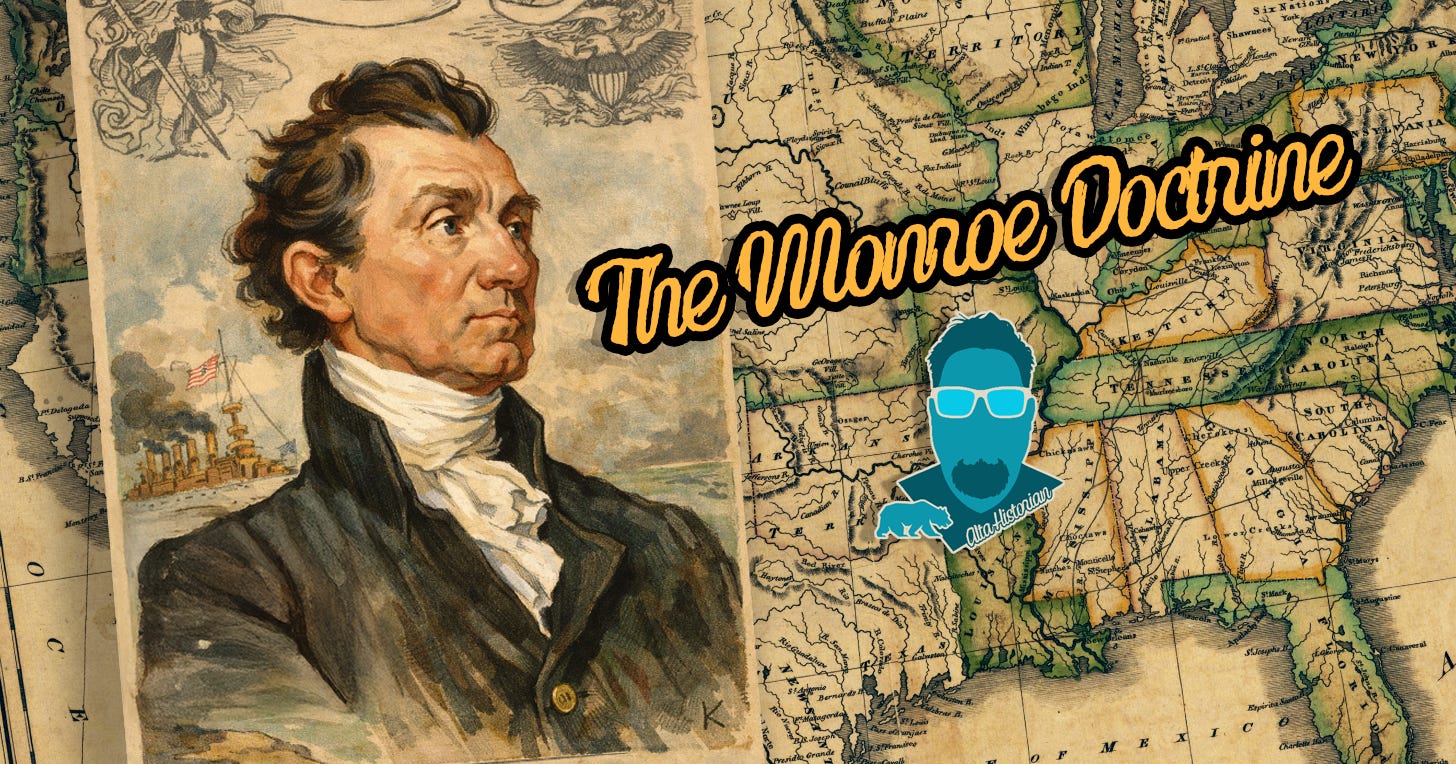
Context of Monroe
On December 2, 1823, President James Monroe (1758-1831) was the last of the “Founding Fathers” to serve as President of the United States. An understudy of Thomas Jefferson and a soldier of the Continental Army wounded in the Battle of Trenton, Monroe served under Madison as Secretary of State and Secretary of War.
Monroe’s presidency marked a pause in America’s party polarization, labeled the “Era of Good Feelings,” yet the same issues persisted. The antebellum debates between free and slave states, arguments of republican restraint to the expansion of federal authority, and the brewing of American nationalism after the War of 1812.
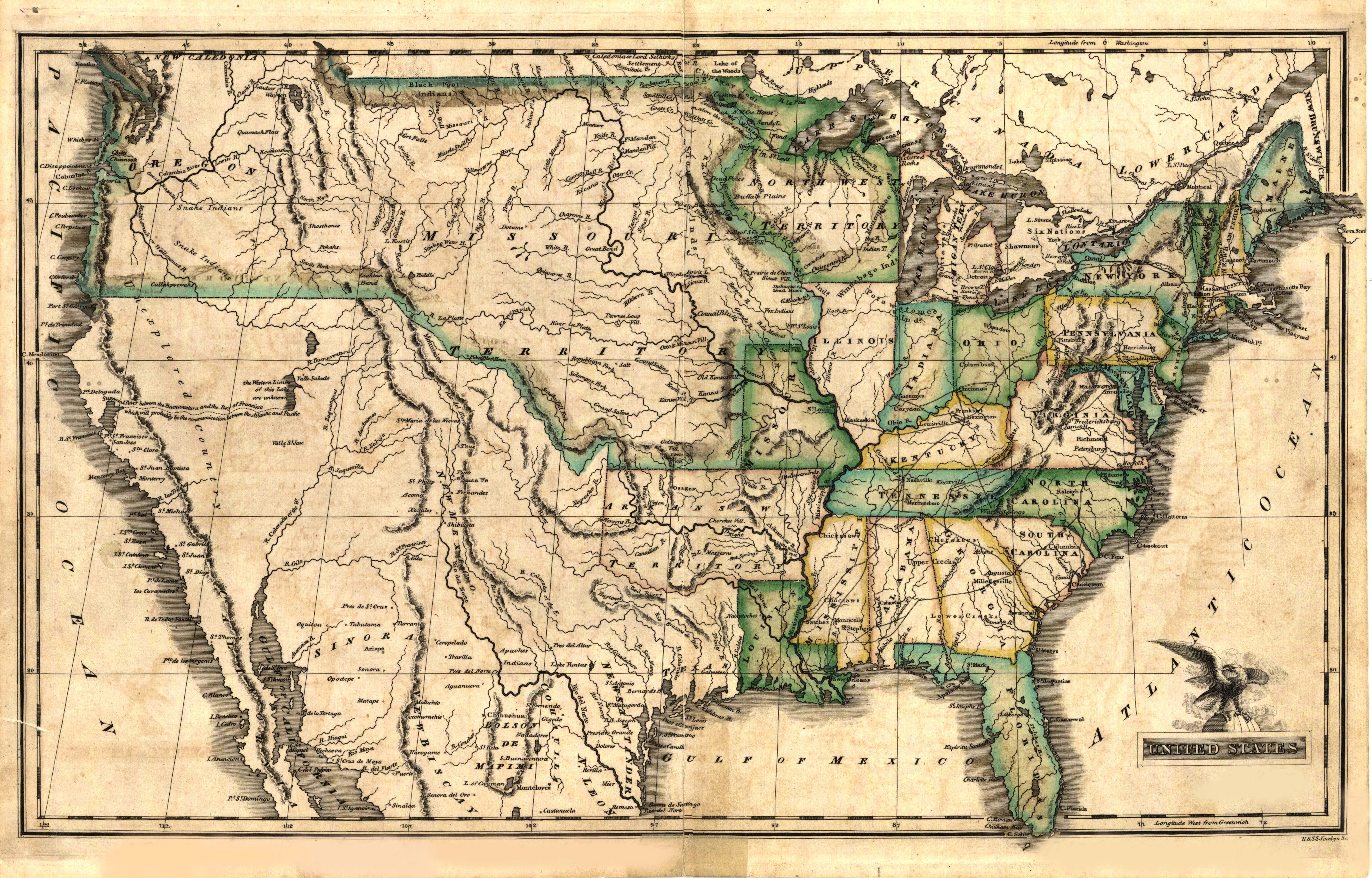
During Monroe’s presidency, there were persistent feelings of westward expansion, the Adams-Onís Treaty (1819) that quietly defined North American borders, and the confirmation of the U.S.’s commitment to continental expansion. There was the Missouri Compromise (1820), admitting Missouri as a slave state and Maine as a free state, while defining the 36°30′ line dividing future slave and free territories.
Monroe knew the moral and political problems posed by slavery, as did Jefferson. Monroe was an advocate for the relocation of freed slaves to Liberia, one of the many attempts to stop a slave uprising against the American Republic. Jefferson attempted to ban slavery in all new western territories after 1800 with his Ordinance of 1784, which failed by one vote in Congress. Had Jefferson’s proposal passed, the entire West would have been free of slavery, leaving power heavily tilted to the free states, and perhaps stopping the Civil War before it started. With examples of successful slave rebellions that overthrew power in Haiti and Latin America, Monroe understood he could not allow Europeans to use the rest of the hemisphere to leverage against the United States.
This brings us to perhaps the most well-known aspect of Monroe’s presidency: the Monroe Doctrine (1823). Simply put, it sought to prevent European colonization of Latin America and to prevent European powers from interfering in the Western Hemisphere. This asserted U.S. opposition to European political systems and became a cornerstone of U.S. foreign policy in the Americas.

My Theory on the Doctrine
My theory on the Monroe Doctrine is that one of its aims was to prevent European powers from leveraging Latin American countries and their emerging independence movements — many of which carried anti-slavery implications, whether explicitly stated or not. The United States attempted to remain neutral in the conflicts between Spain and Simón Bolívar’s liberation movement, but this neutrality was not experienced as neutral by those fighting for independence.
In an 1818 letter to an American agent, Baptis Irvine, Bolívar writes:
“The doctrine cited by Vattel, which is without doubt the most liberal for neutral parties, not only offers powerful support to the justice of Venezuela’s conduct in the condemnation of the sailing ships Tigre and Libertad. It also prompts me to recall events I would prefer to forget so as not to have to lament them. I refer to the conduct of the United States of North America with respect to the independents of South America and to the strict laws promulgated for the purpose of preventing any kind of aid that we might have sought there.”
Bolívar is referencing the work of Emmerich de Vattel (1714–67), most notably The Law of Nations (1758), in which Vattel applied the law of nature to nations. At the core of this doctrine is the idea that independent states have the right to govern themselves free from external interference, and that outside powers may not intervene without cause, making non-intervention the default position of international law.
But Bolívar’s frustration points to the limits of American neutrality. With the internal threat of slave rebellion within the United States, the visible example of successful emancipation movements elsewhere in the hemisphere, and the continued European desire to reestablish itself in the Western Hemisphere, neutrality could only go so far. The Monroe Doctrine gave the United States cause to intervene against European power in the Americas, while simultaneously justifying restraint — and selective recognition — toward the new republics forming to the south.
In his message to Congress, Monroe effectively turned neutrality into authority. The Western Hemisphere was granted autonomy from Europe, but the United States placed itself in the position of arbiter — political, economic, and ultimately moral — of that new hemispheric order.
The Monroe Doctrine
President Monroe delivered the now-famed doctrine at the seventh annual message to Congress, December 2, 1823:
...At the proposal of the Russian Imperial Government, made through the minister of the Emperor residing here, a full power and instructions have been transmitted to the minister of the United States at St. Petersburg to arrange by amicable negotiation the respective rights and interests of the two nations on the northwest coast of this continent. A similar proposal has been made by His Imperial Majesty to the Government of Great Britain, which has likewise been acceded to. The Government of the United States has been desirous by this friendly proceeding of manifesting the great value which they have invariably attached to the friendship of the Emperor and their solicitude to cultivate the best understanding with his Government. In the discussions to which this interest has given rise and in the arrangements by which they may terminate the occasion has been judged proper for asserting, as a principle in which the rights and interests of the United States are involved, that the American continents, by the free and independent condition which they have assumed and maintain, are henceforth not to be considered as subjects for future colonization by any European powers. . .
It was stated at the commencement of the last session that a great effort was then making in Spain and Portugal to improve the condition of the people of those countries, and that it appeared to be conducted with extraordinary moderation. It need scarcely be remarked that the results have been so far very different from what was then anticipated. Of events in that quarter of the globe, with which we have so much intercourse and from which we derive our origin, we have always been anxious and interested spectators. The citizens of the United States cherish sentiments the most friendly in favor of the liberty and happiness of their fellow-men on that side of the Atlantic. In the wars of the European powers in matters relating to themselves we have never taken any part, nor does it comport with our policy to do so. It is only when our rights are invaded or seriously menaced that we resent injuries or make preparation for our defense. With the movements in this hemisphere we are of necessity more immediately connected, and by causes which must be obvious to all enlightened and impartial observers. The political system of the allied powers is essentially different in this respect from that of America. This difference proceeds from that which exists in their respective Governments; and to the defense of our own, which has been achieved by the loss of so much blood and treasure, and matured by the wisdom of their most enlightened citizens, and under which we have enjoyed unexampled felicity, this whole nation is devoted. We owe it, therefore, to candor and to the amicable relations existing between the United States and those powers to declare that we should consider any attempt on their part to extend their system to any portion of this hemisphere as dangerous to our peace and safety. With the existing colonies or dependencies of any European power we have not interfered and shall not interfere. But with the Governments who have declared their independence and maintain it, and whose independence we have, on great consideration and on just principles, acknowledged, we could not view any interposition for the purpose of oppressing them, or controlling in any other manner their destiny, by any European power in any other light than as the manifestation of an unfriendly disposition toward the United States. In the war between those new Governments and Spain we declared our neutrality at the time of their recognition, and to this we have adhered, and shall continue to adhere, provided no change shall occur which, in the judgement of the competent authorities of this Government, shall make a corresponding change on the part of the United States indispensable to their security.
The late events in Spain and Portugal shew that Europe is still unsettled. Of this important fact no stronger proof can be adduced than that the allied powers should have thought it proper, on any principle satisfactory to themselves, to have interposed by force in the internal concerns of Spain. To what extent such interposition may be carried, on the same principle, is a question in which all independent powers whose governments differ from theirs are interested, even those most remote, and surely none of them more so than the United States. Our policy in regard to Europe, which was adopted at an early stage of the wars which have so long agitated that quarter of the globe, nevertheless remains the same, which is, not to interfere in the internal concerns of any of its powers; to consider the government de facto as the legitimate government for us; to cultivate friendly relations with it, and to preserve those relations by a frank, firm, and manly policy, meeting in all instances the just claims of every power, submitting to injuries from none. But in regard to those continents circumstances are eminently and conspicuously different.
It is impossible that the allied powers should extend their political system to any portion of either continent without endangering our peace and happiness; nor can anyone believe that our southern brethren, if left to themselves, would adopt it of their own accord. It is equally impossible, therefore, that we should behold such interposition in any form with indifference. If we look to the comparative strength and resources of Spain and those new Governments, and their distance from each other, it must be obvious that she can never subdue them. It is still the true policy of the United States to leave the parties to themselves, in hope that other powers will pursue the same course....
Bibliography | Notes
Bolívar, Simón. El Libertador: Writings of Simón Bolívar. Translated from the Spanish by Frederick H. Fornoff. Edited with an introduction and notes by David Bushnell. New York: Oxford University Press, 2003. Irvine Letter, p. 156-157.
Map of the United States. Engraved by N. & S. S. Jocelyn. New Haven: N. & S. S. Jocelyn, 1823. Engraved map, 24 × 42 cm. Outline hand color. Scale approximately 1:11,300,000. Mary B. Ansari Map Library, University of Nevada, Reno. Accessed [insert access date]. http://contentdm.library.unr.edu/cdm4/item_viewer.php?CISOROOT=/hmaps&CISOPTR=1971&REC=5.
Monroe, James. Message of President James Monroe at the Commencement of the First Session of the Eighteenth Congress (The Monroe Doctrine), December 2, 1823. National Archives and Records Administration. https://www.archives.gov/milestone-documents/monroe-doctrine.
Vattel, Emer de. The Law of Nations (1758). National Constitution Center. Accessed January 5, 2026. https://constitutioncenter.org/the-constitution/historic-document-library/detail/emmerich-de-vattelthe-law-of-nations-1758.