

The Northern Colonies of North America
United States | The Reformation did not begin in America. It began in protest.

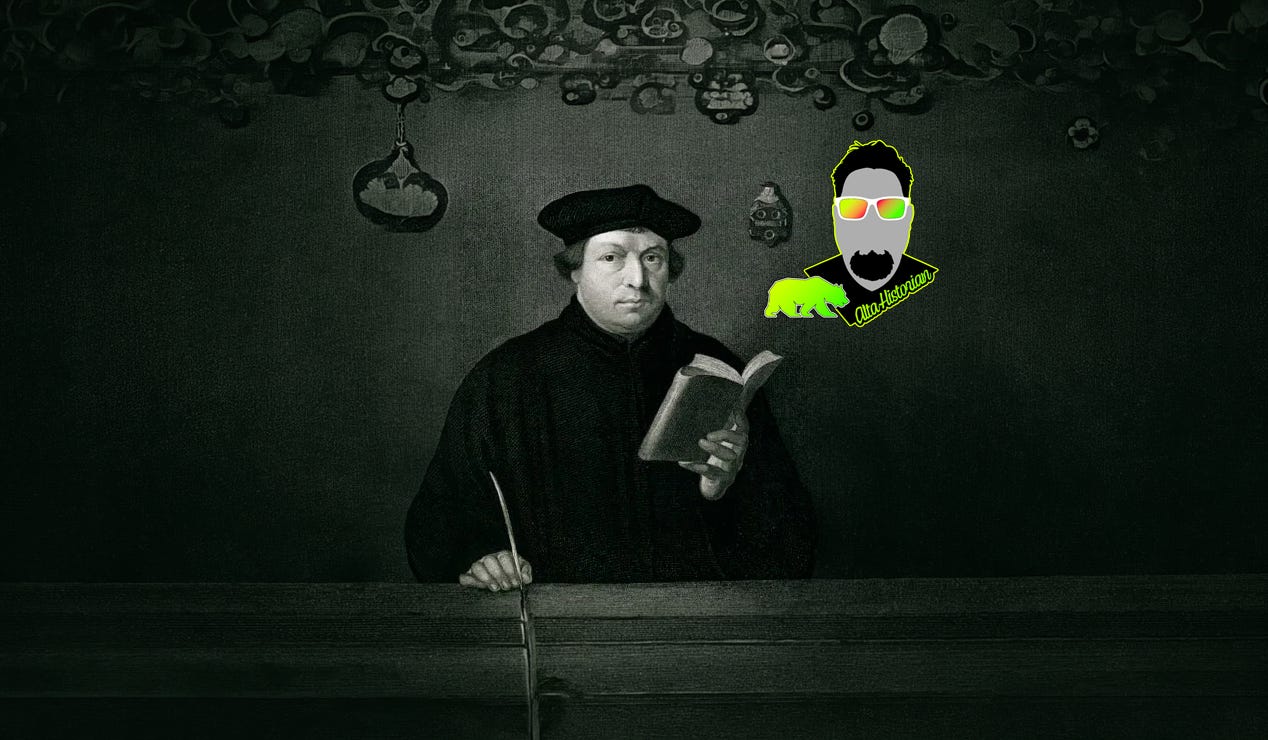
The Reformation did not begin in America. It began in protest — a protest not merely against indulgences, but against authority itself. When Martin Luther questioned Catholic dogma, he did more than quarrel with Rome; he fractured Christendom. The Protestant Reformation of the sixteenth century was not only theological. It was political, social, and psychological. It unsettled the hierarchy. It sanctified dissent. It invited ordinary believers to interrogate inherited power.
In England, the break with Rome did not originate in doctrine but in dynastic necessity. In 1534, Henry VIII initiated the English Reformation. Parliament passed the Act of Supremacy, declaring the king head of the Church of England and outlawing papal authority. Yet Henry remained, in belief, largely orthodox Catholic. The rupture was institutional before it was theological — authority displaced before conscience reformed.
After Henry’s death in 1547, Protestantism fluctuated. Under James I and Charles I, Puritan reformers found little sympathy. Neither monarch welcomed further purification of the Church of England.
Puritans were Protestants who demanded more than separation from Rome. They called for genuine reformation — a purified church grounded in Scripture and disciplined morality. They were less a centralized movement than a moral insistence. They appealed to dissenting members within the Church of England, urging reform from within.
Some lost patience. The Pilgrims embraced separatism. Judging the Church of England irredeemably corrupt, they withdrew entirely. In 1608, they relocated to Holland seeking religious refuge. But exile bred anxiety. Leaders feared their children would lose English identity and religious discipline.
William Bradford emerged as their central figure. He believed America promised protection for their children’s piety. The group obtained permission to settle in the territory granted to the Virginia Company.
In August 1620, 102 passengers boarded the Mayflower. After eleven weeks at sea, they arrived not in Virginia but off the coast of present-day Massachusetts. Outside the Virginia Company’s jurisdiction, they confronted the possibility of disorder.
They answered with a covenant. In 1620, they drafted the Mayflower Compact — an agreement to form a civil body politic for order and security. Legitimacy would rest not on inherited authority but on mutual consent. Plymouth followed. Bradford was elected governor.
The first winter cut the population in half.
In the spring of 1621, the Wampanoag intervened. Squanto taught the settlers to grow corn and fish effectively. In the fall, they marked survival with a feast later remembered as Thanksgiving. Plymouth did not flourish rapidly. It struggled to attract large numbers of English Puritans.
Events in England altered the trajectory. In 1629, Charles I dissolved Parliament — which included significant Puritan representation — and began aggressive anti-Puritan policies. Faced with marginalization and repression, many chose emigration. The largest migration flowed to New England.
In 1629, Puritan merchants and gentlemen secured a royal charter for the Massachusetts Bay Company. The grant extended into what would become New Hampshire, Vermont, Maine, and upstate New York. Crucially, the company’s government could reside in the colony itself rather than in England.
A corporate charter became a political experiment.
John Winthrop, a prosperous lawyer, was elected governor by the stockholders. In 1630, aboard the Arabella, he delivered a sermon later remembered as “A Model of Christian Charity.” He described the colony as a “City upon a Hill.”
The phrase was not boastful. It was cautionary.
Winthrop argued that the Puritan community had entered into a covenant with God. Their conduct — charitable or cruel, disciplined or corrupt — would stand before the world. Failure would make them a spectacle. New England emerged not as a plantation society but as a covenant community.
Calvinist theology infused its structure: the sovereignty of God, the depravity of man, the necessity of discipline, and the visibility of grace through conduct. Church membership required evidence of conversion. Civic participation intertwined with religious standing.
Unlike the Chesapeake, shaped by land abundance and labor scarcity, New England organized around towns, congregations, and communal discipline. Economic life diversified — fishing, trade, and small-scale agriculture. Social order rested less on a single export than on moral conformity.
Strict moral codes governed daily life. Fines punished Sabbath-breaking — working, traveling, even playing a flute. Religious wedding ceremonies were outlawed. Elaborate clothing and finery were prohibited.
The General Court comprised company stockholders, known as freemen, who met to make laws for the company’s affairs. In 1631, freemen and “inhabitants” were distinguished. All male church members were freemen and could vote for governor, deputy governor, and colonial officials. Other men were “inhabitants” and could vote, hold office, and participate fully in town government. Town meetings chose selectmen and administered local affairs.
This was a level of popular participation unprecedented elsewhere. Almost every adult man could speak and vote — though women were prohibited from voting.
Land distribution ranked among the most important functions of the town. Land was more or less equally apportioned — unlike the Chesapeake. Founders divided the land among themselves and the newcomers they admitted. Town layouts encouraged settlers to look inward toward neighbors.
The Reformation, born in protest, matured in covenant.
If Virginia wrestled with survival and profit, New England wrestled with purity and purpose. If the Chesapeake evolved through labor and land, Massachusetts Bay evolved through theology and self-government.
Both called themselves English. Yet they were becoming something else — one grounded in tobacco and servitude, the other in covenant and watchfulness. Between them, the outline of a divided America began to take shape.
Puritans, like those in the Chesapeake, required Native displacement to satisfy their appetite for land. The Pequot stood in the way of southern Connecticut and Rhode Island. The murder of a white trader became a pretext.
As Massachusetts Bay expanded into Connecticut, conflict with the Pequots intensified, centered on the Thames River. In spring 1637, after 13 English colonists and traders had been killed — many white traders, at least one an Indian kidnapper — Governor John Endecott organized a large military force to punish the Natives.
On April 23, 1637, 200 Pequot warriors retaliated, attacking a Connecticut settlement, killing 6 men and 3 women, and taking 2 girls captive.
On May 26, 1637, two hours before dawn, Puritans and their Indian allies marched on the Pequot village at Mystic. Under Captain John Mason near Long Island Sound, they burned and massacred between 400 and 700 Pequot women, men, and children — estimates range from 400–700, with most scholars agreeing on the higher end. Terror was deliberate. Francis Jennings interpreted Mason’s strategy as avoiding direct combat with warriors, thereby sparing his unseasoned troops; massacre achieved destruction with less risk.
On June 5, 1637, Mason attacked another village near present-day Stonington; its inhabitants were defeated and massacred. On July 28, 1637, a third massacre occurred near present-day Fairfield. The Pequot War ended. Survivors were sold into slavery; a few escaped to join other tribes.
Natives learned harsh lessons: English pledges bent before advantage; English warfare knew little scruple or mercy; Native weapons faltered against European arms.
From this emerged a distinct “western way of war.” The English relied not on large professional armies but on militias — men maintaining their own firearms and powder. Communities purchased heavier weapons with public funds. Volley fire shattered morale; Native shock combat was adapted.
Equality between commanders and troops encouraged both free exchange and insubordination. The American landscape hardened men. Abundant game and constant violence trained riflemen on the frontier into some of the world’s best marksmen. All men 16 to 60 served without pay, ready on short notice. In the Pequot War, this system proved devastating.
Massachusetts Bay and Winthrop justified the seizure of land through Scripture. Natives, they argued, had not “subdued” the land; they possessed a “natural right” but not a “civil right.” They cited Psalms 2:8:
“Ask of me, and I shall give thee, the heathen for thine inheritance, and the uttermost parts of the earth for thy possession.”
They invoked Romans 13:2:
“Whoever therefore resisteth the power, resisteth the ordinance of God: and they that resist shall receive to themselves damnation.”
Over forty years later, in 1675, King Philip’s War erupted across Chesapeake and New England. The Wampanoag stood in the way, trading land beyond Massachusetts Company control. Massasoit was dead. Wamsutta was dead. Metacom — later known as King Philip — became the chief.
A murder blamed on Metacom furnished an excuse. War followed — conquest for land. Some Englishmen refused to fight; not all Natives joined either side. Atrocity answered atrocity.
Restraint gave way to annihilation. Colonists prevailed but were drained: about 600 men killed in battle; roughly 2,500 total English deaths from wounds, exposure, starvation — 5–10% of the population. Native losses reached 5,000 or more, perhaps half the regional Native population.
Aftermath left enduring hatred, large debt, devastated frontier.
The Middle Colonies began differently. In 1609, the Dutch commissioned Henry Hudson to seek the Northwest Passage. He failed but found the Hudson River and claimed modern-day New York. New Netherland emerged — vital to the Dutch empire. The Dutch West India Company, chartered in 1621, established colonies in Africa, the Caribbean, and North America. Manhattan became a strategic base.
Peter Minuit purchased Manhattan from the Manhate Indians for trade goods worth roughly a dozen beaver pelts. New Amsterdam became the trading center.
Immigration remained limited but diverse. Religious and ethnic variety exceeded that of New England and the Chesapeake. The West India Company denied representative government, breeding resentment.
The English demanded surrender. Governor Peter Stuyvesant yielded. The Duke of York permitted religious toleration — not out of devotion to conscience but out of recognition of heterogeneity.
He subdivided his grant. The land between the Hudson and Delaware became New Jersey. Disputes led proprietors to consult Quaker William Penn.
Penn resolved the quarrel and envisioned a Quaker colony. Quakers believed in an open, generous God whose love extended equally to all. Women held religious leadership. Such convictions clashed with English authority.
In 1681, Charles II granted Penn, Pennsylvania, partly to rid England of Quakers. Between 1682 and 1685, nearly 8,000 immigrants arrived. Diversity defined the colony — from England, Ireland, Wales, and continental Europe.
Peace with the Indians marked Penn’s policy. He insisted on fair purchase, respect, and even-handed dealing. Protestant sects and Roman Catholics found toleration. Voters and officeholders had to be Christians, but church attendance was not compelled, nor were taxes levied for a state church.
Penn enforced morality through civil government, stressing that the form of government mattered less than the character of those serving in it.
German migrants — “Pennsylvania Dutch,” from Deutsch — formed the largest continental group. Scots-Irish migrants, militant Presbyterians, clustered among kin. Many arrived just before the American Revolution as conditions at home worsened.
Redemptioners sold their labor to repay the cost of passage. Scots-Irish often indentured themselves before departure. Voyages were perilous; redemptioners typically served shorter terms than indentured servants.
By the 1760s, the Navigation Acts and colonial products created Atlantic mass markets. Prices fell. Ordinary colonists purchased mirrors, silver plates, spices, linens, tea services, and books. British exports to North America multiplied eightfold between 1700 and 1770. Credit expanded.
Consumption produced material uniformity across region and class. Colonists looked and felt more British. Consumption also nurtured individuality — power expressed through choice.
Almost all colonists were Protestants, yet faith splintered. Baptists and Presbyterians thrived in the Middle Colonies and the Southern Backcountry. Puritanism fragmented. Urban elites joined the Church of England. Some embraced deism, seeking God’s design in nature rather than Scripture. Enlightenment ideas encouraged inquiry. Philadelphia became a center of thought; the American Philosophical Society was formed in 1769.
Most colonists seldom attended church, yet called themselves Christians. Ministers, alarmed by indifference and rivalry, preached to the heart. The Great Awakening swept the colonies. George Whitefield visited seven times, drawing thousands. Revivals proclaimed that every soul mattered, that salvation could be chosen.
Each colony maintained a militia. Privateers sailed from every port. British forces bore the ultimate defense. Officials feared alliances between Indians and New Spain or New France.
The fur trade bound Indians and settlers. Empires competed; Indians balanced rivals. Violence always loomed. The Yamasee War of 1715 reminded all parties to prepare for the worst.
Before the 1760s, no coherent Indian policy prevailed. Indians were enemies, partners, allies — sometimes all at once.
New France was threatened from the north. Colonists valued English protection and feared Catholic encouragement of raids. King William’s War brought French attacks on New England and New York. The war ended inconclusively but underscored that the government meant military security.
The monarchy sought tighter control. After King Philip’s War, investigations concluded colonists had deviated from English rules. In 1684, the Massachusetts charter was revoked. In 1686, the Dominion of New England was formed under Sir Edward Andros.
The Glorious Revolution of 1688 reasserted Protestant power in England. Colonists rebelled in Massachusetts, New York, and Maryland. In 1689, they overthrew Andros and dismantled the Dominion. The crown soon restored authority.
In 1691, Massachusetts became a royal colony; landowners, not merely church members, could vote colony-wide.
By the 1700s, wealth was concentrated in Boston. By 1770, the richest 5% owned half the city’s wealth; the poorest two-thirds held less than one tenth. Yet, overall, colonists were better off than most in England — a contrast sharpened by shared ancestry.
By 1770, more than 15,000 slaves lived in New England — though the population remained 97 percent white.
The Reformation had begun as a protest. In America, it evolved into covenant, commerce, conquest, and contradiction. Out of dissent grew discipline. Out of discipline, ambition. And within that ambition — piety and violence, liberty and exclusion — the early architecture of American identity took form.

Bibliography | Notes
Act of Supremacy, 1534.
Bradford, William. Plymouth Colony leadership, 1620.
Foner, Eric, and John A. Garraty, eds. The Reader’s Companion to American History. Boston: Houghton Mifflin Harcourt Publishing Company, 1991.
Locke, Joseph L., and Ben Wright, eds. The American Yawp: A Massively Collaborative Open U.S. History Textbook. Vol. 1, To 1877. January 2019.
Massachusetts Bay Charter, 1629.
Mayflower Compact, 1620.
Roark, James L., Michael P. Johnson, Patricia Cline Cohen, Sarah Stage, and Susan M. Hartmann. The American Promise, Value Edition, Volume 1: To 1877. Bedford/St. Martin’s, 2014.
Schweikart, Larry, and Michael Allen. A Patriot’s History of the United States: From Columbus’s Great Discovery to the War on Terror. New York: Sentinel, 2004.
Winthrop, John. “A Model of Christian Charity,” 1630.
Zinn, Howard. A People’s History of the United States. New York: Harper & Row, 1980.
Luther, Martin. Protestant Reformation, sixteenth century.