

The Olmec
World Civilizations | Latin America

Estimated Date Range: c. 1500 BC – 400 BC
We do not know what the Olmec called themselves — in fact, their name comes from the Aztec language, the Nahuatl word meaning “rubber people” (ōlli meaning “rubber” and mēcatl meaning “people”). The Aztec people (who did not call themselves Aztec — that is an academic term created to avoid confusion with Mexica) knew the area with the Olmec ruins as a place to harvest rubber and make rubber balls, though the name was applied to the civilization by modern researchers, just as the Aztec name was.
The emergence of Olmec civilization along the Gulf Coast unfolded within an environment of extraordinary abundance and equally extraordinary constraint. The lowland river valleys of southern Veracruz and Tabasco were fertile, well-watered, and biologically rich. Corn and beans produced reliable surplus through bi-annual harvests, while the surrounding wetlands yielded fish, turtles, clams, and palm nuts in quantities sufficient to sustain early population growth. Yet this abundance lacked diversity. The Olmec heartland possessed neither obsidian for blades, nor salt for preservation, nor hard stone suitable for fine tools. What nature provided in volume, it withheld in variety.
This imbalance proved formative. The Olmec were compelled into long-distance exchange earlier and more intensively than many neighboring societies. Through trade networks that radiated across Mesoamerica, they acquired obsidian, jade, serpentine, mica, and volcanic stone, alongside feathers and salt, while exporting rubber, pottery, and agricultural surplus. Elite contexts reveal polished mirrors of ilmenite and magnetite — materials whose reflective qualities were not merely aesthetic but cosmological. These inventories are not incidental. They reveal an economy in which control of food enabled control of exchange, and control of exchange enabled political authority. An abundance of food was, quite literally, the definition of an abundance of wealth in many of these ancient societies — and the Olmec were no different.
Environmental mastery reinforced this authority. San Lorenzo’s strategic placement above flood-prone terrain allowed its rulers to tame seasonal volatility, stabilizing both agriculture and settlement. The iconography that emerged from these centers reflects this ecological mediation. Olmec rulers appear repeatedly as intermediaries between watery realms — inhabited by fish, alligators, and sharks — and the cultivated world of maize, cotton, and human fertility. Political power was thus framed not as coercion alone, but as the successful management of nature’s thresholds.
These same thresholds structured Olmec ritual life, nowhere more clearly than in the ballgame. Rubber balls recovered from the ritual site of El Manatí, dating to around 1600 BC, attest to the antiquity of the practice. The game was not a mere recreation. Players struck the heavy rubber ball with the trunks of their bodies rather than hands or feet, keeping it in near-constant motion. In some variations, teams attempted to pass the ball through stone rings mounted high along the ballcourt walls — in others, points were scored by striking markers set into the central playing alley or by crossing painted boundary lines on plastered floors. The physical discipline required, the ritualized space, and the relentless demand for motion transformed the game into a metaphor for cosmic balance and political order.
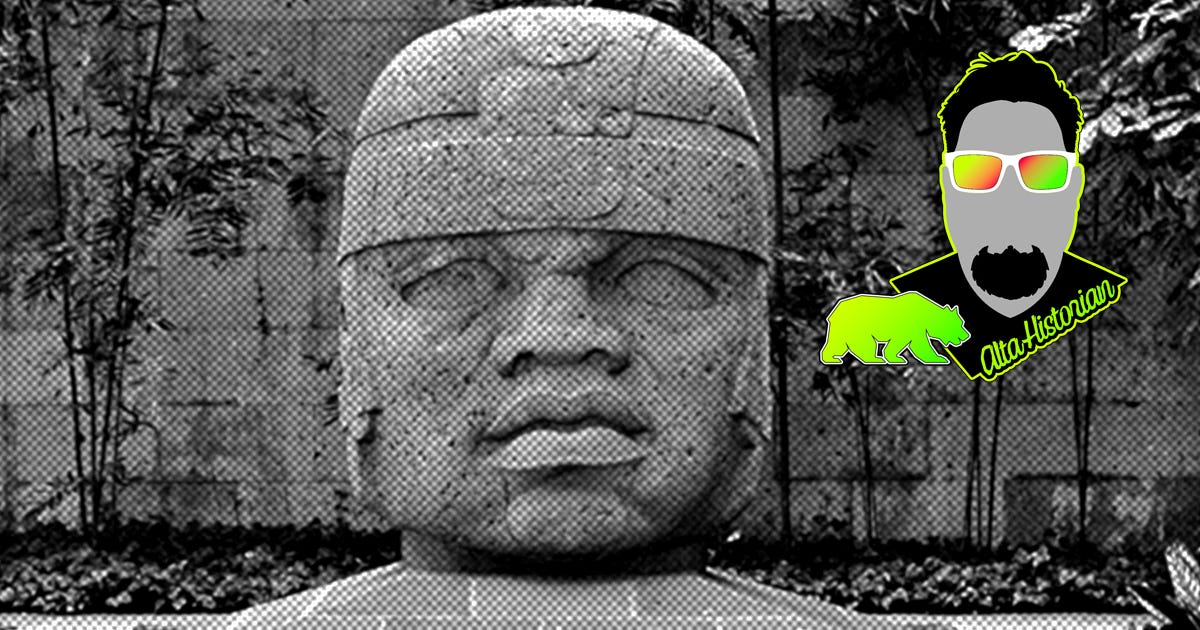
Sport, ritual, and art bled seamlessly into one another. Images of ballplayers appear across Olmec media, from small figurines to monumental sculpture. The colossal heads — carved from basalt and transported on balsa rafts along river systems — are frequently depicted wearing protective helmets. Whether these represent ballplayers, warriors, or ruler-athletes remains debated, but the symbolism is clear. The ballgame embodied strength, endurance, and sanctioned violence, qualities essential to leadership in a society that limited warfare yet depended upon displays of controlled force.
Monumental buildings amplified these messages. Earthen platforms, mud-plastered pyramids, stone-carved thrones, and expansive plazas at La Venta and San Lorenzo required immense labor investment. Such structures exceeded any purely functional need. They were gathering places for large, open-air ceremonies and settings for offerings that frequently emphasized the omnipresence of the jaguar deity. Buried jade caches, serpentine blocks, and ritual deposits point toward beliefs in cosmological renewal and an afterlife. Even in death, elites were positioned within a material vocabulary that fused environment, economy, and the supernatural.
In this light, Olmec civilization appears neither accidental nor inevitable. It arose from the disciplined exploitation of ecological abundance, the political management of scarcity, and the transformation of material exchange into symbolic authority. Fish, maize, rubber, jade, obsidian, mirrors, and monumental stone were not separate categories of life but components of a single system — one in which rulers governed by standing at the intersection of land and water, motion and stillness, earth and the sacred.

Bibliography | Notes
Bethell, Leslie, ed. The Cambridge History of Latin America. Vol. 1. Cambridge: Cambridge University Press, 2008.
Diehl, Richard A. The Olmecs: America’s First Civilization. London: Thames & Hudson, 2004.
Durán, Diego. The History of the Indies of New Spain. Translated by Doris Heyden. Norman: University of Oklahoma Press, 1994.
Khan Academy. “Palenque, Classic Period.” Accessed [insert access date]. https://www.khanacademy.org/humanities/art-americas/early-cultures/maya/a/palenque-classic-period.
Metropolitan Museum of Art. “The Mesoamerican Ballgame.” Heilbrunn Timeline of Art History. Accessed [insert access date]. https://www.metmuseum.org/toah/hd/mball/hd_mball.htm.
OpenStax. World History, Volume 1. Houston: OpenStax, Rice University. Accessed [insert access date]. https://openstax.org/details/books/world-history-volume-1.
World History Encyclopedia. “Olmec Civilization.” Accessed [insert access date]. https://www.worldhistory.org/Olmec_Civilization/.