

The Real Story of Pocahontas
United States History | The Founding of the Virginia Colony

On April 26, 1607, 144 English colonists arrived at the mouth of the Chesapeake Bay. They had crossed 3,000 miles of rough Atlantic in small, crowded ships with terrible food, sailing toward an unknown territory. More than half would die — from sanitation failures, disease, starvation, and conflict with Native peoples. They selected an uninhabited peninsula forty miles upriver on the James River — named for King James I — in present-day Virginia, itself named for Elizabeth I, the Virgin Queen.
The site appeared defensible. It lay upriver and out of sight of Spanish patrols. It offered protection against ground assaults. It was close to Indian villages and their potentially lucrative trade networks. But Indians had ignored the peninsula for two reasons: terrible soil that hampered agriculture, and brackish tidal water that produced debilitating disease.
Despite these setbacks, the English built Jamestown — the first permanent English colony in what would become the United States. They encountered what seemed an unlimited abundance of natural resources — land, fish, and the promise of liberation. There was a sense of greater freedom from Europe's rigid structure. Yet the appearance of abundance masked fragility.
The Virginia Company, a joint stock enterprise backed by London investors, operated under a land grant from King James I. The king sought territory that Spain could not defend. Investors hoped colonists would both consume English goods and produce commodities for export. In 1609, the company received a new charter, sold additional shares, and promised dividends.
But no charter altered geography.
The Powhatan empire, at the time of the colonists’ arrival, covered present-day eastern Virginia, extending from the Potomac River to the Great Dismal Swamp. Its capital stood at Werowocomoco. Powhatan had inherited rulership of six tribes from his father and, after succeeding him, incorporated roughly two dozen more. At the height of his authority, he ruled between 13,000 and 34,000 people.
In the Algonquian language, his title was mamanatowick. His territory was Tsenacommacah. Each tribe maintained its own chief — a weroance — but Powhatan ruled as chief of chiefs. He was an astute and energetic ruler — sometimes strict, occasionally cruel.
The Algonquian Indians attacked the colonists on their first night, demonstrating immediately that survival would require vigilance. The English faced threats from Indians and the Spanish alike — as well as disease and starvation. By September 1607, fifty colonists were dead.
Powhatan’s posture toward the English was ambivalent. At times, he ordered or permitted attacks. At other times, he traded corn for English metal tools — knives, axes, and pots. During the early years, he may have viewed the English as potential allies against his own enemies — the Monacan, Mannahoac, and Massawomeck tribes to the north and west. Native leaders understood something the English barely grasped: the strangers were not leaving.
Trade defined the early relationship. The English desperately needed corn. Natives preferred iron and steel tools. Powhatan himself rescued the colony at times by bringing corn for barter. Starving English settlers overcame their prejudice against corn.
Still, most settlers in Virginia went to an early grave.
Few farmers had come. Most settlers were gentlemen and their servants. They were ill-suited for agricultural labor. Meanwhile, the Powhatan chiefdom faced its own pressures. Contact spread deadly diseases. The settlers’ appetite for corn forced Native communities to increase agricultural production. Women performed most agricultural labor, so their burden intensified.
The winter exposed the illusion of English security.
Scientists have since uncovered evidence of cannibalism during Jamestown’s desperate months. As winter set in and supplies failed to arrive, bones bore knife marks. A fourteen-year-old girl’s skull revealed large gashes inflicted after death. The colony survived not through heroism but through degradation.
During these early exchanges, John Smith emerged as the principal English negotiator. In his dealings with Powhatan, each side engaged in a measured contest — a cat-and-mouse assessment of intentions and capabilities.
A speech attributed to Powhatan, addressed to Smith in 1607, captures the spirit — whether verbatim or not — of Native sentiment:
“I have seen two generations of my people die… I know the difference between peace and war better than any man in my country. I am now grown old, and must die soon; my authority must descend… I wish [my descendants] to know as much as I do, and that your love to them may be like mine to you. Why will you take by force what you may have quietly by love? Why will you destroy us who supply you with food? What can you get by war? We can hide our provisions and run into the woods; then you will starve for wronging your friends.
Why are you jealous of us? we are unarmed, and willing to give you what you ask, if you come in a friendly manner, and not so simple as not to know that it is much better to eat good meat, sleep comfortably, live quietly with my wives and children, laugh and be merry with the English, and trade for their copper and hatchets, than to run away from them, and to lie cold in the woods, feed on acorns, roots and such trash, and be so hunted that I can neither eat nor sleep. In these wars, my men must sit up watching, and if a twig break, they cry out ‘Here comes Captain Smith!’ So, I must end my miserable life. Take away your guns and swords, the cause of all our jealousy, or you may all die in the same manner.”
The English rarely learned Algonquian languages. Mutual distrust hardened.
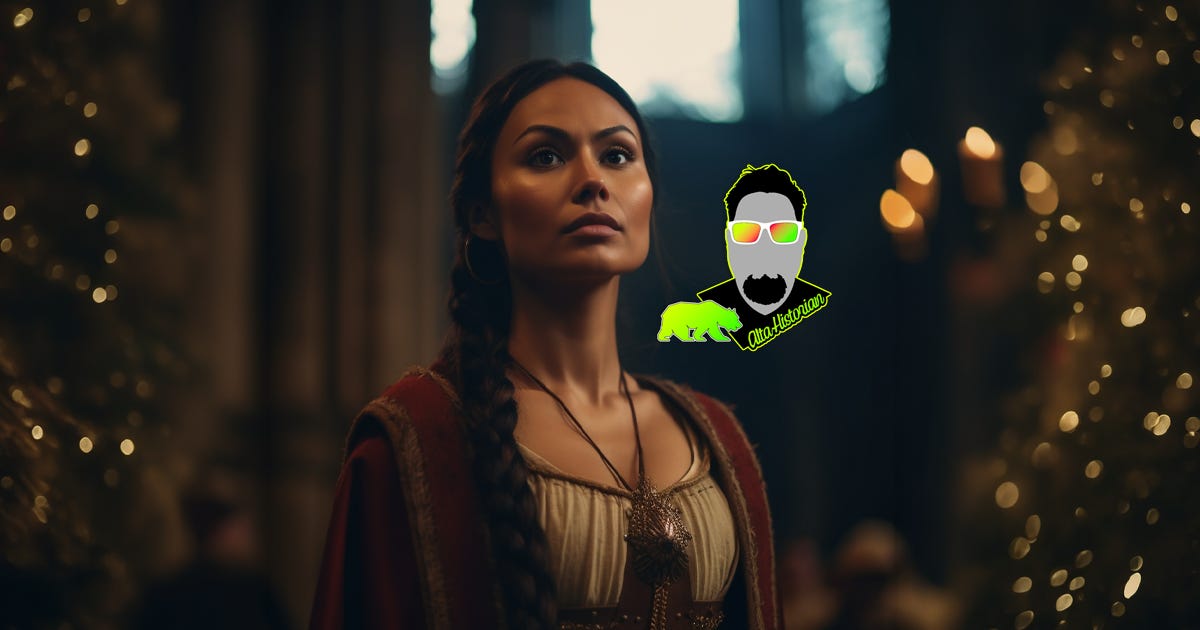
The figure later called Pocahontas — a nickname meaning “Little Wanton” or playful, merry little girl — was approximately twelve years old when the English arrived. Her proper name was Matoaka. She developed a fascination with the English settlement and became a frequent visitor to Jamestown, sometimes supplying food.
In 1607, John Smith was captured by Powhatan’s men. According to Smith’s later account, Pocahontas rescued him from execution. That rescue did not appear in his published accounts of 1608 and 1612. It surfaced in 1624 in his General History of Virginia, New England, & the Summer Isles. Doubts about its authenticity persist. Many historians interpret the episode as an adoption ceremony misunderstood by Smith — Powhatan symbolically incorporating him as a subordinate chief.
Whatever its precise meaning, relations temporarily improved.
When Smith returned to England, Pocahontas disappeared from English records. She may have married within her own people and resumed her proper name. Under Sir Thomas Dale, the English and Powhatan were again at war.
In 1609, the Virginia Company ordered colonists to present Powhatan with a royal crown and gifts — symbolizing his status as a prince in the service of King James I. Powhatan rejected the gesture. In Native political culture, gifts were given to the weak.
He cut off trade and attacked colonists who left the fort. Between 1609 and 1610, during the First Anglo-Powhatan War, some 80 percent of the colonists died. Powhatan laid siege to the fort during the winter of 1609–1610 — the “Starving Time.” Some English fled to join Powhatan, where food was available.
When spring came, the English demanded the return of the runaways. Powhatan refused. English soldiers retaliated. They attacked a Native settlement, killed fifteen or sixteen inhabitants, seized the queen and her children, threw the children overboard, and shot them in the water. The queen was later stabbed to death.
Jamestown nearly collapsed in 1610. Only the timely arrival of supply ships and new colonists saved it.
The English then adopted tactics learned from Elizabeth’s conquest of Ireland — terror as policy. They burned villages and executed women and children.
In the spring of 1613, Captain Samuel Argall captured Pocahontas by luring her aboard a ship and holding her hostage to force Powhatan’s submission. During captivity, she converted to Christianity under Reverend Alexander Whitaker and was baptized “Rebecca.”
In 1614, she married John Rolfe — a prominent colonist and recent widower. Powhatan grudgingly accepted a truce that lasted until 1622. The colony began to grow.
In 1616, the Virginia Company transported Rolfe, Pocahontas, their son Thomas (born 1615), and several other Natives to England. She was presented at court and met prominent figures. Her presence served as propaganda — proof of Anglo-Indian harmony and missionary success.
In March 1617, after boarding a ship for her return to Virginia, Pocahontas fell ill — likely from European diseases that had no American counterpart — and died. She was buried in Gravesend, England.
Soon after, Powhatan died. His brother Opechancanough assumed power.
Although John Smith portrayed Opechancanough as immediately hostile, he had earlier treated Smith well. As Powhatan aged, Opechancanough had increasingly filled the power vacuum. Upon Powhatan’s death in 1618, he wielded the greatest authority.
That same year, England instituted the Headright System — granting land to immigrants seeking tobacco fortunes. English settlements pressed upriver toward the fall line. Native leaders prepared resistance.
On March 22, 1622, Opechancanough launched a coordinated surprise assault on English settlements along the James River. The attack killed 347 colonists — nearly one-third of the English population. Men, women, and children died.
The Virginia Company issued a report written by Edward Waterhouse, describing the massacre as an attempt at “utter extirpation.” He labeled the Indians “beasts,” “without remorse or pity,” a “Viperous brood” of “hell-hounds” and “wicked Infidels.”
Opechancanough did not pursue total destruction. A ten-year conflict followed — the Second Anglo-Powhatan War (1622–1632). The English repeatedly targeted Native food supplies. After a 1624 battle, colonists claimed to have destroyed enough corn to feed 4,000 men for a year.
In 1624, King James I revoked the Virginia Company’s charter. Royal officials investigating the colony determined that deaths resulted more from disease and mismanagement than from Indian raids. Virginia became a royal colony. The king appointed a governor. Colonists continued electing members of the House of Burgesses, though their laws required royal approval.
The third Anglo-Powhatan War erupted in 1644. Opechancanough launched another assault. He was captured and later died in English custody in 1646.
Neither war halted English expansion. By the early eighteenth century, Native resistance failed to dislodge settlers but did intensify English violence. Many colonists came to regard Indians as perpetual enemies. The defeated Powhatan receded into distant memory. Popular writing would later diminish his military and diplomatic achievements.
Jamestown survived. But survival altered both worlds — irreversibly.

Bibliography | Notes
Foner, Eric, and John A. Garraty, eds. The Reader’s Companion to American History. Boston: Houghton Mifflin Harcourt Publishing Company, 1991.
Locke, Joseph L., and Ben Wright, eds. The American Yawp: A Massively Collaborative Open U.S. History Textbook. Vol. 1, To 1877. January 2019.
Roark, James L., Michael P. Johnson, Patricia Cline Cohen, Sarah Stage, and Susan M. Hartmann. The American Promise, Value Edition, Volume 1: To 1877. Bedford/St. Martin’s, 2014.
Schweikart, Larry, and Michael Allen. A Patriot’s History of the United States: From Columbus’s Great Discovery to the War on Terror. New York: Sentinel, 2004.
Smith, John. General History of Virginia, New England, & the Summer Isles. 1624.
TIME. “Cannibalism at Jamestown: Listening to the Bones.” YouTube video, published May 4, 2013.
Virginia Company Charter, 1609.
Waterhouse, Edward. Virginia Company Report, 1622.
Zinn, Howard. A People’s History of the United States. New York: Harper & Row, 1980.