

Preface
This series is meant to be an autobiography — a blend of history and pop culture from a millennial’s perspective. It is serious, but not too serious, and it is an attempt to teach republicanism (small “r,” not the party), while also exploring California through the lens of the Republican Party. Why? Let me explain.
First, I tried to put out more polished content that is, for me, harder to produce. This style is my native form, and fun, which is the entire point. My best buddy Lopez and I talked about doing something similar in 2012, but we never got going — too many hours touring every diner in Los Angeles, one time sitting between C-Lo Green and Ron Jeremy at Mel’s Diner in the wee hours of three in the morning. It felt like a simulation.
So let me introduce you to the situation we have here.
I am a professor, both before and after AI and COVID, in the era of The Donald, where the world has flipped upside down. It is a remarkable timeline, this millennial experience, and I’ve found my way to these parts almost by accident.
First. Why does the professor part matter?
I want to say this: I’ve always used the em dash. I like it — “I like it A-LOT” — and AI may take my job but it is not taking my em dash.
Back to it — I am one of those professors who assigns lots of reading and writing — usually more than most — because I believe there is value in writing it out. Don’t worry, I’m an easy(ish) grader, because the point is improvement. I impose this upon my students: work to better your best work and follow the directions (FTD).
Through this process, I’ve had a window into the minds, viewpoints, and interpretations of thousands upon thousands of students. What I often see is a diary of inner dialogue.
“It’s the best!”
Jack Black as a Mexican priest in Nacho Libre (2006). Could you imagine that today? Don’t even speak of Tropic Thunder (2008).
In the age of AI, it is less frequent that I have a window into young and curious souls. Literacy is the only way to read the writing on the wall — dominance of a person comes through illiteracy — socially, spiritually, psychologically, biologically, politically, financially — literally, keep them illiterate, keep them poor. And do the same with math! (see the results with UC San Diego Freshmen) — but why do I believe so much in literacy in all things? Because I owe all my humble success to it! Now not everything is right for everyone, but what is the alternative?
It feels that illiteracy is the unspoken agenda. Now, when I read papers, I often feel cold, smooth metal — perfectly organized, predictable words, neatly ordered — the cold heart of a robot. It’s not a human, AI makes it too easy to not learn literacy (in all things), and is, therefore, dangerous. I like danger, adventure, but not like that.
As Forrest Gump said to Lieutenant Dan on New Year’s, “She tastes like cigarettes.” Well, these papers I read taste like aluminum, motor oil, and copper wire.
The imperfections used to be the best part of reading student papers, like getting a curly fry in your regular fries at Jack in the Box: the awkward paragraphs, the errors, all of it. I saw those as opportunities, but I also saw students (and myself) working toward something better.
Instead, the “Yutes,” My Cousin Vinny (1992) have been crate-trained, as Adam Carolla would say during COVID, not to seek self-improvement, but to chase the “A.”
Many students shifted to only care about getting the grade and moving on with their lives while learning nothing. Not improving. But they got into a UC — where they will be eaten by the very professors who advocated for reducing the standards that cooked these students — much to the delight of the intersectional coalition, or so it sometimes feels. Keep reading as to the Alta Historian’s reasoning, and let me know your thoughts.
What is usually the response to fix this problem? It’s to see the statistics on what color they are (that’s them) — and it breaks my heart, bends my mind — but for me? I look at the system and the money. Money is most important in these matters: who gets it, how it’s being spent, and who doesn’t have it — and there is an entire system dedicated to “sorting” us peasants. Only the most nimble find their niche and make that bread, how about the next generation’s best? Cooked, I say!
The problem is that many of the best people in this world bend the rules — which I love seeing in my students — and hunt for knowledge, with the grade merely a byproduct. They exist less and less. I love the “come at me, bro” attitude of the old days, now mostly gone, replaced with AI’s hive mind predictability.
And yes, call me an OG, but those kinds of people are on the endangered species list, especially since COVID. The three years between 2020 and 2022 broke many people — their spirit, their wildness, their rebel instinct — through fear. Fear of being ostracized. Fear of being canceled. Fear of looking like that Gen Z guy who doesn’t care enough.
They say you should care, Gen Z guy, clearly you should care about conflicts on the other side of the globe, and not that your dollars are growing weaker, or that your future job is offshored, and if you want women to want you, remember, they’ve been trained to want 6/6/6 — THE DEVIL — six feet, six figures, six pack. Good luck, tho’! We lost Kevin Samuels too soon.
Here is the little wisdom I possess for the next generations: the best thing I’ve learned is the love for imperfection, the unique, the different, the strange, like me, a 6+/6+/1! I must confess, being 4/6+/3 was not bad, either. Enjoying the ride is some good advice I was given as a college kid.
And then came 2016. Everything became about The Donald, the world revolved around his chaos. As someone who views almost everything through a historian’s economic lens, I felt, like many, I was on the outside looking in. Never have I felt in my lifetime so many people connected so tightly to the POTUS, the good, the bad, the ugly.
“You like Donald Trump?” I’d get asked by students. My answer was always, “I don’t know. Never met him.” I’ve always tried not to think about people who don’t think about me — who don’t wonder about my existence or my thoughts on any particular topic.
My favorite was during my Assembly campaign someone asked: “Do you endorse Donald Trump!” I didn’t know he cared enough to want my endorsement, and why would anyone? Sure, some parts of him are terrible, and some parts have objectively made our country better. Life, nor politics, is a zero-sum game.
Now, back to 2016.
Those years felt like a perfect storm: a population with deep disdain for The Donald, followed by putting him center stage during The Pandemic. From a distance, it felt like classical comedy.
Before The Donald — both his presidency and his party registration — I was a republican. Always had been. And yes, I used the small “r” there, because the party itself falls into the category of “people who don’t think about me.”
I think I registered Republican in 2001, when I first registered to vote in college. I was a big Arnold fan. Nixon was California-born. Reagan was Governor of California. Arnold would be, too. No other ulterior motives. The teachers who hated Republicans didn’t like me, so an enemy of an enemy is my friend — a good lesson for teachers out there. Don’t make more of them, which is exactly what’s happening with Gen Z and Gen Alpha.
Prior to 2016, political dialogue was fairly docile. It happened at card games, at bars, the kitchens of the restaurants I worked at — informal settings like that. I remember working at a bar on the Westside of Los Angeles when Donald Trump was elected in 2016. Election night. I remember saying, “He won Florida? He’s not losing Pennsylvania. I lived there — they aren’t voting for Hillary Clinton.” You would have thought I was standing there naked. Maybe I was.
One woman — an older woman I had always gotten along with — became my enemy that night for that simple comment. A seventy-something who lived in the cozy comfort of the Santa Monica Mountains, originally from Pittsburgh, she worked for one of the biggest directors in Hollywood history, a lesbian (none of which mattered to me) — was furious. Why? Because she wasn’t a thinker, a comment that The Donald was going to win was a sin, and clearly it wouldn’t make her a compassionate person if someone were to admit the obvious.
And to boot, I was, obviously, correct. To her, her entire world was shattered that evening because…she was a millionaire missing teeth? No, because The Donald won!
We’re all still here (she might be dead), but I’m not in a concentration camp, and The Donald still hasn’t grown out his tiny mustache (but it’s coming, I hear). And if she is alive, I bet she hasn’t fixed the most important things — like her teeth. And that is confusing, no?
As I said, it was all confusing, still is.
I’ve always described Donald Trump as an American cultural novelty — like Silly Puddy, Jim Varney, Puck from The Real World on MTV. I heard about the Obama birth certificate hoax and thought, “I guess when you have time and money, you get bored.”
The Apprentice was a massive television show. He was in Home Alone and appeared on WWF programming. But for most, it was the debates, and watching the 2016 debates felt like watching a roast. Career politicians couldn’t handle the kind of heat that was routine in bars, kitchens, and card games throughout my adult life. The Donald wasn’t something many guys hadn’t already seen — he just had a lot more money.
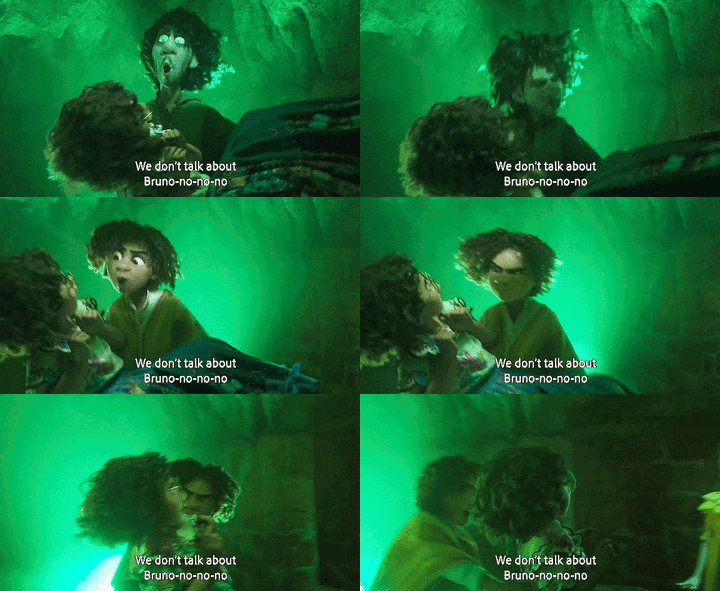
As I started in the Professoriate (academics love fancy words) the following year, what struck me most was how unwilling people were to “talk politics” in a history classroom. It felt like “We Don’t Talk About Bruno,” Encanto (2022). And I kept thinking — why?
One student told me he had been yelled at by another professor and told to leave the classroom for being a Trump supporter. He was also a military veteran who had served at Guantanamo Bay as a guard of the terrorists of 9/11. After class, he came up to me and said, “Hey, I appreciate you allowing us to express our political opinions.”
I replied, “What do you mean?”
To me, this was the entire point of the classroom. How else do you figure out if what you think is adequately calibrated if you’ve never challenged your ideas?
Apparently, by 2017, students already assumed their professors would punish them for wrongthink. Very 1984. That realization shocked me.
I was once told by a Dean during COVID, “You need to decolonize your syllabus.” — my immediate reaction was to think of my neighbor’s chihuahua dog named Cortés — he wasn’t a conquistador, he was never going to colonize anything, nor was the syllabus.
Don’t worry, UC Berkeley’s Nazune Menka had a course in 2021 called “Decolonizing UC Berkeley,” and I thought, “I guess when you have time and money, you get bored.”
I digress.
By 2018, when I applied to PhD programs, I didn’t get into any of the three I applied to — despite being pretty darn well qualified. I took graduate courses for fun and met many PhD students, most of whom were miserable and many of whom, when I’ve since looked them up, are jobless today or working outside their field, or still there. Five years, for what? Dodged a bullet. They’re always looking for priests. Nacho knows a guy.
I planned to apply again the following year, and one professor pulled me aside and said privately:
“Hey, I looked you up. You’re a registered Republican. You need to change that to at least No Party Preference. They check that, and you won’t make it past the first round.”
That night, I registered as NPP and hoped for the best. I didn’t get in, again. I remember thinking, “Really? It’s that petty, huh?” This was 2018.
Is this true? I honestly hope not, it would be great if it were just a strange alignment of events.
If you want to know what 2018 was like, here is a great historical reference:
And by 2019? Yes, just as petty — it was that petty. The show was just getting started.
Ironically, I later met many people in Republican political circles who said they hate this kind of thinking and actively oppose it. These were politicians you know, and their social media influencer buddies. Then, when I ran for office in 2025, I realized they are even more petty than academia — story for a later date.
This, unfortunately, is confirmed true. Unfortunately.
So, here I am — a man in no-man’s-land — writing a historical account of my journey through the American Republic as a (small “r”) republican thinker.
Sidebar:
If there is ever a moment when I have a seat at the GOP table, this is what you’d get: republicanism, small government, debate, free speech, and the belief that the American people have the right to succeed — and the equal right to fail — without government standing in the way of the natural rights it is meant to protect.
So let me make my pitch to you: in an age of AI, I am writing in a way that AI cannot (currently). There will be a lot of inside baseball, jokes, and cultural references that not everyone will get. But if you do get it, or I’m writing about you, you’re welcome, sweetheart.
You’ll get, as a reader, and at the very least, the nostalgic comfort that a human wrote this series from their scarred heart, and that there is someone alive behind these words. Rigid. Broken. Imperfect. Me.
We are now an endangered species, so subscribe and pledge money to help save us. Fear works.
I hope you enjoy it. Not the fear part.
I will publish at least one article per week in this series, beginning in 2026.
Will you join he/him, the Alta Historian?
P.S. If nobody ever reads this, let this stand as a primary source of the moment many Americans realized something fundamental was breaking, and that the choice to act still existed. And if the republic collapsed, I’m sorry, I tried. :’ (
Bibliography | Notes
Esaki-Smith, Anna. “UC San Diego Finds One in Eight Freshmen Lack High School Math Skills.” Forbes, December 11, 2025.
https://www.forbes.com/sites/annaesakismith/2025/12/11/uc-san-diego-finds-one-in-eight-freshmen-lack-high-school-math-skills/.
National Education Association (NEA). “The Racist Beginnings of Standardized Testing.” NEA Today. Accessed December 28, 2025.
https://www.nea.org/nea-today/all-news-articles/racist-beginnings-standardized-testing.
Sternberg, Robert J. “The SAT’s Racist Past.” Inside Higher Ed, August 17, 2020.
https://www.insidehighered.com/admissions/views/2020/08/17/history-sat-reflects-systemic-racism-opinion.
UC Berkeley News. “Be the Change, Season 2, Episode 2: Nazune Menka.” Berkeley News, March 15, 2023.
https://news.berkeley.edu/2023/03/15/be-the-change-s2-ep2-nazune-menka/.
The term “YUTES” instead of “YOUTHS” is from My Cousin Vinny:
“We don’t talk about Bruno,” Encanto: