

The Rise and Eclipse of Sumer
World Civilizations

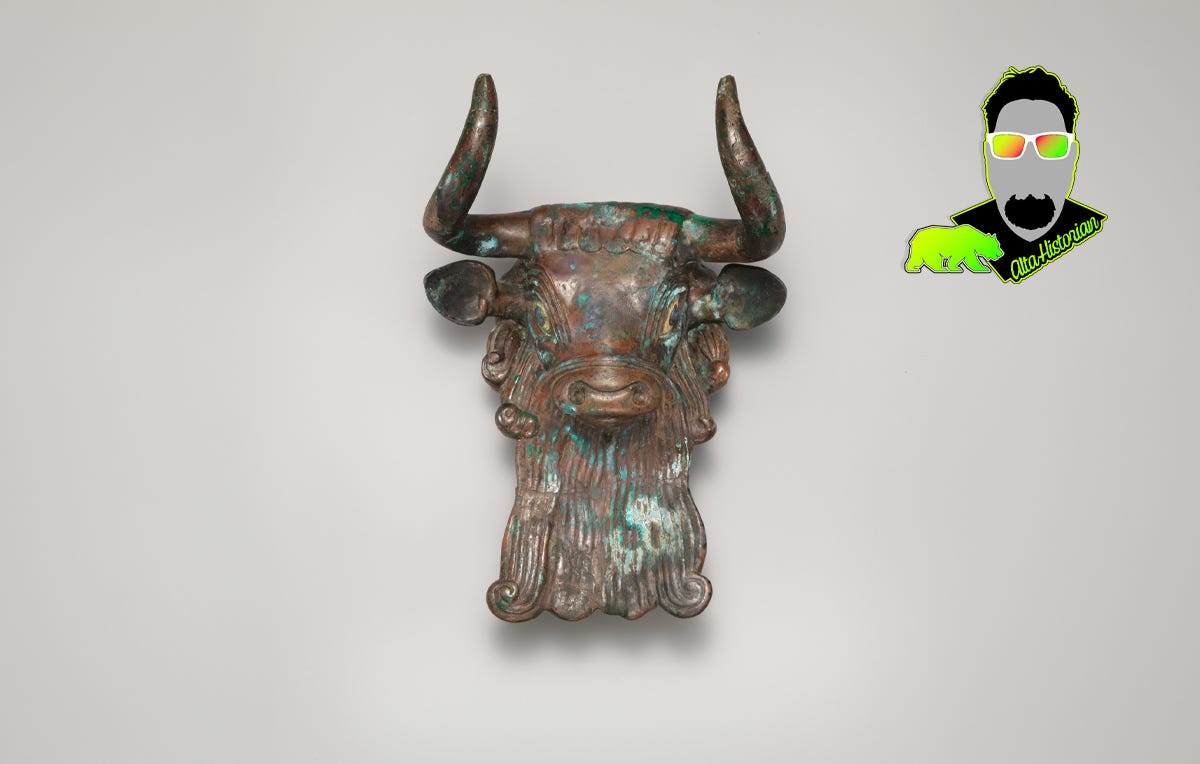
Sumer (Southern Mesopotamia)
Estimated Date Range: 4500 BC – 2000 BC
In the fourth millennium BC, the world’s first great cities rose from the alluvial plain of southern Mesopotamia — the land between the Tigris and Euphrates Rivers — a region the Greeks would later name Mesopotamia. In antiquity, this landscape was known as Sumer, and its inhabitants, the Sumerians, were among the most inventive peoples in human history. Here, for the first time, urban life emerged as a permanent condition — cities as the dominant form of human organization.
The geography both enabled and threatened this transformation. The rivers flowed south from the Taurus Mountains toward the Persian Gulf, carrying fertile silt, but unpredictably. Floods came often and without warning. Survival demanded coordination. Irrigation canals, dikes, reservoirs, and drainage systems were not optional conveniences but civilizational necessities. The management of water forged cooperation, hierarchy, and eventually power.
Agriculture had reached Mesopotamia by around 8000 BC, yet for millennia, settlement remained modest — villages of a few hundred at most. Around 5500 BC, populations pushed into southern Mesopotamia, a wetter but more volatile environment. There, something changed. By 4500 BC, villages began swelling into towns. By the late fourth millennium, urbanization accelerated dramatically. By 3000 BC, the Sumerian landscape contained more than a hundred villages, dozens of towns, and several true cities. One of them — Uruk — may have reached a population of fifty thousand, making it the largest city on earth at the time.
Urban growth demanded new tools, and the Sumerians proved equal to the task. After 4000 BC, they developed bronze metallurgy, inaugurating the Bronze Age in Mesopotamia. Stone yielded to metal. The plow, the wheel, and advanced irrigation followed, expanding agricultural output and allowing cities to feed themselves. Beneath these material advances lay a conceptual one: a mathematical system based on 60, 10, and 1 — a legacy still embedded in our measurements of time and space.
Yet Sumer’s most consequential invention was not material at all. Around 3200 BC, the Sumerians developed cuneiform, a wedge-shaped script inscribed on clay. What began as pictographic notation evolved into a phonetic system capable of recording language itself. Laws, contracts, hymns, inventories, myths — all could now be fixed in durable form. Baked clay tablets became archives, and archives became a preserved historical memory. Even after spoken Sumerian faded in the early second millennium BC, Sumerian texts endured, copied and preserved by later peoples in the world’s first libraries (the Greeks).
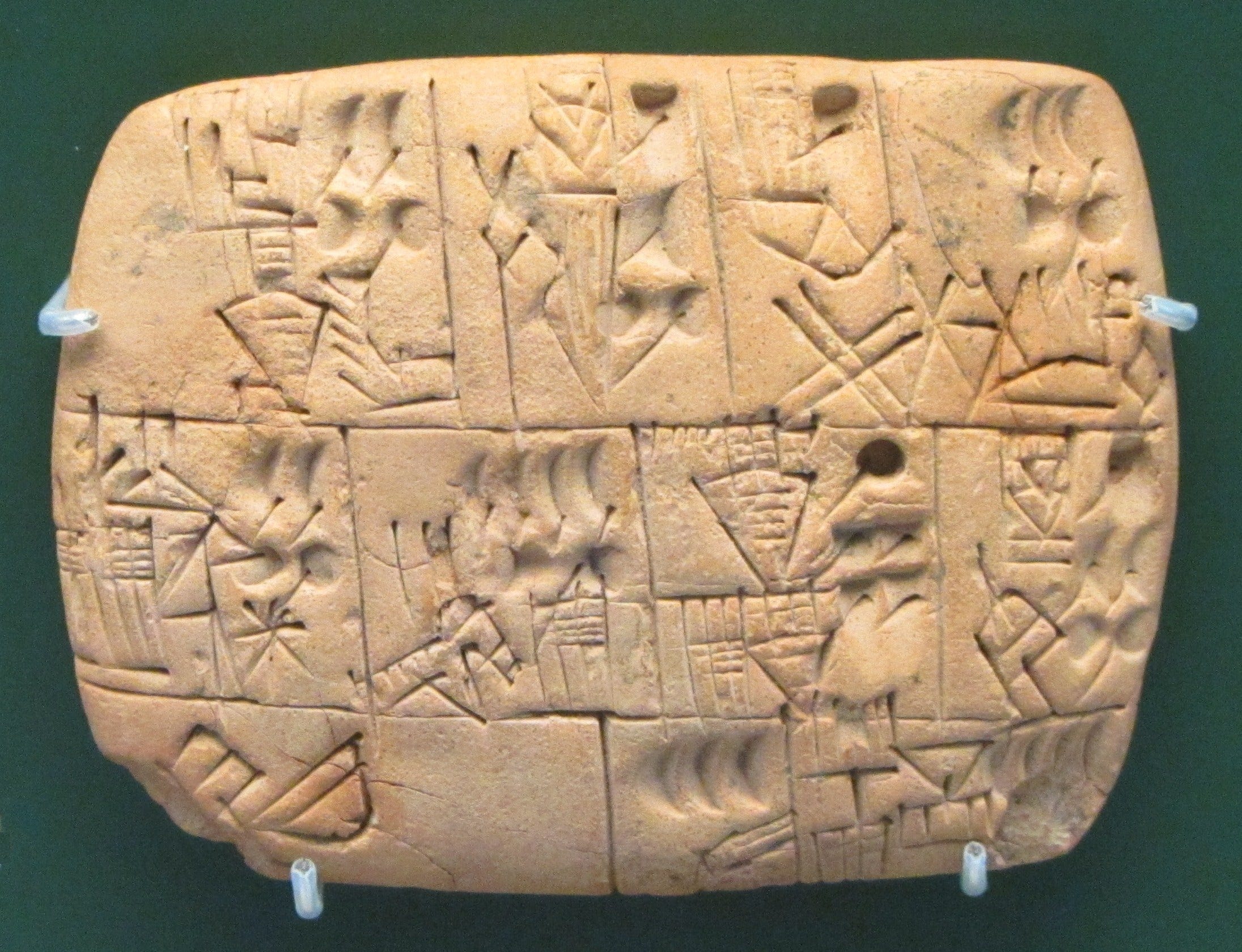
Why writing emerged remains contested. Denise Schmandt-Besserat argued that writing grew out of accounting: clay tokens representing goods, sealed in clay envelopes called bullae, eventually gave way to written symbols. Others, notably Jean-Jacques Glassner, see writing as something more deliberate — a conscious attempt to render sacred language visible, to place the speech of the gods under human control. The debate endures because writing itself transformed the world so profoundly that it cannot have a single, simple origin.
Religion anchored Sumerian urban life. The Sumerians were polytheists, but each city was under the protection of a particular god. Uruk honored Inanna, goddess of fertility. Nippur revered Enlil, god of wind and storms. Ur served the moon god Sin. Towering over each city rose the ziggurat — a stepped, mud-brick mountain crowned with a shrine. These ziggurats were temples, economic engines, administrative hubs, and symbols of divine ownership. The city, in Sumerian thought, belonged to its god.
By the Early Dynastic Period (c. 2650–2400 BC), secular power consolidated alongside religious authority. Kings known as Lugals emerged, often first as war leaders in conflicts over land and water. Legitimacy flowed from the gods. At Ur, the king’s daughter served as high priestess. Power was hereditary, sacred, and contested. Among these rulers, one loomed larger than all others in memory if not in fact: Gilgamesh, whose exploits, later recorded in the Epic of Gilgamesh, explored friendship, mortality, and the limits of human ambition.
The wealth of this period is visible in death. The Royal Cemetery of Ur yielded beehive-shaped tombs filled with gold, lapis lazuli, musical instruments, and the bodies of sacrificed attendants. One burial — that of Pu-Abi — revealed a woman adorned with extraordinary regalia, likely a queen. Hierarchy in life extended beyond it.
Sumerian city-states never formed a unified nation. They competed, allied, and warred incessantly. That fragmentation ended abruptly around 2300 BC, when Sargon of Akkad conquered Sumer and forged the world’s first empire. Ruling from the city of Akkad, Sargon united Mesopotamia, extended power into Syria and Iran, and created a new imperial model. His Akkadian successors adopted Sumerian culture, language, and gods, identifying Inanna with Ishtar and preserving Sumerian literature even as Akkadian became the spoken tongue.
The Akkadian Empire endured for roughly two centuries before collapsing around 2193 BC, weakened by internal strain, famine, and incursions by the Guti. Sumer revived briefly under the Third Dynasty of Ur (c. 2112–2004 BC), whose rulers styled themselves kings of “Sumer and Akkad” and even gods. Ur-Nammu issued one of the world’s earliest law codes, seeking order in a fragile world. But pressure mounted. Amorites, Elamites, and others breached defenses. Ur was sacked. Sumer fell.
Yet Sumer did not vanish. Its language survived as a sacred and scholarly medium. Its myths, mathematics, and institutions shaped every civilization that followed in Mesopotamia. Amorite rulers, including Hammurabi, built empires on Sumerian foundations. Hammurabi’s law code, inscribed on stone and proclaimed throughout his realm, echoed earlier Sumerian principles while formalizing social hierarchy — justice calibrated by class.

Bibliography | Notes
Early Writing Tablet Recording the Allocation of Beer, 3100–3000 BC (Late Prehistoric period). Clay tablet, height 9.4 cm, width 6.87 cm. Probably from southern Iraq. British Museum, London (ME 140855). Photograph, March 25, 2012. https://www.britishmuseum.org/collection/object/W_1989-0130-4.
OpenStax. World History Volume 1. OpenStax, Rice University. Accessed January 22, 2026. https://openstax.org/details/books/world-history-volume-1.
University of North Georgia Press. World History Textbook. University of North Georgia Press, 2017. https://web.ung.edu/media/university-press/World%20History%20Textbook-082817.pdf?t=1510261063109.