

The Rise of George Washington
United States | The French and Indian War and a prelude to revolution

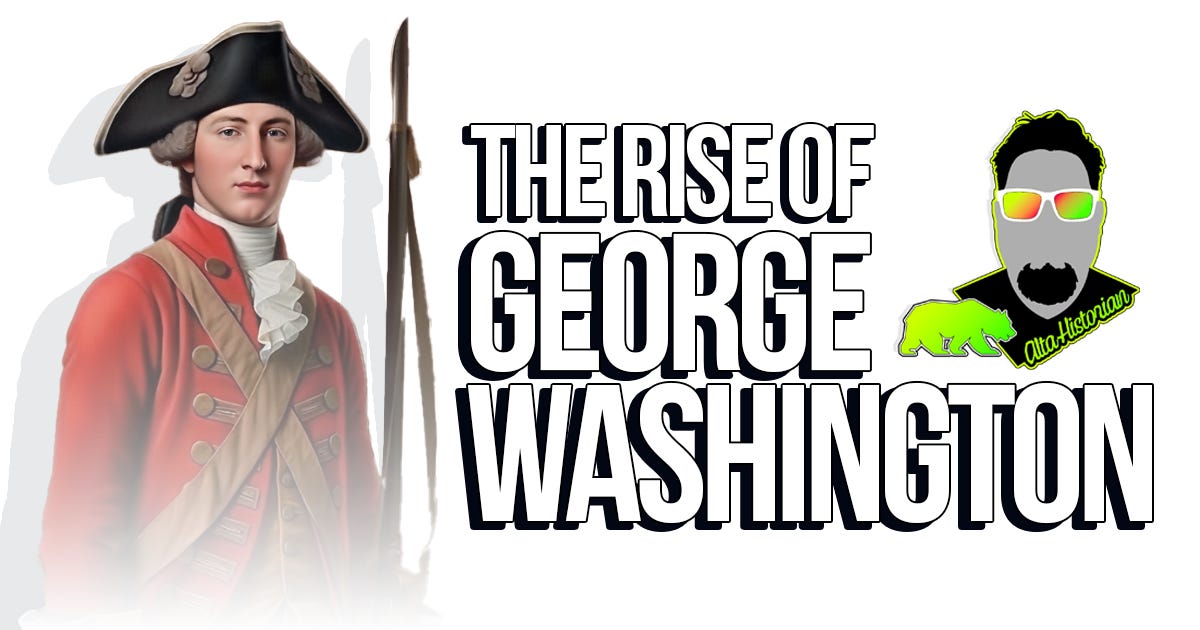
For decades before open conflict erupted in North America, French traders had cultivated alliances with Indian nations throughout the interior. Their presence rested on exchange rather than settlement. Manufactured goods moved outward from French trading posts, while beaver furs flowed back through the frontier networks that linked the Ohio Valley to Atlantic markets. By the 1740s, however, British colonists in Pennsylvania began pressing into territory long associated with these French trade relationships, and the delicate balance that had governed the region for generations began to erode.
Economic ambition sharpened these tensions. In 1749, a group of influential Virginians organized the Ohio Company, a land speculation enterprise intended to encourage settlement and development in the vast Ohio Valley. The Crown granted the company 200,000 acres of land between the Kanawha and Monongahela Rivers, with the promise of an additional 300,000 acres if settlement succeeded. The company’s shareholders represented some of the most powerful men in Virginia.
Royal Governor Robert Dinwiddie held shares, as did George William Fairfax and George Mason. The Washington family also possessed a stake in the venture — George’s half-brothers Lawrence and Augustine Washington among the investors — and many of George Washington’s political allies held similar economic interests in the region. For these men, the Ohio Valley was not a distant wilderness; it was land, commerce, and future settlement. When French forces began intruding into the area, they threatened not only imperial boundaries but the financial interests of Virginia’s political elite.
French soldiers began constructing a chain of forts across the Ohio Valley in order to protect their trade routes and create a western barrier against American expansion. Governor Robert Dinwiddie warned that these fortifications trespassed upon land claimed by Virginia. The dispute soon required more than diplomatic protest.
In 1753, Dinwiddie sent twenty-one-year-old Major George Washington of the Virginia Regiment into the contested Ohio Valley to deliver an ultimatum to the French. Control of this region — particularly the junction of the Monongahela and Allegheny rivers, in the area of modern Pittsburgh — held immense strategic importance. Rivers such as the Ohio connected the interior to the Mississippi system and formed vital transportation corridors for goods produced in the fertile lands beyond the Appalachian Mountains.
Concerned by reports of French expansion, Dinwiddie ordered Washington to confront the French forces, assert Virginia’s claim, and gather intelligence. Washington was to deliver a message demanding that the French withdraw from the region and cease harassing English traders.
In October 1753, Washington departed Williamsburg and began the difficult journey into the trans-Appalachian wilderness. Accompanying him were Jacob Van Braam, a family friend who spoke French, and Christopher Gist, an Ohio Company trader and experienced frontier guide. After weeks of travel through rugged terrain, Washington reached Fort LeBoeuf on December 11, 1753, during a raging snowstorm. There he was politely received by Captain Jacques Legardeur de Saint-Pierre.
After reviewing Dinwiddie’s letter, Saint-Pierre calmly drafted a reply declaring that the French king’s claim to the Ohio Valley was “incontestable.” The diplomatic exchange resolved nothing. Washington’s return journey to Virginia during the winter of 1753 proved perilous, but his party eventually arrived safely in Williamsburg after traveling nearly nine hundred miles in two and a half winter months.
Soon after his return in January 1754, Washington sat down to write a detailed account of the expedition, describing what he had seen in the Ohio Valley. The journal included Washington’s careful narrative of events as well as Dinwiddie’s letter to the French and Saint-Pierre’s response.
Dinwiddie was so impressed that he arranged to have the account published as a monograph in both Williamsburg and London and reprinted in various newspapers. Washington’s journal made the young officer famous on both sides of the Atlantic, important later during the American Revolution, and helped inform British and American readers of what many perceived as a growing French threat in the Ohio Valley.
The next stage unfolded quickly. Washington soon found himself leading troops in the wilderness, and the confrontation that followed would ignite a global war.
In May 1754, Washington commanded roughly 160 Virginians, accompanied by a small contingent of Mingo Indians. A detachment of Washington’s soldiers, working closely with the Mingo chief Tanaghrisson, learned of a nearby French encampment. Washington led a force of about forty militiamen on an all-night march through the forest toward the French position.
Tanaghrisson himself was a complex figure — bitter toward the French, who he believed had once boiled his father to death, yet aware that Washington’s presence represented another threat to Native lands. Despite that tension, he joined Washington’s expedition.
On May 28, 1754, the combined force discovered a small French camp hidden in the woods. Washington’s men approached stealthily at dawn, but the French spotted them at close range. Shots rang out, and a fierce firefight erupted in the forest. Washington’s force quickly overwhelmed the surprised French detachment, killing thirteen soldiers and capturing twenty-one.
Washington could not speak French and therefore could not communicate with the wounded French commander. During the aftermath, Tanaghrisson and his warriors killed and scalped the wounded soldiers. The encounter — remembered as the skirmish at Jumonville Glen — became the opening clash of the French and Indian War.
Tanaghrisson rode afterward to nearby Delaware and Shawnee villages, attempting as he had before to rally Native support for the British cause. Yet French economic power across the region remained formidable, and Tanaghrisson’s vendetta alone could not overcome it.
Washington later described his first military engagement with unmistakable enthusiasm:
“I fortunately escaped without any wound, for the right wing, where I stood, was exposed to and received all the enemy’s fire, and it was the part where the man was killed, and the rest wounded. I heard the bullets whistle, and, believe me there is something charming in the sound.”
Both sides later claimed the other had fired first. What neither side disputed was that this brief clash deep in the American wilderness helped spark a war that would soon spread far beyond the Ohio Valley — reaching Europe, Africa, and India.
Expecting retaliation, Washington ordered his men to construct a crude defensive position that became known as Fort Necessity. In July 1754, French forces, accompanied by about one hundred Shawnee and Delaware warriors, attacked the fort. The engagement proved disastrous. Roughly one-third of Washington’s men were killed, and the defeat made clear that the French would not abandon the disputed territory.
Even before the broader war unfolded, colonial leaders recognized the need for cooperation and the disadvantage of slow decision-making as a colony of a faraway imperial power. In 1751, Benjamin Franklin had written to James Parker reflecting on the political strength of the Iroquois Confederacy:
“It would be a strange thing if Six Nations of ignorant savages should be capable of forming a scheme for such an union, and be able to execute it in such a manner as that it has subsisted ages and appears indissoluble; and yet that a like union should be impracticable for ten or a dozen English colonies, to whom it is more necessary and must be more advantageous, and who cannot be supposed to want an equal understanding of their interests.”
In June and July of 1754, delegates from seven colonies met with representatives of the six Iroquois nations at Albany, New York. The Albany Congress sought to repair trade relations with Native nations and secure their help — or at least their neutrality — in the growing struggle against the French.
Benjamin Franklin of Pennsylvania and Thomas Hutchinson of Massachusetts drafted the Albany Plan of Union. The proposal envisioned a unified but limited government for the colonies, consisting of a president-general appointed by the Crown and a grand council representing the colonies that would meet annually to address matters of war, peace, and trade with the Indians. Though the plan still affirmed parliamentary authority, it also represented an early attempt to coordinate colonial military forces and Indian policy.
Delegates at Albany approved the plan, but no colonial assemblies adopted it. Some colonies feared it gave too much power to a central authority; others doubted that so many colonies could ever cooperate effectively. British officials and Native leaders also rejected it.
Meanwhile, the imperial struggle expanded into what became known as the Seven Years’ War. In the colonies, it was called the French and Indian War, but it formed one chapter in the larger imperial contest between Britain and France, sometimes described as the Second Hundred Years’ War.
In 1755, British forces launched a major expedition toward Fort Duquesne at the forks of the Ohio River. General Edward Braddock led nearly two thousand troops into the backcountry, accompanied by Washington and his Virginia soldiers. Engineers attempted to carve a road through the wilderness while three hundred axemen cleared trees along the route. Progress was painfully slow. After one week, the army had advanced only twenty-two miles, its column stretching nearly four miles in length across muddy terrain and steep mountain passes.
Just one day before reaching Fort Duquesne, Braddock’s army was ambushed by approximately 250 French soldiers and 640 Indian warriors attacking from both sides of the forest. British troops began falling back but collided with the soldiers behind them, creating chaos in the confined woodland terrain. Their bright red uniforms made them easy targets in the trees. Artillery proved useless in the dense forest.
The Battle of the Monongahela ended in catastrophe. Braddock was mortally wounded, and casualties mounted rapidly. Of the fifty-four women who had accompanied the army, only four returned. Some of the missing later appeared in Canada. French and Indian losses numbered only twenty-one dead, while Braddock’s army suffered more than one thousand casualties.
Washington had several horses shot from beneath him but emerged unharmed. He organized a desperate retreat, pulling Braddock’s body by wagon for miles before the general died five days later. Braddock was buried in the middle of a road so that passing wagons would conceal the location of his grave from enemy forces.
The defeat stunned British leaders and left imperial strategy in disarray for nearly two years. Washington, however, retained a lifelong admiration for Braddock. At his own presidential inauguration years later, Washington wore Braddock’s blood-stained sash.
Then came the years of escalating conflict.
In 1755, Braddock’s successor, Governor William Shirley of Massachusetts, faced another dilemma. Fearing that French settlers in Nova Scotia — the Acadians — would side with France during the conflict, Shirley expelled hundreds of them to other British colonies. Many of these exiles suffered greatly.
In 1756, Britain formally declared war, marking the official beginning of the Seven Years’ War. Yet the new American commander, Lord Loudoun, struggled with the same difficulties that had plagued earlier campaigns and achieved little success against French forces and their Indian allies.
The turning point came in 1757 when William Pitt rose to power as Britain’s prime minister. Pitt recognized that the colonial theater formed the key to building a vast British empire. He borrowed heavily to finance the war, subsidized Prussia’s military campaigns in Europe, and reimbursed the American colonies for raising troops in North America. By paying colonial assemblies to recruit and equip soldiers, Pitt dramatically expanded British manpower in the colonies.
The strategy worked. British forces captured Louisbourg near the mouth of the St. Lawrence River in July 1758. A month later, they seized Fort Frontenac at the river’s western end. By 1759, British armies closed in on Quebec. That September, General James Wolfe achieved a dramatic victory over French forces under the Marquis de Montcalm on the Plains of Abraham. Both commanders were fatally wounded during the battle.
Despite these victories, British military efforts had often been hindered by a lack of enthusiasm at home, rivalries among the American colonies, and France’s greater success in securing Native alliances. Yet by September 1760, the fall of Montreal eliminated the last major French foothold in Canada.
Soon afterward, Spain joined France against Britain, widening the conflict further. Britain responded by seizing French and Spanish territories around the globe.
The war concluded with the Treaty of Paris in 1763. France surrendered Canada to Britain, while Spain ceded Florida. France retained its valuable West Indian sugar islands, including Martinique and Guadeloupe. France transferred Louisiana west of the Mississippi River to Spain, and Britain restored Cuba to Spanish control.
The treaty dramatically reshaped the map of North America. Britain emerged dominant, removing European rivals from both the north and south of the American colonies and opening the Mississippi Valley to westward expansion.
Yet victory produced new tensions and set the stage for the coming decades. British leaders grew suspicious of colonial traders who had engaged in smuggling during the war, while colonists resented arrogant British commanders who had relegated them to menial tasks and subjected them to harsh discipline. The war had also proven extraordinarily expensive. Britain’s national debt doubled during Pitt’s ministry, and the government decided to maintain ten thousand soldiers in North America to guard the new territories.
For George Washington, the French and Indian War proved formative. As a young and ambitious officer, he encountered the realities of life along the edges of British North America and learned to negotiate with experienced Native and French commanders. Serving under Braddock allowed him to study military manuals, treatises, and histories. Washington practiced writing clear military orders by copying those issued by more experienced British officers.
More practically, the war taught him how to organize supplies, administer military justice, command troops, build forts, and manage subordinates. Although he was denied a royal commission in the British army, Washington carefully imitated the habits and manners of the regular officers around him.
As historian Fred Anderson later observed:
“Washington at age twenty-seven, was not yet the man he would be at age forty or fifty, but he had come an immense distance in five years’ time. And the hard road he had traveled from Jumonville’s Glen, in ways he would not comprehend for years to come, had done much to prepare him for the harder road that lay ahead.”
The end of the war did not bring peace to the frontier. Instead, it produced a new crisis among Native nations. A renewed commitment to traditional ways and the formation of intertribal alliances led to what the British called Pontiac’s Rebellion, named after the Ottawa leader Pontiac.

Bibliography | Notes
Anderson, Fred. Crucible of War: The Seven Years’ War and the Fate of Empire in British North America, 1754–1766.
Foner, Eric, and John A. Garraty, eds. The Reader’s Companion to American History. Boston: Houghton Mifflin Harcourt Publishing Company, 1991.
Ford, Paul Leicester. The True George Washington. Philadelphia: J. B. Lippincott Company, 1896.
Franklin, Benjamin. Letter to James Parker, 1751.
Locke, Joseph L., and Ben Wright, eds. The American Yawp: A Massively Collaborative Open U.S. History Textbook. Vol. 1, To 1877. January 2019.
Mount Vernon Ladies’ Association. “Biography of George Washington.” Mount Vernon. Accessed March 12, 2026. https://www.mountvernon.org/george-washington/biography.
Roark, James L., Michael P. Johnson, Patricia Cline Cohen, Sarah Stage, and Susan M. Hartmann. The American Promise, Value Edition, Volume 1: To 1877. Bedford/St. Martin’s, 2014.
Schweikart, Larry, and Michael Allen. A Patriot’s History of the United States: From Columbus’s Great Discovery to the War on Terror. New York: Sentinel, 2004.
Zinn, Howard. A People’s History of the United States. New York: Harper & Row, 1980.Luther, Martin. Protestant Reformation, sixteenth century.