

The Second Conquest of Latin America, pt. 1
Latin America | Free Trade, Industry, and the Discipline of Dependency

Political independence in Latin America did not inaugurate economic autonomy — it revealed its absence. The banners of sovereignty rose, yet the structure of dependence remained. As Steven Topik and Allen Wells write in The Second Conquest of Latin America, between 1850 and 1930,
“…closer economic ties among Western Europe, the United States, and Latin America abruptly transformed Latin American societies. In some ways, this encounter was as dramatic as the conquistadors’ epic sixteenth-century first encounter with Native American civilizations.”
The comparison is exacting. Steel and sacrament once reordered the hemisphere. In the nineteenth century, contracts and commodities accomplished the same.
Latin America was yet another opportunity for the great empires to extract raw materials in the late nineteenth and early twentieth centuries, as it had been in the centuries prior. For Latin America, seeking integration into the world’s economy through the export of raw materials meant accepting the price that came with acceptance — foreign investment and liberal ideology sustained the export model.
Governments believed that economic prosperity would pave the way for a strong nation. The liberal export regime sought to overthrow the statist colonial inheritance and integrate far-flung populations into a citizenry linked not by custom or religion but by the market. Efficiency, productivity, and international competitiveness replaced protectionism and self-sufficiency.
Yet the transformation was not uniform. The export boom’s effects differed markedly across Latin America due to inconsistent implementation of liberal policies, vast environmental variations, and the region’s unique cultural and political inheritances. This effect amplified the fractures and instability of Latin America’s governments and combined to produce widely varying outcomes from this global encounter.
The interactions brought by economic integration into world markets meant local geography, the resources being extracted, labor, and government had to contend with the consequences of such a decision in an unstable political and economic environment.
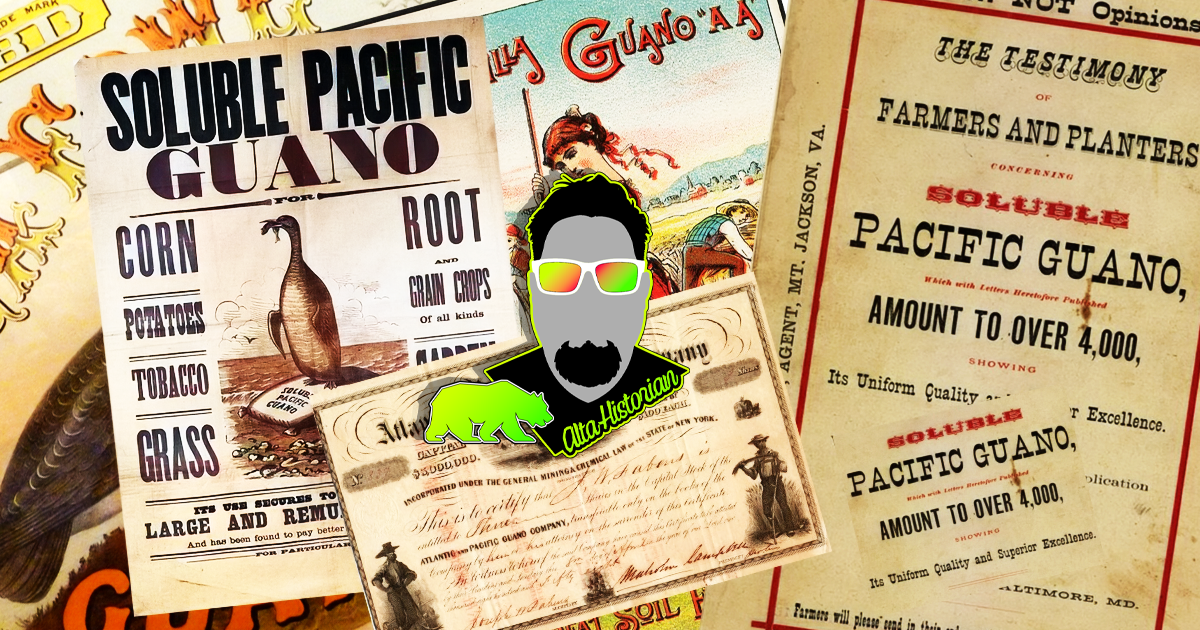
Nowhere is that interaction more visible than in Peru’s guano.
Before the Age of Guano, Peru had known what one observer called its Golden Age — before any Spaniard had set foot in the country, when it bore another name. “Peru,” which signifies nothing, arose by accident or mistake — first spelled “Piru” — likely from the name “Biru,” the native name of a river. Time and use established the name. By that insignificant designation, the country would continue to be known.
Conquered in the sixteenth century and independent by 1824, Peru entered the nineteenth century with its guano beds largely untouched. For centuries, millions of seabirds had deposited layers upon layers of nitrogen-rich excrement along the arid coast. By 1840, some islands bore crowns 120 feet thick, glistening like helmets beneath the desert sun. Nature had accumulated wealth in silence.
Climate made the treasure possible. Had the coast been subject to rain, the nitrogenous portion would have been converted to ammonia and lost through evaporation or drainage, leaving only a lower-value phosphatic residue. Instead, aridity preserved the deposits. Guano consisted of the excrement of birds and sea lions, along with the other offal of the rookeries — bodies, eggs, and fish remains.
At least twenty-four species frequented the islands — twelve nested there. Commercially, the most important were the cormorant, pelican, and gannet. The white-breasted cormorant — the guanay — nested in dense rookeries averaging three nests per square meter. Counting parents and young, four birds per nest. Multiply the square meters by twelve, and one approximates a flock’s population.
Nature provided abundance. The market demanded extraction.
The guano problem soon became perhaps the most important economic question confronting Peru. It could not be separated from fisheries, for guano was, strictly speaking, a fishery product. The anchobeta — the most important resource of Peru’s waters — fed the birds. In the United States, fish guano was manufactured directly from menhaden — in Peru, nearly equal value was produced annually through the agency of birds, at little more than transportation cost.
Around 1840, the Peruvian government leased the deposits to contractors and middlemen, who resold guano-enriched soils worldwide. Millions of tons were shipped within a few years. Introduced into the United States as early as 1825, its value was not immediately recognized. In 1848, only 869 tons were imported. In 1849, imports rose to 21,243 tons. By 1853, annual imports through North American ports approached 200,000 tons. The beginnings of exportation may be dated to around 1840. The exhaustion of the ancient accumulation, for the world market, occurred in 1874.
The deposits were ruthlessly exploited. By 1910, only 23,000 tons remained of what had once seemed inexhaustible.
The contradiction deepened. Agriculturists within Peru required 40,000 tons annually. Under prevailing conditions, they secured only about two-thirds of that amount. Of approximately 124,000 tons extracted in 1907, only 26,000 were used domestically. The deposits had been mortgaged for bonded debt; export prevailed over national need.
At the existing rate of exportation, all available guano of old formation would be removed within four or five years. Future production — estimated at 20,000 to 30,000 tons annually from ongoing bird deposition — might suffice for domestic agriculture if carefully managed and the birds protected. But even this would require foresight and discipline.
Extraction also required labor that the country could not provide.
So, Peru experimented with immigration. In 1857, Germans established themselves at Pozuzo, a fifteen-day journey northeast of Lima. By 1870, they numbered 360 souls, 112 children — carpenters, coopers, cigar-makers, cabinet-makers, blacksmiths, shoemakers, tailors, saddlers, machinists, tanners; a priest, a grave-digger or clerk, a schoolmaster, and an architect among them. Each colonist cultivated a plot measuring 33,000 yards by 13,000 yards — tobacco, coca, maize, yuca, beans, rice, coffee, and garden produce. They lived in wooden houses — three were of wrought stone. An enthusiastic deputy declared they had erected “a city which perhaps is on a level with any city of Europe!”
Polynesians followed — subjects of the King of Hawaii — later discovered to have been kidnapped. They died “like flies that had been poisoned.” Immigration was prohibited when the deception was exposed.
The only considerable immigration proved to be Chinese, and it began as kidnapping and commercial speculation. Of 65,000 Chinese taken from their native land, 5,000 died en route. Some threw themselves overboard — some smoked too much opium — some were shot, others succumbed through all these causes together. An Italian chief mate once boasted, “I shot two of them down, sacramento [or, ‘hell’].” When asked what became of him, he replied that Captain Venturini had accommodated him with a passage to shore, where he remained to make “an extended acquaintance with the Celestial Empire.”
For the enslaved Chinaman, day dawned with labor. Labor pursued him through weary hours. Night brought only dreams of the tormenting routine awaiting him. In sickness, he had no mother — and in death, no sacred tears. The authorities knew where the meanest Peruvian lived and died, the Asiatic was disembarked, scattered, forgotten. He did not live — he vegetated. He died beneath a scourge or a burden too heavy to bear. Rebellion brought desolation and blood.
A North American traveler wrote in 1853 that the only labor on the islands consisted of Chinese coolies (Asian day laborers) or slaves. Their grim faces showed merciless treatment — long hours, poor food, no recreation. Scantily clothed, they bared skin to the hot sun and knotted ropes of taskmasters. Many leapt from cliffs, crazed by torture.
Thus, guano fertilized foreign fields while exhausting Peruvian bodies.
The pattern was not isolated. The expansion of Latin American markets accelerated capital accumulation in British industry. The Atlantic had become the main highway of world trade. Britain organized a worldwide system: the world supplied raw materials, and Britain supplied manufactured goods. It commanded insurance, freight, and the international gold market.
Friedrich List observed that free trade was Britain’s chief export. Yet free trade became a doctrine only after British supremacy had been secured under the umbrella of stringent protectionism. An Englishman caught exporting raw wool lost his right hand — a second offense meant hanging. Even a burial required certification that the shroud was made in a British factory.
Latin America’s entry into the British orbit — later the U.S. orbit — consolidated dependence. Free circulation of merchandise and capital carried dramatic consequences.
Bolívar had understood the structure early. “How different it was in our case,” he wrote. “From the beginning we were plagued by a practice that in addition to depriving us of the rights to which we were entitled left us in a kind of permanent infancy with respect to public affairs.” After independence, Bolívar welcomed British trade and investment, even seeking to sell the Aroa mines and recommending the sale of Peruvian silver mines.
Tariffs, for him, were fiscal, not systematic protection. Yet later, he lamented that everything had sunk into desolation, that foreign trade had gone the way of domestic industry, and asked, “How can commerce thrive without trade and profits?” This opened the door over the next two centuries to the English, Germans, French, and of course, the Americans — each acting in their interests to control cultivation, manufacture, and trade — fields of indigo, grain, coffee, sugar cane, cacao, cotton — cattle and precious metals — as consumers, partners, and competitors in global markets that were imperially controlled.
Mexico attempted resistance. Vicente Guerrero rose amid artisan despair as British goods flooded markets. Lucas Alamán warned that Adam Smith’s ideas (philosopher and economist widely regarded as the father of modern economics) contained poison for the national economy. As minister, he established a credit and loan bank to promote industrialization: tax foreign textiles, purchase machinery, and employ hydraulic power cheaper than coal.
By 1844, Puebla plants produced 1.4 million lengths of heavy cotton. In 1840, U.S. mills averaged fewer spindles than Mexico’s. A decade later, the ratio reversed. Political instability, foreign pressure, and a weak internal market strangled the experiment. By 1850, progress had ceased.
The pattern held. Commodities bound Latin America to the world economy. Guano in Peru, cotton in Mexico, coffee in Brazil — each promised prosperity — each deepened dependence on imperial empires sustained by their internal markets, strong militaries, and sturdier positioning by which to negotiate.

Bibliography | Notes
Bolívar, Simón. El Libertador: Writings of Simón Bolívar. Edited by David Bushnell. New York: Oxford University Press, 2003.
Eduardo Galeano, Open Veins of Latin America: Five Centuries of the Pillage of a Continent, trans. Cedric Belfrage. New York: Monthly Review Press, 1973.
Topik, Steven, and Allen Wells. The Second Conquest of Latin America: Coffee, Henequen, and Oil during the Export Boom, 1850–1930. Austin: University of Texas Press, 1998.