

The Virginia Colony: Tobacco and Bacon
United States | How John Rolfe planting West Indian tobacco seeds gave the Virginia colony purpose and how Bacon made "race" in North America

Tobacco did not merely sustain Virginia — it reorganized it. In 1612, John Rolfe planted West Indian tobacco seeds. By 1617, colonists grew enough to ship back to England. What had begun as a precarious settlement of adventurers hardened into a society of planters.
Tobacco was not forgiving. It demanded constant attention and year-round labor. Colonists worked with primitive tools. The work was exhausting, repetitive, and exacting. Yet profit justified strain. Men could earn two to three times more in Virginia’s tobacco fields than in England. Land was abundant and comparatively cheap. The Headright System granted fifty acres to those who paid their own passage. Land, labor, and ambition fused into a single crop.
In 1619, the colony established the House of Burgesses — the first representative assembly in a British overseas possession. The General Assembly, organized by Governor George Yeardley at Jamestown on July 30, 1619, included the governor and council appointed by the Virginia Company and two elected burgesses from each of the colony’s eleven settlements. Political voice existed, but within the framework of corporate oversight.
Labor quickly became the colony’s defining problem.
By 1620, indentured servitude supplied the workforce. Approximately eighty percent of immigrants arrived under contracts promising four to seven years of labor. Indenture functioned as credit. Poor migrants borrowed the cost of transportation from merchants or sea captains, who then sold the right to their labor to tobacco planters.
The system was efficient. It took roughly one year for a servant to grow enough tobacco to equal the cost of his indenture. The remaining three to six years generated profit for the planter.
But efficiency did not imply mercy.
Servants could not choose their masters. They were bought and sold, sometimes multiple times. Work was harsh. Minor infractions extended contracts beyond their original terms. Servitude in Virginia’s tobacco fields approached slavery more closely than anything known in England. Men served longer, endured more rigorous punishments, and were traded as commodities.
Most servants were unskilled men between fifteen and twenty-five years old. Women were rare. Approximately three-fourths of servants were male, creating a pronounced gender imbalance. Planters preferred men for field labor, reinforcing the disparity.
Female servants faced legal restrictions. They were prohibited from marrying, the law reasoning that a woman could not “serve” two masters — the owner of her labor and a husband. The imbalance pressured women into sexual relationships. Roughly one-third of immigrant women were pregnant at marriage. Because pregnancy hindered labor, women who bore children during servitude were required to serve two additional years and pay fines. In some cases, the father purchased the woman, freed her, and married her.
For decades, the Chesapeake’s primary division was not between rich and poor but between free and unfree. A yeoman — a small landowner who farmed with family labor and perhaps one servant — stood closer socially to his neighbors than to any grand planter. Only a small number of elite planters dominated the early decades. Frontier equality characterized many free households.
That balance shifted.
An oversupply of tobacco depressed European prices, reducing profits and limiting freed servants’ ability to acquire land. Mortality rates declined. More servants survived their indentures, creating a growing class of landless freedmen. At the same time, longer life expectancy allowed established planters to accumulate wealth, purchase slaves, extend credit, and consolidate influence.
By the 1670s, Chesapeake society polarized between landowners and landless.
The government reinforced the distinction. In 1670, voting by poor men was outlawed. Previously, all freemen had voted, typically electing prosperous planters. After 1640, no former servant served in the governor’s council or the House of Burgesses.
Race had not yet hardened into a permanent caste, but attitudes were forming.
Africans had been present even before the slave trade fully matured. The English language and culture have long associated “black” with dirt, foulness, malignancy, death, disaster, and sin. In contrast, Elizabethan poetry often paired “white” with beauty and virtue. These symbolic associations preceded statutory slavery.
Despite these emerging perceptions, white and black servants often shared more in common with each other than with their masters. They labored together. They endured similar punishments. They recognized a common adversary. Historian Kenneth Stapp observed that Black and White servants of the seventeenth century were “remarkably unconcerned about the visible physical differences.” As noted in Stapp’s article:
“There are hints that the two despised groups initially saw each other as sharing the same predicament. It was common, for example, for servants and slaves to run away together, steal hogs together, get drunk together. It was not uncommon for them to make love together.”
Fraternization was common enough that laws attempted to prevent it. In 1661, Virginia declared that if any English servant ran away in the company of any “Negros,” both would have additional years added to their service. In 1691, Virginia imposed banishment for any free person who intermarried with “a negro, mulatoo, or Indian,” whether slave or free. Court records reveal that interracial relationships persisted nonetheless.
The elite feared not only slave rebellion but the possibility that poor whites and enslaved blacks might unite against them. That fear crystallized in 1676.
Nathaniel Bacon, a tall, slender man in his thirties with black hair and an ominous, pensive disposition, arrived in Virginia after his father sent him there, hoping he would mature. Intelligent and eloquent but disdainful of labor, Bacon quickly entered colonial politics. Governor William Berkeley treated him with respect, granting him land and a seat on the council in 1675.
Economic tensions simmered. Tobacco prices declined. Competition from Maryland and the Carolinas intensified. The Navigation Acts of the 1660s restricted English markets. Frontier settlers resented limits on westward expansion. Berkeley sought to manage Native relations carefully, while settlers demanded aggressive action.
When conflict erupted with the local Indian tribes, Bacon led frontier settlers who accused the colonial elite of protecting Native peoples for private gain. Berkeley branded Bacon a traitor and called for new elections. The strategy failed. Bacon and his allies won seats in the legislature.
The new assembly passed reform measures known as Bacon’s Laws. These measures restored voting rights to all freemen, forbade officials from demanding bribes, and granted local settlers greater influence in taxation.
Berkeley initially pardoned Bacon but soon renewed the charge of treason. Bacon declared war.
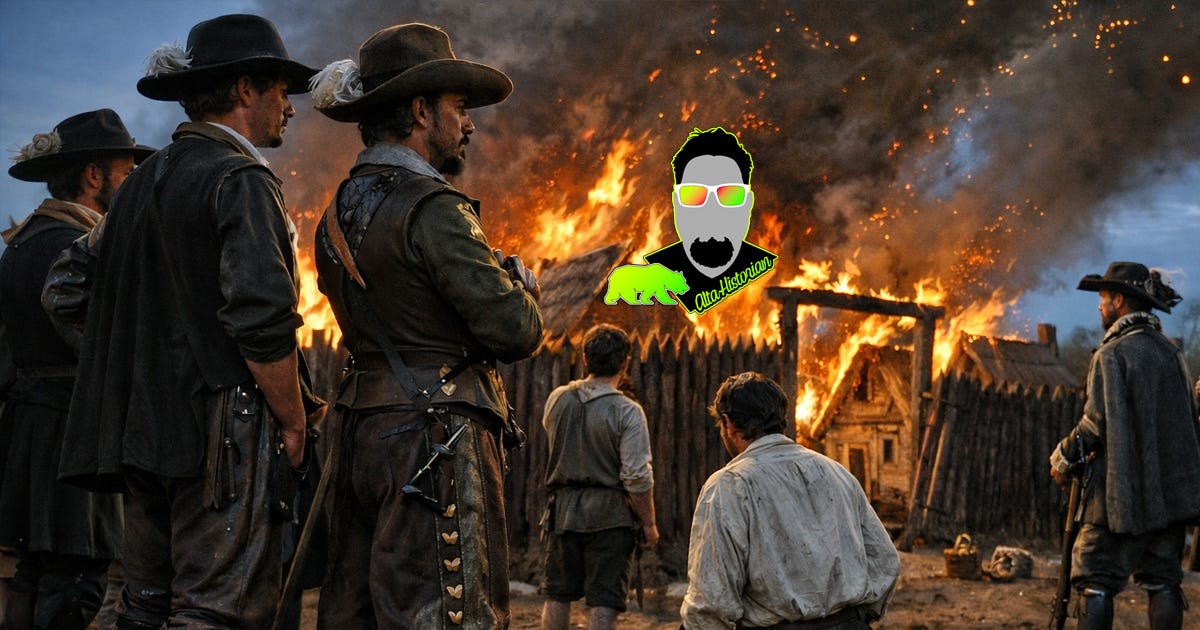
For three months, his forces fought Indians, attacked elite plantations, and burned Jamestown. On July 30, 1676, Bacon issued his “Declaration of the People,” accusing Berkeley of corruption, favoritism, and selfish protection of Indians.
On October 26, 1676, Bacon died suddenly of the “Bloodie Flux” and “Lousey Disease.” His body was never recovered; it may have been burned to prevent contagion. As one scholar noted, “In Bacon’s Rebellion, one of the last groups to surrender was a mixed band of eighty negroes and twenty English servants.”
Berkeley regained control. Twenty-three rebels were hanged. Rebel property was seized without trial. King Charles II eventually removed Berkeley from office. He returned to England and died in July 1677.
The rebellion altered the colony.
Tensions between large planters and small farmers eased. The elite concluded that it was safer to permit settlers to fight Indians than to fight each other. Restrictions on Western expansion loosened. Taxes were reduced.
Historians have long debated the rebellion’s consequences. Some argue that discontent among former servants fueled the uprising. By redirecting that discontent toward enslaved Africans — emphasizing racial solidarity among whites — elites could construct a more stable labor force less likely to threaten their authority.
Others note that the supply of English servants declined beginning in the 1660s and fell sharply around 1680, compelling planters to rely increasingly on enslaved Africans. By the 1670s, slaves were already replacing indentured servants among the Virginia gentry — before both Bacon’s Rebellion and the sharp decline in new servants.
Slavery did not immediately end indentured servitude. Rather, the gradual decline of servitude gave rise to slavery.
By 1690, enslaved Africans accounted for nearly all of the gentry’s bound workforce, though only twenty-five to forty percent of the non-elite’s. As supply increased, prices decreased. Enslaved Africans — imported and visibly distinct — were easier to enslave permanently.
By 1700, Virginia counted approximately 6,000 slaves — one-twelfth of the population. By 1760, there were 170,000 — half the population. Ultimately, with resistance suppressed, the number would reach three million.
Historian John C. Coombs has suggested there was no single “trigger” for the transition. Slavery expanded gradually as the English Empire matured and enslaved Africans became more available.
In 1705, Virginia passed “An act concerning Servants and Slaves.” Slavery was fully codified. It had become entrenched at every level of society and was well on its way to replacing indentured servitude as the primary source of bound labor.
At the same time, lawmakers reinforced racial divisions. A 1705 statute required that at the end of an indenture, white men receive ten bushels of corn, thirty shillings, and a gun; white women, fifteen bushels of corn and forty shillings; and fifty acres of land. These provisions alleviated class tensions while strengthening racial hierarchy.
Planters and small farmers alike concluded that a slave for life was preferable to a servant who might one day claim freedom.
Thus tobacco did more than enrich Virginia.
It reshaped labor, hardened race, and divided society in ways that would define the South long after Jamestown’s fragile beginnings were forgotten.

Bibliography | Notes
Bacon, Nathaniel. “Declaration of the People,” July 30, 1676.
Foner, Eric, and John A. Garraty, eds. The Reader’s Companion to American History. Boston: Houghton Mifflin Harcourt Publishing Company, 1991.
Locke, Joseph L., and Ben Wright, eds. The American Yawp: A Massively Collaborative Open U.S. History Textbook. Vol. 1, To 1877. January 2019.
Morgan, Edmund S. Commentary on servitude in Virginia tobacco fields.
Roark, James L., Michael P. Johnson, Patricia Cline Cohen, Sarah Stage, and Susan M. Hartmann. The American Promise, Value Edition, Volume 1: To 1877. Bedford/St. Martin’s, 2014.
Schweikart, Larry, and Michael Allen. A Patriot’s History of the United States: From Columbus’s Great Discovery to the War on Terror. New York: Sentinel, 2004.
Stapp, Kenneth. Observations on seventeenth-century servant relations.
Virginia Statutes, 1661; 1691; 1705.
Yeardley, George. Establishment of the General Assembly, Jamestown, July 30, 1619.
Zinn, Howard. A People’s History of the United States. New York: Harper & Row, 1980.