

The War of 1812: Tecumseh
United States | The story of the most beloved enemy-hero of the United States

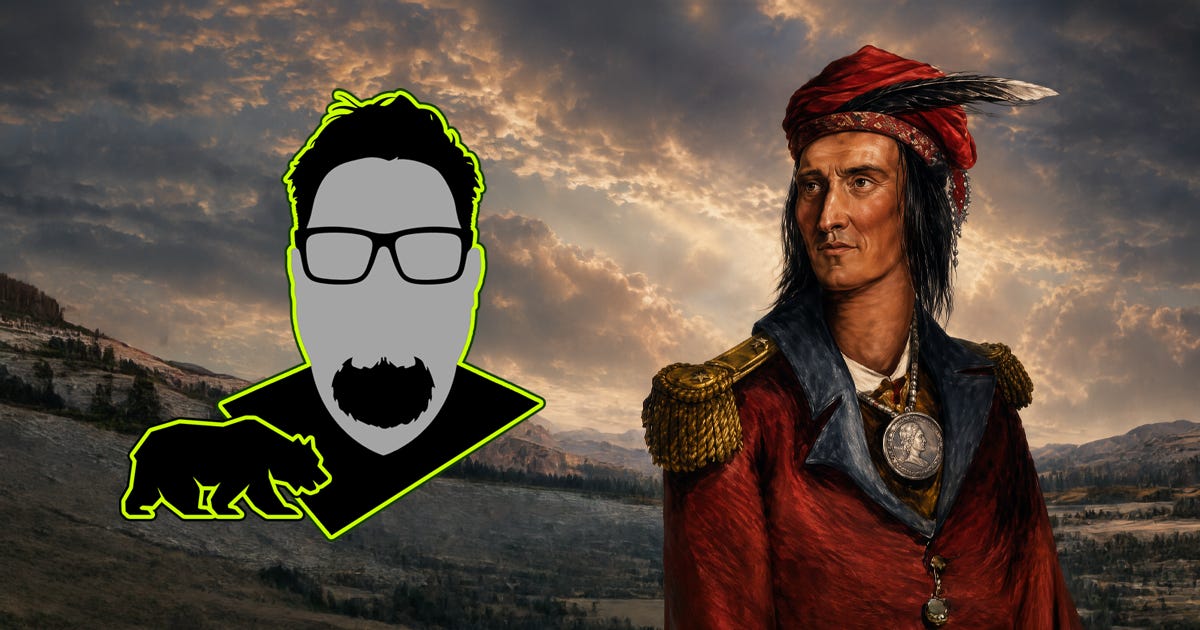
“The way, and the only way, to check and to stop this evil, is for all the Redmen to unite in claiming a common and equal right in the land, as it was at first and should be yet; for it was never divided, but belongs to all the use of each. That no part has a right to sell, even to each other, much less to strangers — those who want all and will not do with less.”
Those words belonged to Tecumseh, the Shawnee war chief whose life’s work was the construction of a political fact that American expansion could not tolerate: unity. The frontier’s logic demanded Indian lands be taken piecemeal, one tribe at a time, through treaties that divided peoples from one another as surely as they divided them from their territory. Tecumseh understood this logic and set about dismantling it. In 1811, he assembled a gathering of five thousand American Indians on the banks of the Tallapoosa River, in what is now Alabama — a demonstration of strength that was also a declaration of principle.
Tecumseh faced resistance from within. The southern tribes were not of one mind. The Creeks, who occupied most of Georgia, Alabama, and Mississippi, contained factions willing to accommodate white settlement in the hope that accommodation would purchase peace. Such hopes had been purchased before, and they had never held. But the pressure of proximity, of watching one’s neighbors trade land for promises, had a corrosive effect on the resolve even of those who knew better.
In the Northwest, Tecumseh found more purchase. The more northern tribes — pressed harder, aligned longer with British fur traders and agents — renewed their ties to Britain as American settlement advanced. The Shawnee chief solidified his confederacy there, binding together peoples who shared a material interest, if not always a single tongue. His brother Tenskwatawa, called the Prophet, gave the movement its spiritual dimension: a revival of native ways, a rejection of Anglo-American culture root and branch, including the whiskey that had done to Indian communities what no army had yet accomplished.
William Henry Harrison occupied the territorial governorship of Indiana with one consuming purpose. He negotiated treaty after treaty in what he called a diplomatic strategy, but what amounted, in practice, to a divide-and-conquer campaign — extracting Indian land through paltry payments from whichever tribal leaders could be induced to sign, on the calculated assumption that unity was the only thing that could stop him. The rise of Tecumseh and the Prophet made this strategy more difficult. They could not make it impossible so long as Harrison moved with sufficient speed.
In 1809, while Tecumseh was away on a recruiting journey for the Western Confederacy, Harrison assembled the leaders of the Potawatomi, Miami, and Delaware tribes and negotiated the Treaty of Fort Wayne. He falsely promised them it was the last cession of land the United States would seek. It was not the last. When Tecumseh returned and learned what had been signed in his absence, his fury was unambiguous — directed at Harrison, at the local leaders who had capitulated, at the structure of a diplomacy that treated indigenous sovereignty as a commodity to be purchased rather than a right to be respected.
In November 1811, Harrison moved on to Prophetstown, the Shawnee settlement on the Tippecanoe River named in honor of Tenskwatawa. Tecumseh was away again — this time in the South, building the confederacy he had spent years assembling. Harrison took the absence as his opportunity. The ensuing battle lasted two hours. American forces, numbering in the hundreds, destroyed the settlement and killed forty Indians at a cost of sixty-two American lives. When the warriors fled, the Americans burned what remained of the town.
The Americans heralded it as a glorious victory. Harrison would carry the phrase “Tippecanoe and Tyler Too” all the way to the White House in 1840. What the battle actually accomplished was the discovery, in the ruins of Prophetstown, of ample evidence that the British had supplied the Western Confederacy with weapons. For those already agitating for war with England, it was proof of what they had long asserted. For Tecumseh, returning from the South to find his settlement ash, the battle settled something simpler: he was now readier than ever to make war on the United States.
The maritime grievances had been accumulating for years. In 1806, France prohibited all neutral trade with Great Britain. In 1807, Great Britain banned trade between France, her allies, and the Americas. Congress responded in 1807 with an embargo act prohibiting American vessels from trading with European nations, followed by the Non-Intercourse Acts aimed solely at France and Britain. Neither measure worked. Both were evaded with a fluency that exposed the limits of economic coercion.
By 1810, the United States had reopened trade with both powers, on the condition that they cease their blockades against neutral commerce. Great Britain did not cease. Royal Navy warships continued stopping American merchant vessels, searching them for deserters, and impressing American seamen into the British Navy. The practice was not random — it was policy, and it was felt most keenly by the merchant communities of the coast and the pride of a republic that believed its flag should protect its sailors.
Into this climate came the Congress of March 1811, containing several dozen young Democratic-Republicans who had grown impatient with patience. They were informally called War Hawks — mostly lawyers from the West and South, led by Henry Clay of Kentucky and John C. Calhoun of South Carolina. They welcomed war with England for overlapping reasons: to legitimize attacks on American Indians whose resistance was backed by British arms, to end impressment once and for all, and to pursue expansion into Florida and Canada. They were not merely reactive. They were ambitious.
When Congress declared war on Great Britain in June 1812, the vote split along lines that already anticipated the fractures that would widen in the coming decades. New England and some of the Middle Atlantic states opposed the war — their merchants had too much to lose, and some carried on illegal trade with Britain even after the declaration. The South and West supported it with the fervor of men who believed the war would settle something beyond the immediate grievances. The War Hawks had predicted victory in Canada within four weeks. The war lasted two and a half years. Canada never fell.
James Madison made impressment a matter of national sovereignty — a correct framing, as far as it went, though it did not go far enough to account for the expansionist dreams that also animated the call to arms. Even after the British agreed to end the practice, he asked Congress for a declaration of war on June 1, 1812. Many who supported him saw British and Spanish territory in North America as prizes to be won. The sovereignty of sailors was not the only thing on their minds.
The war’s most dramatic moment came in August 1814, when British ships sailed into Chesapeake Bay and landed five thousand troops, sending Washington City into a panic. Families evacuated. Dolley Madison fled with her husband’s papers — and with Gilbert Stuart’s portrait of George Washington, a decision that ensured at least one artifact of the young republic would survive what came next. British troops entered the capital and began burning government buildings, including the White House, before turning toward Baltimore.
The war had not gone uniformly well for either side. In August 1812, the United States lost Detroit to a British and Indian force of one thousand men led by Tecumseh. By the end of that year, the British controlled half the Northwest. The following year brought American recoveries. Captain Oliver Hazard Perry’s naval force defeated the British on Lake Erie, and at the Battle of the Thames in Ontario, American forces defeated the British and their native allies. Tecumseh was counted among the dead. With his death, Indian resistance began to ebb. The Indiana and Michigan territories opened for white settlement.
British troops marched south from Canada toward New York, but a series of miscalculations cost them a naval skirmish at Plattsburgh, and they retreated. With the mediation of the Czar of Russia, British and American negotiators met in the summer of 1814. On Christmas Eve, they signed the Treaty of Ghent, restoring the political boundaries of North America to the status quo antebellum and establishing a boundary commission to resolve further territorial disputes with Indian nations on the frontier.
The treaty settled very little. Neither country claimed victory. No land changed hands. Yet Americans celebrated as though they had won something decisive, and in a narrow sense they had — the republic had survived a second war with the world’s preeminent military power. The War Hawks emerged as the biggest winners, carrying the Republican Party in new, expansive directions: in favor of trade, western expansion, internal improvements, and the development of new markets. The biggest losers were the Native Americans, who had lost both their land and the British protectors who had, at least intermittently, checked American advance. Tecumseh was dead. His confederacy died with him.

Bibliography | Notes
Locke, Joseph L., and Ben Wright, eds. The American Yawp: A Massively Collaborative Open U.S. History Textbook. Vol. 1, To 1877. January 2019.
Roark, James L., Michael P. Johnson, Patricia Cline Cohen, Sarah Stage, and Susan M. Hartmann. The American Promise, Value Edition, Volume 1: To 1877. Bedford/St. Martin’s, 2014.
Schweikart, Larry, and Michael Allen. A Patriot’s History of the United States: From Columbus’s Great Discovery to the War on Terror. New York: Sentinel, 2004.
Zinn, Howard. A People’s History of the United States. New York: Harper & Row, 1980.