

The Why of the Spanish-American War
United States | Latin America | The United States' Hemispheric dominance

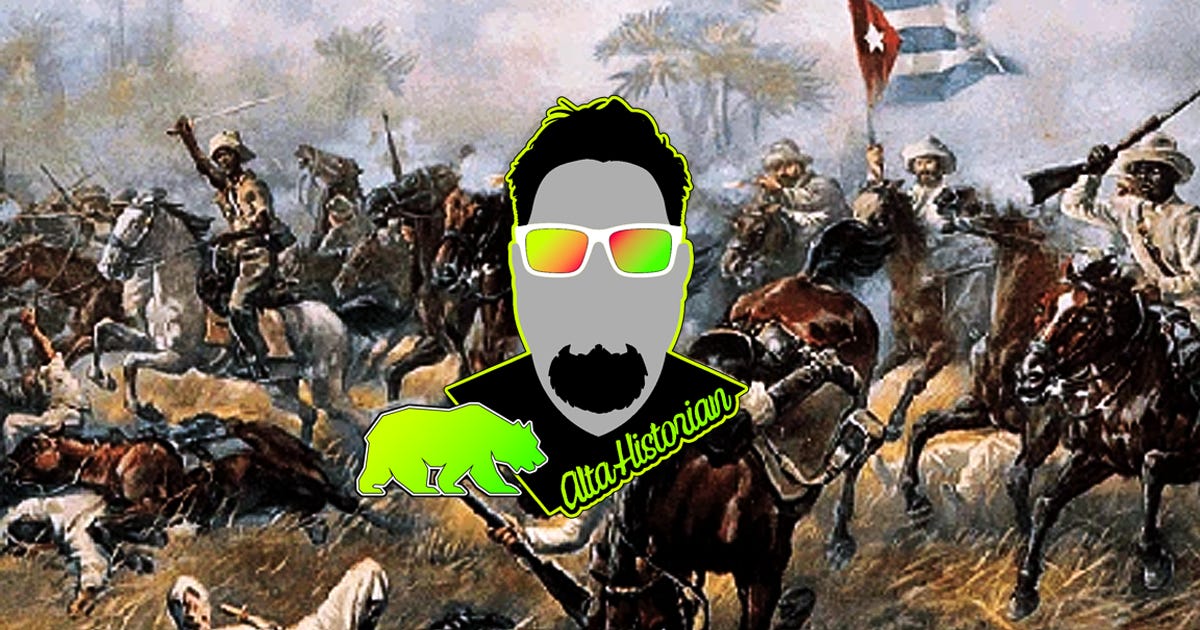
The Spanish-American War was a popular war, in large part due to its perceived morality. It was presented to the American public as a morally purposeful crusade — the liberation of the Cuban people from the fading authority of Spain. The struggle appeared noble when filtered through the powerful machinery of American journalism. The newspapers of William Randolph Hearst’s New York Journal and Joseph Pulitzer’s New York World transformed distant events in the Caribbean into a moral drama unfolding before the American public.
Hearst himself openly articulated the ideological language of the moment. In 1898, he asked, “Shall we not continue to hold power, in growth and expansion our first place among the nations of the earth?” For Hearst, such convictions were not abstract philosophy. They were intertwined with his substantial portfolio in mining and agricultural holdings throughout Latin America and the wider world. Expansion promised both national prestige and private opportunity.
Around Hearst, a circle of political and intellectual allies gathered who shared a similar outlook. Among them was Theodore Roosevelt. Captain Alfred Thayer Mahan, whose naval theories promoted an “Ideology of expansion” across the seas. There was also Senator Henry Cabot Lodge of Massachusetts.
Together, they articulated a vision of American power that reached beyond continental boundaries. Historians have often described the Spanish-American War as the “last war of a more innocent era.” Yet it was also something new — the dawn of what has been called American “large policy,” a moment when the United States began its transformation from a continental nation into a global influence.
The intellectual and economic groundwork for this transformation had been laid several years earlier. The Depression of 1893 shook the foundations of American society. The crisis nearly fractured the country’s two-party political system as the left-wing Populist Party surged in protest before eventually merging back into the Democratic Party under the leadership of William Jennings Bryan.
More profoundly, the depression revealed a structural problem within the American economy — agricultural overproduction. Farmers in the tobacco, cotton, and wheat regions depended heavily on international markets for their prosperity. When those markets faltered, the consequences rippled across the nation. Expansion into foreign markets increasingly appeared not merely desirable but necessary.
At the same moment, the geographic frontier that had long absorbed American energy seemed to close. Historian Frederic Jackson Turner famously articulated this reality in his “Frontier Thesis,” arguing that the American frontier — the defining environment of the nation’s political and social character — had effectively disappeared. If the frontier had once provided the outlet for American ambition, the search for new markets and new influence would now carry that impulse outward.
Four hundred years after Columbus’s arrival in the Americas, and roughly fifty years after the Mexican War had fulfilled the continental phase of expansion, the older doctrine of Manifest Destiny began to evolve. What John L. O’Sullivan once imagined as a continental mission now seemed destined to move beyond North America itself.
By the end of the nineteenth century, American commerce had already begun that outward movement. By 1898, American capital invested overseas had reached approximately $1 billion. Nearly ten percent of American products were sold abroad. As early as 1893, American trade had surpassed that of every nation except England. Industrial giants such as Standard Oil extended American economic power far beyond its borders. By 1891, Rockefeller’s company controlled 90% of American kerosene exports and nearly 70% of the global market.
Economic power, in other words, had already begun to cross oceans. The political and military structures to support that power would soon follow.
Long before the Spanish-American War, the United States had been steadily extending its commercial and political presence throughout Latin America. As one historian notes, “The ascendency of US commercial influence provided considerable leverage in swaying the Latin American political elite; and leaders in Washington began invoking the Monroe Doctrine in unprecedented ways.” Through new treaties, foreign investments, and constitutional reforms within Latin American states, the United States increasingly assumed the role of hemispheric “protector.”
American military activity accompanied this growing economic influence. As early as 1822, the United States established the Pacific Squadron in order to protect “American whalers and commercial interests in South America.” The defense of commerce soon justified repeated interventions across the hemisphere.
American forces saw action in Cuba in 1822, Puerto Rico in 1824, Argentina in 1833, 1852, and 1853, and Peru between 1835 and 1836. In 1832, the United States dispatched a naval fleet to the Falkland Islands to suppress an Argentine garrison that had harassed American shipping. These interventions were framed not as conquest but as the protection of commerce — an early example of the economic motivations that would later shape American foreign policy.
The Mexican War provided the most dramatic expression of Manifest Destiny during the mid-nineteenth century. Yet American involvement in Latin America did not end with continental expansion. Following the Civil War, the United States resumed its outward engagement. Between the end of the Civil War and the outbreak of the Spanish-American War, American Marines landed in Cuba, Uruguay, Argentina, Chile, Colombia, and Haiti.
These early interventions formed the institutional and ideological scaffolding of later expansion. By the 1890s, American power was already familiar in the Caribbean and along the coasts of South America. Yet the crisis that would eventually draw the United States fully into the region had begun decades earlier on the island of Cuba.
Since its discovery by Christopher Columbus in 1493, Cuba had been known as the “Pearl” of the Spanish Empire. Its sugar plantations and strategic position in the Caribbean made it one of Spain’s most valuable colonial possessions. Yet by the middle of the nineteenth century, Spain’s imperial power had begun to decline, and unrest steadily grew within Cuban society.
In 1866, the government in Madrid created the Junta de Informacion to respond to rising Cuban nationalist demands. Many Cubans hoped the body would bring reforms — equality before the law, the emancipation of enslaved people, and the extension of political rights. Instead, the Spanish government responded with increased taxation and the banning of reformist meetings.
Reform soon gave way to revolution.
The movement for independence emerged under the leadership of sugar planter Carlos Manuel de Céspedes del Castillo. On October 10, 1868, Céspedes proclaimed independence and established the Republic of Cuba. By 1869, he drafted a constitution that abolished slavery and even proposed annexation to the United States.
Yet the United States, still struggling through the social and political complexities of Reconstruction, declined to intervene. President Ulysses S. Grant consciously ignored the Cuban claim. Even without official recognition, Cuban exiles organized an active Junta in the United States. They raised money and spread pro-Cuban propaganda in support of the revolution.
Other prominent leaders joined the cause. Máximo Gómez became a central military strategist, while Antonio Maceo y Grajales emerged as one of the most formidable commanders of the insurgent forces. But unity proved elusive. Gómez’s strategy of burning sugar plantations to cripple the Spanish economy provoked controversy, while Maceo’s popularity among Afro-Cuban fighters generated anxiety among white Cuban nationalists who feared a broader social revolution.
The movement struggled to coordinate its goals. Despite mobilizing more than 12,000 fighters in guerrilla warfare, internal divisions and dwindling resources weakened the insurgency. By 1877, the rebellion had begun to collapse. In 1878, Cuban leaders and the Spanish government signed the Pact of Zanjón, formally ending the conflict known as the Ten Years’ War.
Although the revolution failed to secure independence, it proved that organized resistance to Spanish rule was possible. The memory of the struggle—and the leaders it produced—would shape the next generation of Cuban revolutionaries.
Even as these revolutionary traditions matured within Cuba, larger forces were reshaping the hemisphere. In the closing decades of the nineteenth century, capital, commerce, and strategic ambition increasingly drew the United States into the affairs of Latin America. Economic transformations on both sides of the Caribbean began to bind the island—and the wider region—more closely to the expanding power of the United States.
One example can be found in Mexico under the rule of Porfirio Díaz. Seeking to modernize his country and attract foreign capital, Díaz implemented policies that favored foreign investors and domestic elites. Traditional systems of communal land ownership among Indigenous communities were privatized under what Díaz described as “scientific management.”
Land surveyors were often compensated with one-third of the land they measured, allowing foreign investors to acquire enormous tracts of property. Among those beneficiaries was George Hearst, the father of William Randolph Hearst and a United States senator from California. By the 1880s, George Hearst had accumulated more than 375,000 acres in Veracruz, Campeche, and the Yucatán, along with another 200,000 acres in Sonora. Some scholars estimate that the Hearst family ultimately controlled as much as 7.5 million acres in Mexico.
The Hearst holdings were only one example of a broader pattern. American investors poured capital into Latin American mines, plantations, and infrastructure projects, eager to exploit the region’s abundant natural resources. Hearst himself maintained mining interests in Peru.
Shortly after the Spanish-American War, Hearst articulated what he believed to be a central principle of American identity. Writing under the headline “Expansion, Growth, and Progress Are Synonymous,” he declared:
“Liberty is expansion, life is expansion. Contraction, stagnation, lifelessness — these conditions mark the decay of a nation ….”
Expansion, in this vision, was not merely a policy. It was a philosophy of national vitality. The unresolved tensions of the Ten Years’ War returned in 1895 with a new Cuban revolution. The movement was led by three central figures: Máximo Gómez, Calixto García, and José Martí.
García served as a crucial military leader and later provided vital intelligence to the United States military, including maps and detailed information about Spanish officers. Martí, a Cuban émigré who organized the Cigarworkers Party, joined Gómez in the revolutionary effort. Killed in action shortly after the uprising began, Martí became a martyr of the Cuban cause and a lasting symbol of Cuban nationalism.
Spain responded to the insurgency with overwhelming force, sending approximately 100,000 soldiers to the island. Yet Spain’s heavy-handed policies ultimately strengthened the international case against its rule.
One of the most controversial measures was the Reconcentrado Policy implemented by General Valeriano “the Butcher” Weyler. Inspired in part by the scorched-earth tactics associated with William Tecumseh Sherman, Weyler forced rural Cuban populations into concentration camps in order to isolate guerrilla fighters from civilian support.
Reports from Cuba shocked American observers. C. W. Russell, an attaché of the United States Department of Justice who visited the island after the policy took effect, described what he witnessed:
“I spent just two weeks in Cuba…I found reconcentrados…and begging everywhere about the streets of Havana…women and children emaciated to skeletons and suffering from diseases produced by starvation, was sickening…
In one case the remnant consisted of two children, seven or eight years old. In another case, where I talked to the people in broken Spanish, there were four individuals, a mother, a girl of fourteen, and two quite small girls. The smallest was then suffering from malarial fever. The next had the signs on her hands…of having had that dreadful disease, the beri-beri. These four were all that order of concentration had left alive of eleven…
San Domingo is little more than a railroad station in times of peace, but at present it has a considerable population…composed of the survivors of the reconcentrados…They had no work to do, no soil to till, no seed to plant, and only begging to live on…Practically they were prisoners…”
Such reports circulated widely in American newspapers. The suffering of Cuban civilians became powerful material for the expanding world of American mass media.
Journalists such as William Randolph Hearst and Joseph Pulitzer filled their pages with dramatic accounts of Spanish brutality. Their newspapers sold millions of copies. Whether motivated by humanitarian concern, commercial opportunity, or both, these publications ensured that the Cuban struggle became a central issue in American public life.
By the late 1890s, the United States itself had changed. The Civil War was long over. The western frontier had been settled. Immigration had reached record levels, and the nation’s industrial economy had expanded dramatically. Historian Stephen Ambrose captured the restless energy of the period when he wrote that the United States “had to find some new outlet for our energy, for our dynamic nature, for this coiled spring that was the United States.”
Political thinkers reinforced that sentiment. Captain Alfred Thayer Mahan argued that global power belonged to nations with the strongest navies — those who controlled the sea lanes of the world would ultimately “inherit the earth.” His ideas deeply influenced younger politicians such as Theodore Roosevelt, who believed that Americans must now begin to look outward.
Senator Henry Cabot Lodge expressed a similar vision in his 1895 article “The Business World vs. the Politicians”:
“In the interests of our commerce… we should build the Nicaragua canal and for the protection of that canal and for the sake of our commercial supremacy in the Pacific we should control the Hawaiian islands and maintain our influence in Samoa… and when the Nicaraguan canal is built, the island of Cuba…will become a necessity…The great nations are rapidly absorbing for their future expansion and their present defense all the waste places of the earth. It is a movement which makes for civilization and the advancement of the race. As one of the greatest nations of the world the United States must not fall out of the line of march.”
By the mid-1890s, the language of expansion had acquired both an intellectual and a commercial grammar. Mahan supplied the naval doctrine. Lodge supplied the political rationale. Hearst and Pulitzer supplied the emotional register through which the public would encounter Cuba. Together, they helped transform expansion from an elite argument into a national mood.
The emerging ideology claimed continuity with older American principles. It drew upon Manifest Destiny, now revised for an oceanic age, and it invoked the Monroe Doctrine as though an anti-colonial and anti-imperial warning against European intervention could be converted into a justification for American territorial control. The contradiction was not incidental. It was the very mechanism by which American power could present itself as something other than empire. What was once a doctrine of exclusion became, by the 1890s, the vocabulary of possession.
President William McKinley himself used the term “Manifest Destiny” in 1898. By then, the older continental language of the republic had been redirected outward. The closing of the West, the depression of 1893, the pressure of agricultural surplus, and the search for foreign markets all converged into a single proposition: that American stability at home required American movement abroad.
That proposition rested, at least superficially, upon Anglo-Exceptionalism. The claim was that it was the duty of the United States to “Anglo-Saxon-ize” the world with its Republican values, its frontier democracy, and its supposed ability to “raise up the poor.” The idea naturally extended to support for a canal through Central America, whether at Nicaragua or Panama, and to the broader desire for strategic footholds in the Caribbean and Pacific. The purpose was said to be civilization. The function was more immediate — to relieve social unrest, answer economic depression, and secure markets that would absorb American agricultural surplus, willingly if possible, forcibly if necessary.
In Cuba, meanwhile, Spanish repression provided the moral scene upon which this new American purpose could act. By February 1896, political pressure had begun to bear down upon the administration of Grover Cleveland. Spain’s Reconcentrado Policy under General Valeriano “the Butcher” Weyler gave American newspapers the images they needed and expansionists the outrage they required. The camps were not merely a Spanish crime. In the United States, they became a political instrument. The suffering of Cubans was real, but so too was the way that suffering was translated into a justification for American intervention.
This is what made the Spanish-American War so distinctive. It could be presented as both a moral duty and a national opportunity. It was a war for Cuban freedom, and it was a war for American expansion. It was a war against an empire, and it marked the arrival of a new one. That tension sits at the center of the conflict and explains much of its enduring power in American memory. The war could be imagined as innocent precisely because its material ambitions were clothed in the language of liberation.
Unlike the Ten Years’ War, the Cuban independence movement of the 1890s was not ignored by the United States. By 1895, the nation was no longer burdened by the immediate aftermath of the Civil War or Reconstruction. The republic had become more industrial, more commercially ambitious, and more confident in its power. Cuba now appeared not only as a nearby humanitarian crisis, but as the ideal outlet for what Stephen Ambrose called the “coiled spring” of the United States.
The sequence of events from 1896 to 1898 reveals how rapidly this pressure accumulated. Reconcentration in Cuba, revolt in the Philippines, the inauguration of McKinley, the appointment of Theodore Roosevelt as Assistant Secretary of the Navy, the Dupuy de Lôme scandal, the destruction of the U.S.S. Maine, Senator Proctor’s exposure of Spain’s brutality, and finally the declaration of war — each event intensified the sense that the United States was being drawn toward a destiny already prepared for it by depression, commerce, ideology, and media.
When Commodore Dewey won in the Philippines on May 1, 1898, and American troops landed in Cuba in June, the war ceased to be merely a Caribbean war. It became hemispheric and then global. Spain’s surrender at Santiago and the Peace Protocol of August 12, 1898, signaled not only the collapse of Spanish power in the Western Hemisphere but also the emergence of the United States as a power willing to gather the scattered remains of another empire. The Treaty of Paris, the Senate debate over ratification, and the later capture of Aguinaldo all demonstrated that the war’s logic did not end with Cuba. It widened.
That widening is what makes 1893 so important. The Depression of 1893 did not by itself cause the Spanish-American War. But it laid the foundation for the kind of America that would wage it. Economic crisis exposed the need, or what influential Americans defined as the need, for new markets. The closing frontier removed the old domestic outlet for national ambition. Commercial expansion in Latin America and abroad had already accustomed American elites to thinking in hemispheric terms. Cuba then provided the moral emergency through which those larger desires could be enacted.
The result was a new Manifest Destiny. Not the old continental version of O’Sullivan, though it descended from it. This new form was maritime, commercial, and increasingly imperial. It spoke the language of liberty while preparing the machinery of power. It defended Cuban freedom while inaugurating American “large policy.” It claimed to end an empire, and in doing so announced the arrival of another.
Cuba, the “Pearl” of the Spanish Empire, thus occupied a tragic and revealing position in this history. Its repeated struggles for independence were real, its leaders were real, and its suffering was real. But Cuba was also made to serve another story — the story the United States told about itself at the end of the nineteenth century. In that story, intervention became virtue, expansion became life, and empire became destiny.

Bibliography | Notes
Brechin, Gray. Imperial San Francisco: Urban Power, Earthly Ruin. UC Press, 1999.
Locke, Joseph L., and Ben Wright, eds. The American Yawp: A Massively Collaborative Open U.S. History Textbook. Vol. 1, To 1877. January 2019.
Mead, Walter Russell. Special Providence: American Foreign Policy and How It Changed the World. United Kingdom: Routledge, 2002.
PBS. “1868–1878: The Ten Years’ War in Cuba.” Crucible of Empire: The Spanish-American War.
Schweikart, Larry, and Michael Allen. A Patriot’s History of the United States: From Columbus’s Great Discovery to the War on Terror. New York: Sentinel, 2004.
Stromberg, Joseph. The Spanish-American War. Narrated by George C. Scott. United States at War series. Unabridged audiobook. October 1, 2012.
White, Trumbull. “Weyler’s Reconcentration Policy and Its Horrors.” In Our War with Spain for Cuba’s Freedom. C. W. Russell's account of reconcentrados, as cited in notes.
Zinn, Howard. A People’s History of the United States. New York: Harper & Row, 1980.Luther, Martin. Protestant Reformation, sixteenth century.
Washington Post editorial, as cited.
Henry Cabot Lodge, “The Business World vs. the Politicians,” as cited.