

To Alta California: Cabrillo
California History

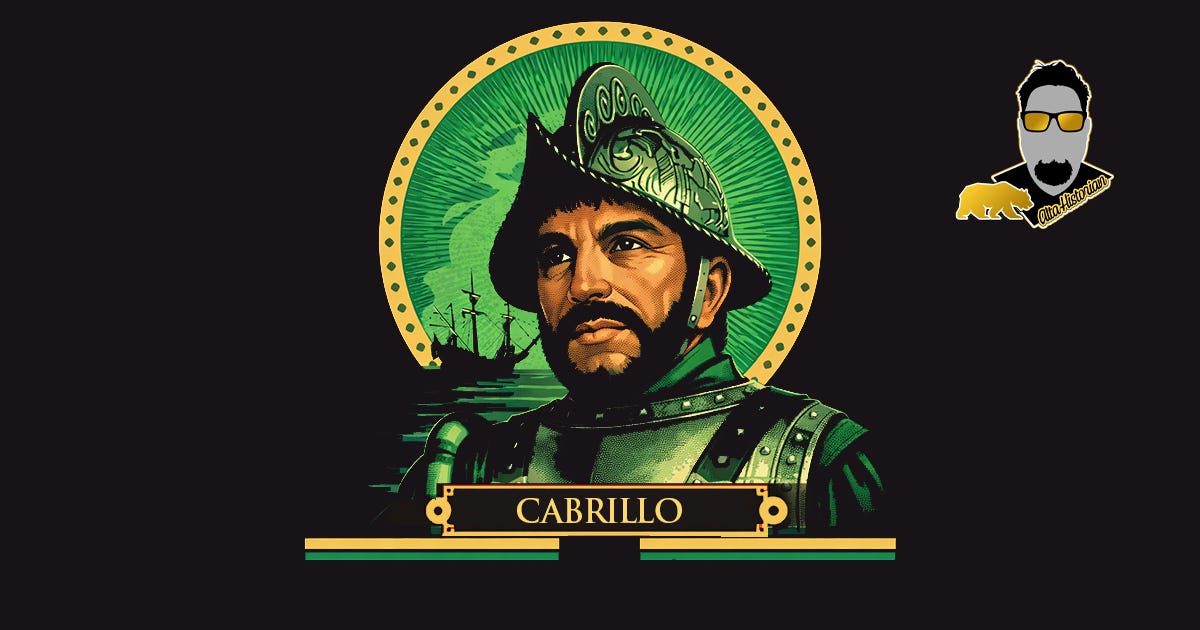
In the early 16th century, Juan Rodríguez Cabrillo, a Portuguese conquistador known for his skills as a navigator, crossbowman, and horseman, set out to reach the west coast of North America, eventually making landfall in present-day San Diego. His trip to North America’s west coast was fraught with danger and uncertainty. Still, Cabrillo was undaunted, driven by a desire for adventure and, no doubt, the promise of riches and glory—a hallmark of his career as a conquistador.
Before this journey, Cabrillo had participated in the 1520 expedition led by Panfilo de Narváez, which was sent to Mexico by the Governor of Spanish Cuba to confront and punish the conquistador Hernán Cortés, who was already looting the gold-rich Aztec Empire. However, upon arriving in Mexico, Cortés and allied Native warriors successfully defeated Narváez in a surprise attack in the dead of night. Many of Narváez’s men, including Cabrillo, joined Cortés’s forces, attracted by the promises of gold, land, and women — a more appealing offer for the conquistadors than anything Narváez could provide.
After defeating Narváez and reinforcing his forces, Cortés returned to the Aztec capital of Tenochtitlán to continue his conquest of the empire. In Cortés’ absence, tensions had risen due to the actions of Pedro de Alvarado, who had imprisoned and killed several important Aztec leaders. During the Aztec festival of Huitzilopochtli, Alvarado ordered the execution of more Aztec leaders, leading to the expulsion of the Spaniards from the city. This event was a full-scale Aztec assault on the Europeans, known as the Noche Triste, or “Sad Night,” on June 30, 1520, in which the Aztecs trapped the Spaniards in the city and cut off the causeways, bridges, and escape routes.
Cortés attempted to use the Aztec ruler Montezuma to calm his people, but was met with a hail of arrows and stones. In the process, Montezuma was killed, and the Spanish attempted to leave the city undetected. Still, chaos erupted upon the news of Montezuma’s death, as did the attacks against Cortés's forces. Cortés and his men fled the city, with 65% of them (around 800) being killed in battle, on the sacrificial altars, or in the lake as they tried to swim to the boats of their Native allies. Weighed down by the stolen gold on their persons, many of the conquistadors sank into the waters surrounding Tenochtitlán.
Despite his earlier experiences, Cabrillo survived and later played a key role in founding Guatemala’s first capital. However, Cabrillo’s life was forever tied to the Spanish Empire’s colonial efforts, and the empire’s demands outweighed his desire for a more normal life. After the conquest of Tenochtitlán, he married an indigenous woman. He had children before later marrying the sister of his business partner to comply with the Spanish Crown's requirement that landowners be Spanish. Cabrillo also oversaw the construction of ships that helped open the Pacific Ocean to trade with the Philippines and California. When Pedro de Alvarado, the Governor of Guatemala, needed a fleet to be built for a voyage to California, he chose Cabrillo.
After Alvarado was killed in an Indian uprising, Cabrillo was selected to lead one of two expeditions exploring the Pacific. The other voyage, led by Ruy Lopez de Villalobos, was headed to the Philippines. It ended in disaster for Villalobos, who was killed in a mutiny, and his men surrendered to a Portuguese garrison in the Spice Islands. Before Villalobos died, he had discovered Cape Mendocino in Northern California in 1542 at 41 ½ °, which would gain importance a half-century later. This experience foreshadowed the challenges the Spanish would face in their explorations of the Pacific.
Cabrillo set out in 1542 on a journey to find the western entrance to the mythical Northwest Passage connecting the Atlantic and Pacific oceans, also seeking a faster route to the wealthy islands of Asia. Cabrillo left Puerto de Navidad on June 27, 1542, with two ships, the San Salvador and the Victoria, and arrived in San Diego Bay on September 28. The voyage was slow and arduous, with the ships sailing 15 to 20 miles per day using imprecise maps and information from previous expeditions. On September 17, the expedition reached Ensenada and stayed there for five days, noting that the weather and landscape reminded them of Spain.
They continued and sailed near the Coronado Islands before reaching Point Loma, where they anchored in the bay and stepped onto California soil, naming the area San Miguel (which was later renamed San Diego by explorer Sebastian Vizcaino about 60 years later). The expedition’s journal entry for that day details the discovery and their interactions with the Native inhabitants, who appeared to be aware of the Spanish expeditions in the area. Most of the Natives fled, but those who remained showed “signs of great fear.” To ease the tensions, Cabrillo gave the Natives gifts.
That evening indicated what was to come, as some expedition members went ashore to fish and were attacked by Native arrows, wounding three. The Natives encountered by the expedition were likely the Kumeyaay, well-known for their resistance to European intruders and a tendency to seek violent revenge. The Native’s behavior during the encounter, as described in the expedition’s journal, suggests that they were aware of the violence and destruction that the Spanish had inflicted on other Native groups in the region,
“…men like us were traveling about, bearded, clothed, and armed like those of the ships. They made signs that they carried crossbows and swords; and they made gestures with the right arm as if they were throwing lances, and ran around as if they were on horseback. They made signs that they were killing many native Indians, and that for this reason they were afraid.”
According to Spanish records, the Natives encountered by Cabrillo’s expedition were large and well-proportioned and wore animal skins. The Natives had contact with or information about the Europeans, having a name for the Christian conquistadors: Guacamal.
The expedition continued its journey on October 3, mapping and exploring the California coast. They landed on what is now San Miguel Island (which Cabrillo named La Posesión) and met friendly Natives on the Channel Islands. Juan Paez, a member of the expedition, described the Chumash Natives of the Santa Barbara Channel Islands as having “hair very long and tied up with long strings interwoven with the hair, there being attached to the strings many gewgaws of flint, bone, and wood.”
The expedition may have continued as far north as Monterey, but they encountered severe storms and missed both Monterey Bay and San Francisco Bay. After engaging hostile Natives and facing severe storms, Cabrillo and his men decided to winter on San Miguel Island. The Natives had grown tired of the constant demands for “food, wood, and fresh water,” as Francisco de Vargas recalled, “the Indians never stopped fighting us.”
Christmas Eve 1542 would be no exception, as the expedition was attacked as they camped on shore, and the Natives were exceptionally relentless. The Chumash Natives, who had initially welcomed the Spanish, now attacked the men camping on the beach in the middle of the night. Cabrillo, reportedly on the ship, went to help his men ward off the Chumash. In the process, Cabrillo fell and suffered a catastrophic injury. Francisco de Vargas remembered, “As he [Cabrillo] began to jump out of the boat, one foot stuck on a rocky ledge, and he splintered a shinbone.” There are also accounts that Cabrillo suffered a broken arm in the fall; both injuries are possible in describing Cabrillo’s condition.
Despite his injuries, the expedition continued until Cabrillo’s death on January 3, 1543. It is said that his crew buried him on San Miguel Island. The crew, discouraged and disheartened, may have sailed as far north as Oregon but found nothing of value, no Northwest Passage or shortcut to the Spice Islands, no gold or Amazonian women. Cabrillo’s name soon faded into obscurity, with his enemies dividing up his property and taking its revenues even before his death on the island.

Bibliography | Notes
Bean, Walton, and James J. Rawls. California: An Interpretive History. New York: McGraw-Hill, 1973.
Burney, James. A Chronological History of the Discoveries in the South Sea or Pacific Ocean. London: Luke Hansard Printing, 1803.
Calloway, Colin G. One Vast Winter Count: The Native West Before Lewis and Clark. Lincoln: University of Nebraska Press, 2003.
Cutter, Donald C. “Plans for the Occupation of Upper California: A New Look at the ‘Dark Age’ from 1602 to 1769.” The Journal of San Diego History 24, no. 1 (Winter 1978).
https://sandiegohistory.org/journal/1978/january/plans/.
Gutiérrez, Ramón A., and Richard J. Orsi. Contested Eden: California Before the Gold Rush. Berkeley: University of California Press, 1998.
Heizer, Robert F. “Francis Drake and the California Indians, 1579.” University of California Publications in American Archaeology and Ethnology 42, no. 3 (March 20, 1947): 251–302.
Kelly, David. “Archaeologists Explore a Rural Field in Kansas, and a Lost City Emerges.” Los Angeles Times, August 19, 2018.
https://www.latimes.com/nation/la-na-kansas-lost-city-20180819-htmlstory.html.
Kessell, John L. Spain in the Southwest: A Narrative History of Colonial New Mexico, Arizona, Texas, and California. Norman: University of Oklahoma Press, 2013.
Montalvo, Garcí Ordóñez de. Las Sergas de Esplandián. First published 1510.
Moriarty, James R. “The Discovery & Earliest Explorations of Baja California.” San Diego Historical Society Quarterly 11, no. 1 (January 1965).
https://sandiegohistory.org/journal/1965/january/discovery-2/.
National Park Service. “Juan Rodriguez Cabrillo.” Last modified October 4, 2022.
https://www.nps.gov/cabr/learn/historyculture/juan-rodriguez-cabrillo.htm.
Niemann, Greg. Baja Legends: The Historic Characters, Events, and Locations That Put Baja California on the Map. San Diego: Sunbelt Publications, 2002.
Oswalt, Robert L., ed. Kashaya Texts. Berkeley: University of California Press, 1964.
Pourade, Richard F. The History of San Diego, Volume I: The Explorers. San Diego: San Diego Historical Society, 1960. https://sandiegohistory.org/archives/books/explorers/.
Sanchez, Joseph P. “From the Philippines to the California Coast in 1595: The Last Voyage of San Agustín Under Sebastián Rodríguez Cermeño.” Colonial Latin American Historical Review 10, no. 2 (Spring 2001): 221–254.
San Diego History Center. “Sebastián Vizcaíno.” Accessed n.d.
https://sandiegohistory.org/archives/biographysubject/vizcaino/.