

To Alta California: Hernán Cortés’ Torture
California History

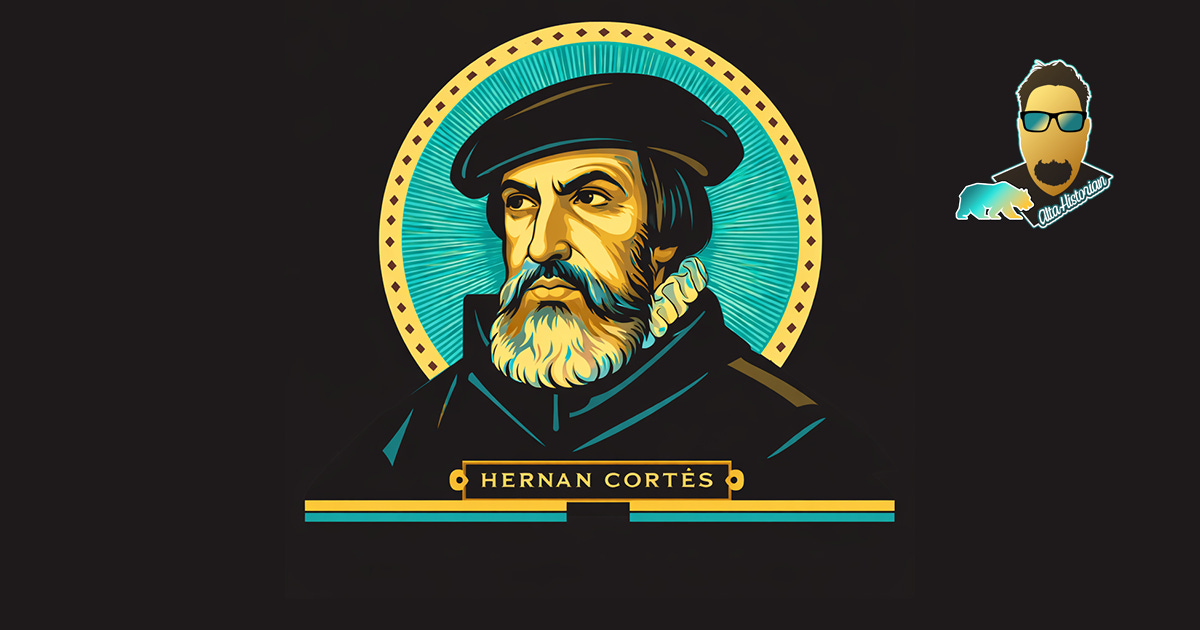
For the Spanish conquistadors, conquering Alta California proved more challenging than their conquests of the Aztec and Inca empires. The state’s population was decentralized and located far from Mexico City, New Spain’s operations base. Additionally, Alta California was protected by its treacherous deserts, stormy ocean, and towering mountain ranges.
It is believed that the Spanish first learned of California from the Aztecs during Hernán Cortés’ torture of Aztec nobles. While the powerful Aztec ruler Montezuma and his courier system held influence as far north as Oaxaca, there is no evidence that Montezuma or any other Aztec noble had a significant presence in Alta California.
Spanish attempts to conquer California eventually led to the occupation of Colima and Zacátula. However, these efforts only brought them as far north as the Río Grande de Jalisco, still nearly 1,400 miles from the future American border of California. Many of these early attempts were led by Hernán Cortés, who, despite conquering the gold-rich Aztec Empire, believed that the mythical land of El Dorado in the north held even greater riches.
Cortés arrived in what is now Mexico in 1519 and conquered the Aztecs in 1521, winning favor with Spanish royalty. However, by 1530, Cortés returned to Spain and was not well received by the Royal Court, leading to an increased appetite for territorial expansion. Under his leadership, progress was made. On June 5, 1530, Nuño de Guzmán arrived on the Pacific Coast in Nayarit, a place so beautiful that the local indigenous people used the word Nayarit to mean “Son of god which is in heaven and in the sun.” Cortés also claimed the harbor of Acapulco in 1531, and it was then that the mythology of the Aztecs and the Spanish intersected.
The Aztec roots are of the Mexica people, said to have migrated from Aztlán in the north, some say, to Alta California. This aligns well with Garcí Ordónez de Montalvo’s book titled Las Sergas de Esplandian, first printed in 1510, which names “California” as “an island” that was “peopled with black women, without any men among them, because they were accustomed to live after the fashion of the Amazons.” While there are other theories regarding the origin of the name “California,” none are as convincing, romantic, or exciting as Montalvo’s book, which fueled expeditions northward.
In pursuit of restoring his reputation and salvation with royalty, Cortés turned to the north and the Baja Peninsula, where he was able to establish the colony of Santa Cruz at Puerto de la Paz, also known simply as “La Paz.” However, his efforts, like those of the Ximénez Expedition before him, ultimately proved unsuccessful. Cortés remained constantly occupied with suppressing the mutiny of unhappy colonists, avenging the deaths of his soldiers killed by the Native people, and suffering significant losses due to starvation. His invasion of Native lands and kidnapping of Natives for intelligence and translation purposes were also largely unsuccessful.
The settlers were disappointed by the doomed colonization effort. The situation was further exacerbated by Francisco Pizarro’s discovery and conquest of the Inca in 1532 in present-day Peru, which offered hope to some in the struggling colony of La Paz — but also left a sour taste in the mouths of those who felt they had missed out on the riches of the last great gold-rich American empire. The Spanish colonial regime’s bureaucracy hindered the progress of other ambitious conquistadors seeking the next great find in the north.
Cortés, once again battling for his reputation, delegated his responsibilities in La Paz to Francisco de Ulloa in 1536 and returned to Spain. Around the same time, the discovery of Alvar Núñez Cabeza de Vaca by Spanish slave hunters in northern Mexico after a six-year journey added to the mythology of the north.
Ulloa was an enigmatic figure who had assisted Cortés during the conquest of the Aztecs and was part of the expedition that discovered the Gulf of California (then known as the Red Sea of Cortés). Despite their numerous failures in the dangerous waters of the West Coast, Cortés entrusted Ulloa with one final attempt to explore California in 1539. During this journey, Ulloa kept a detailed journal later discovered in an archive in Seville, Spain.
On July 8, 1539, Ulloa set out from Acapulco towards the Gulf of California with three ships: the Santa Agueda, Trinidad, and Santo Tomás. By August, they stopped in the Manzanillo harbor before departing on the 27th. Four days later, Ulloa was caught in a fierce storm, which caused trouble for the smallest ship, the Santo Tomás, which was never seen again. The expedition continued to La Paz and the mainland, to the tropical flatlands of Northern Mexico. It was here that Ulloa encountered the sandy delta of the Colorado River, but was stopped from any further progress—the sandbars were too high and the tide too low for his ships to pass. Ulloa described the rage of the Colorado meeting the ocean as “a thing to be marveled at.” At this point, Ulloa realized that Baja California was not an island but a peninsula. Ulloa attempted to round the peninsula and head north, but was not successful until returning some months later in January of 1540.
As quickly as Ulloa appeared in the historical record, the end of his journal marked the end of his official historical record. Some claim that he died on the coast of Southern California. At the same time, Bernal Díaz del Castillo, the renowned historian who documented the conquest of Mexico, alleges that Ulloa was murdered by one of his crew in Mexico. According to Castillo, Ulloa returned to the Port of Jalisco and, while resting ashore, was killed by the sword — the deed of a soldier on his flagship. Cortés never stopped exploring, even doing so at his own expense. It was his addiction, and he would continue forward even when not in an official capacity (he returned to Mexico in 1547 in disguise). Unfortunately, upon his return to Seville, Spain, he contracted dysentery and later died of pleurisy in December of that year at 62.

Bibliography | Notes
Bean, Walton, and James J. Rawls. California: An Interpretive History. New York: McGraw-Hill, 1973.
Burney, James. A Chronological History of the Discoveries in the South Sea or Pacific Ocean. London: Luke Hansard Printing, 1803.
Calloway, Colin G. One Vast Winter Count: The Native West Before Lewis and Clark. Lincoln: University of Nebraska Press, 2003.
Cutter, Donald C. “Plans for the Occupation of Upper California: A New Look at the ‘Dark Age’ from 1602 to 1769.” The Journal of San Diego History 24, no. 1 (Winter 1978).
https://sandiegohistory.org/journal/1978/january/plans/.
Gutiérrez, Ramón A., and Richard J. Orsi. Contested Eden: California Before the Gold Rush. Berkeley: University of California Press, 1998.
Heizer, Robert F. “Francis Drake and the California Indians, 1579.” University of California Publications in American Archaeology and Ethnology 42, no. 3 (March 20, 1947): 251–302.
Kelly, David. “Archaeologists Explore a Rural Field in Kansas, and a Lost City Emerges.” Los Angeles Times, August 19, 2018.
https://www.latimes.com/nation/la-na-kansas-lost-city-20180819-htmlstory.html.
Kessell, John L. Spain in the Southwest: A Narrative History of Colonial New Mexico, Arizona, Texas, and California. Norman: University of Oklahoma Press, 2013.
Montalvo, Garcí Ordóñez de. Las Sergas de Esplandián. First published 1510.
Moriarty, James R. “The Discovery & Earliest Explorations of Baja California.” San Diego Historical Society Quarterly 11, no. 1 (January 1965).
https://sandiegohistory.org/journal/1965/january/discovery-2/.
National Park Service. “Juan Rodriguez Cabrillo.” Last modified October 4, 2022.
https://www.nps.gov/cabr/learn/historyculture/juan-rodriguez-cabrillo.htm.
Niemann, Greg. Baja Legends: The Historic Characters, Events, and Locations That Put Baja California on the Map. San Diego: Sunbelt Publications, 2002.
Oswalt, Robert L., ed. Kashaya Texts. Berkeley: University of California Press, 1964.
Pourade, Richard F. The History of San Diego, Volume I: The Explorers. San Diego: San Diego Historical Society, 1960. https://sandiegohistory.org/archives/books/explorers/.
Sanchez, Joseph P. “From the Philippines to the California Coast in 1595: The Last Voyage of San Agustín Under Sebastián Rodríguez Cermeño.” Colonial Latin American Historical Review 10, no. 2 (Spring 2001): 221–254.
San Diego History Center. “Sebastián Vizcaíno.” Accessed n.d.
https://sandiegohistory.org/archives/biographysubject/vizcaino/.