

To Alta California: Sir Francis Drake and Others
California History

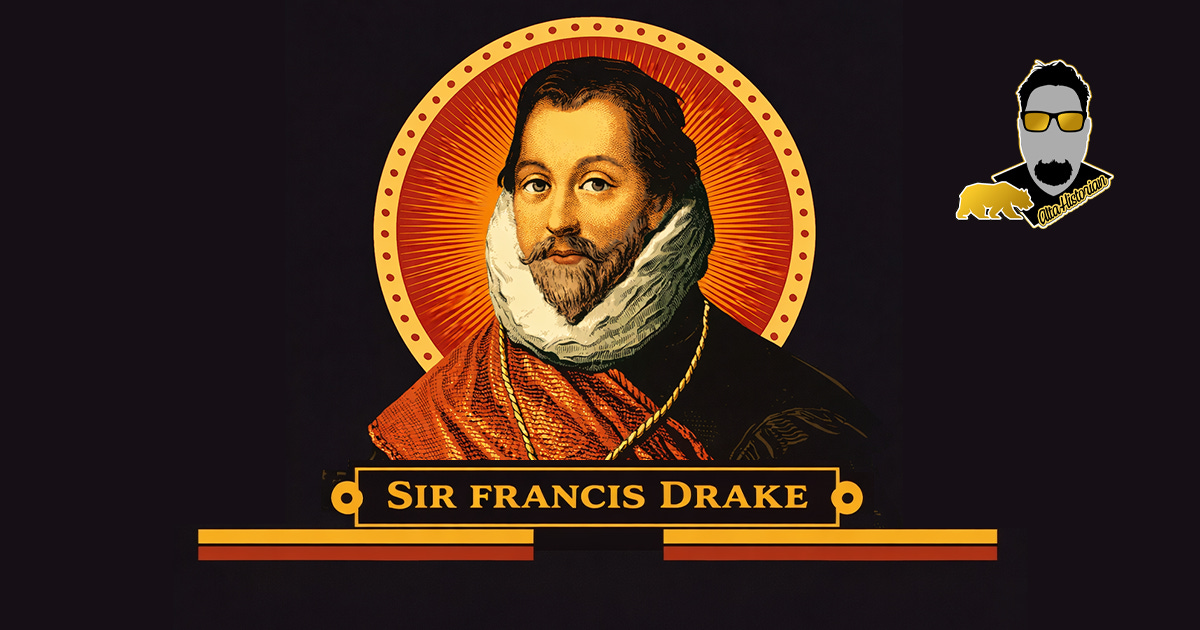
The Spanish were not the only empire scouring the world for riches. So too were the English and the empire’s most noteworthy pirate, Sir Francis Drake. As historian Donald Cutter wrote, between “1578 and 1579 Francis Drake, English gentleman or heretic pirate, depending on the point of view, entered what the Spanish had considered a Spanish lake—the Pacific Ocean.” Indeed, the tale of Sir Francis Drake, a man who was as much a gentleman as a scoundrel, recounts his raiding the coastal cities of Latin America. His escapades were the stuff of legend, and his acquisition of vast riches through nefarious means was a testament to his cunning and boldness.
Drake’s accumulation of Spanish booty was so grandiose that some estimate his take on a single trip to be over 30 tons, taken across two continents. When Drake landed in Alta California, it was to “caulk and boot-top his vessel, thereby restoring its seaworthiness,” as his ship, the Golden Hind, could no longer carry crew and treasure. Drake’s crew did so on the sun-drenched shores of modern Marin County (either Drake’s Bay or Bodega Bay), a temporary stay that would leave a lasting impression on the region’s history.
The historical narrative begins on June 17, 1579, when Drake enters the harbor, where he is later met by a representative in a canoe who shouts in his language until the representative departs. By June 21, Drake’s crew was fortified, and Natives began to show themselves for brief periods, then back to their nearby village. For the next two days, there were no natives in sight until “a great assembly of men, women, and children” appeared on the 23rd of June, as the historical narrative claims, and news became known to the country. The Natives made camp near the English, and by June 26th, word spread, and more came to see the European base until the Hioh (King) arrived with “his guard of about 100, tall and warlike men.”
As the exchange of gifts occurred, whereby the Natives placed a multi-colored feathered crown upon the head of Drake, the Natives cried “and tore their cheeks with their fingernails until blood ran,” the actions were mourning practices — the Natives believed the English were their relatives returning from the dead — this “dark prophecy of future course” meant they were relatives of the future, not the past. The Natives of modern Marin County, the Coast Miwok and Pomo groups, saw the landing of Sir Francis Drake and the Golden Hind as a fulfillment of a prophecy, as a modern account by Essie Parrish notes to Berkeley linguist Robert L. Oswalt in 1958,
“In the old days, before the white people came up here, there was a boat sailing on the ocean from the south. Because before that they had never seen a boat, they said, ‘Our world must be coming to an end. Couldn’t we do something? This big bird floating on the ocean is from somewhere, probably from up high. Let us plan a feast. Let us have a dance.’ They followed its course with their eyes to see what it would do. Having done so, they promised Our Father [a feast] saying that destruction was upon them…. When they had done so, they watched [the ship] sail way up north and disappear. They thought that [the ship] had not done anything but sail northwards because of the feast they had promised. They were saying that nothing had happened to them—the big bird person had sailed northward without doing anything—because of the promise of a feast; because of that they thought it had not done anything. Consequently they held a feast and a big dance…”
As accounts from all the Americas show, interactions between European explorers and Native populations in the New World were often complex and multifaceted. The case of Drake and California’s Natives offers marked insight into the sense of mourning and disbelief, leaving those involved to make sense of it in light of their knowledge of their world. As historian Walton Bean notes, “The main significance of the voyage of the Golden Hind was that it was the second ship to sail around the world…[though] his landing in California…has sometimes been misunderstood and exaggerated.”
The engagement between European explorers and Coast Natives of California, or at least the accounts of which were spread over decades. The history of Sebastian Rodríguez Cermeño provides even more insight into pre-colonial Alta California. Cermeño, the veteran sailor of the Spanish Manila galleon San Agustín, carried loads of treasure like Drake en route from the Philippines to Mexico in November of 1595, but of a different kind — luxury goods from China, specifically porcelain and silk. The San Agustín took on heavy weather, and strong winds threw them about, forcing him to shed treasure and crew.
It was discovered that the ship had taken on too much water. In contrast, in the Philippine Islands, the ship’s repairs and condition forced Cermeño to choose between treasure, passengers, and crew — the luxury goods and crew took priority, leaving all other passengers to find another ship to the Americas. The San Agustín had left Manila on July 5, 1595, and as they moved south toward the South of Japan, they were caught in the Japanese Black Current, which pushed them toward the California coast.
Like Drake, Cermeño and his 80-man crew ran ashore in what the Natives called tamál-húye, their name for the present-day area of the Bodega Head, Bodega Bay, and Drake’s Bay (which Cermeño named Bahía de San Francisco). Alonso Gómez described the abundance of pine forests and the heavy population along the coast, as evidenced by the many fires there and further into the interior.
Cermeño had special instructions from the viceroy of New Spain, Don Luís de Velasco, to explore Cape Mendocino, an area discovered by Captain Ruy López de Villalobos. They crash-landed in November, and Cermeño sent an exploratory crew that would map the region and fulfill the viceroy’s mission. As Cermeño’s crew worked to construct a second ship, the San Buenaventura, their extended stay would lead to interactions with the Coast Miwok population for more than a month.
He describes the Natives in his journal as “well-disposed and robust people, with long hair, and go naked, with their private parts out…” clarifying that “only the women cover their private parts with grass and some deerskins.” Gómez noted that, despite the long hair, most men lacked facial hair, and those with beards shaved them. To Cermeño and crew, this mission is more about survival and trade than colonization. Cermeño notes,
“Having anchored in the said bay on the sixth of said [month], shortly an Indian of one of those living on the beach came alongside in his small boat made of grass…. The said Indian was seated in the middle, and he had in his hand an oar with two blades with which he rowed with great swiftness. He came alongside our ship, where he remained talking in his language a good while without anyone understanding what he was saying. Having lured him with endearing words, he came closer to the ship and there we gave him things such as pieces of silk and blankets and other trifles, which the ship carried, and with which he returned to shore very contented.”
As the Spanish explored the beach, there were many Natives — men, women, and children — in their interactions, which remained relatively peaceful until Cermeño, Juan de Morgana, Don García de Paredes, and nine others approached to confront the Natives, who had taken wood from the San Agustín for their fire. The Natives did not take kindly, and a melee occurred, the Natives sending arrows toward the Spaniards, injuring at least one. The Indians would flee, and Cermeño and crew salvaged what they could of their fallen ship.
Cermeño departed for Acapulco on the San Buenaventura, with some following by land. The viceroy saw his mission of mapping California, Cape Mendocino, Cermeño was claimed to have “crossed from point to point and by night,” and should not have been done in hunger or haste to return home. This was effectively the end of Cermeño’s career — as Francisco Bolaños noted of the San Agustín in 1603, “The loss was caused more by the man commanding her than by the force of the wind.”
As Cermeño’s days drew to sunset, so did the light of exploration in California with the expedition of Sebastián Vizcaíno, landing in California on November 12th, 1602. Vizcaíno’s journey was long and complicated, lasting 10 months and 5 days. Accompanied by the ships San Diego and Santo Tomás, as well as the frigate Tres Reyes and a long boat left behind in Cabo San Lucas, they faced many of the same struggles as other expeditions before them — separation and scarcity of water among them.
This expedition landed in the San Miguel harbor, renamed after Vizcaíno’s flagship, the San Diego. In a move not unlike Cermeño before him, Vizcaíno navigated the politics of the viceroy by dedicating the harbor to Gaspár de Zúñiga y Acevedo, Count of Monte Rey, perhaps to earn political favor — or, perhaps, forgiveness. The group pushed on to Catalina Island and sailed past Point Conception and even Carmel Bay by December 16th.
Amidst great suffering of scurvy and strife, the expedition led by Vizcaíno pitched their tents beneath the shade of an oak tree, its branches reaching towards the tidewater, and set camp near springs of sweet water in a ravine. Though many of the sailors were ill, 16 souls were lost at their landing point, they persevered. The voyage proved a disaster — by the end, the group tallied 25 deaths and a mere 14 survivors.
Though little substance was gained, save for updating maps that would aid the Sacred Expedition of Junípero Serra, some minor significance may be found in the naming of San Diego de Alcalá. Further, Vizcaíno’s expedition marked the dark age of Spanish exploration in Alta California. Nearly 170 years would pass before the next incredible journey, outlined in 1768 and led by Portolá and Serra.

Bibliography | Notes
Bean, Walton, and James J. Rawls. California: An Interpretive History. New York: McGraw-Hill, 1973.
Burney, James. A Chronological History of the Discoveries in the South Sea or Pacific Ocean. London: Luke Hansard Printing, 1803.
Calloway, Colin G. One Vast Winter Count: The Native West Before Lewis and Clark. Lincoln: University of Nebraska Press, 2003.
Cutter, Donald C. “Plans for the Occupation of Upper California: A New Look at the ‘Dark Age’ from 1602 to 1769.” The Journal of San Diego History 24, no. 1 (Winter 1978).
https://sandiegohistory.org/journal/1978/january/plans/.
Gutiérrez, Ramón A., and Richard J. Orsi. Contested Eden: California Before the Gold Rush. Berkeley: University of California Press, 1998.
Heizer, Robert F. “Francis Drake and the California Indians, 1579.” University of California Publications in American Archaeology and Ethnology 42, no. 3 (March 20, 1947): 251–302.
Kelly, David. “Archaeologists Explore a Rural Field in Kansas, and a Lost City Emerges.” Los Angeles Times, August 19, 2018.
https://www.latimes.com/nation/la-na-kansas-lost-city-20180819-htmlstory.html.
Kessell, John L. Spain in the Southwest: A Narrative History of Colonial New Mexico, Arizona, Texas, and California. Norman: University of Oklahoma Press, 2013.
Montalvo, Garcí Ordóñez de. Las Sergas de Esplandián. First published 1510.
Moriarty, James R. “The Discovery & Earliest Explorations of Baja California.” San Diego Historical Society Quarterly 11, no. 1 (January 1965).
https://sandiegohistory.org/journal/1965/january/discovery-2/.
National Park Service. “Juan Rodriguez Cabrillo.” Last modified October 4, 2022.
https://www.nps.gov/cabr/learn/historyculture/juan-rodriguez-cabrillo.htm.
Niemann, Greg. Baja Legends: The Historic Characters, Events, and Locations That Put Baja California on the Map. San Diego: Sunbelt Publications, 2002.
Oswalt, Robert L., ed. Kashaya Texts. Berkeley: University of California Press, 1964.
Pourade, Richard F. The History of San Diego, Volume I: The Explorers. San Diego: San Diego Historical Society, 1960. https://sandiegohistory.org/archives/books/explorers/.
Sanchez, Joseph P. “From the Philippines to the California Coast in 1595: The Last Voyage of San Agustín Under Sebastián Rodríguez Cermeño.” Colonial Latin American Historical Review 10, no. 2 (Spring 2001): 221–254.
San Diego History Center. “Sebastián Vizcaíno.” Accessed n.d.
https://sandiegohistory.org/archives/biographysubject/vizcaino/.