

To America
United States History


“Knowledge makes a man unfit to be a slave.”
Frederick Douglass
Most native American origin stories assert that the American Indian has always called the Americas their home. Some scholars believe the timeline is 9,000 to 15,000 years ago. You have heard the stories of the Strait of Beringia. There is more recent evidence pointing to a range of 11,550 to 13,000 years ago, when humans, along with the animals they were likely hunting, were found in Lake Otero, now within White Sands National Park in New Mexico. In the Science article written in 2021, notes of the studies being done there seem to date back further:
Their studies “reveal numerous human footprints dating to about 23,000 to 21,000 years ago. These finds indicate the presence of humans in North America for approximately two millennia during the Last Glacial Maximum south of the migratory barrier created by the ice sheets to the north.”
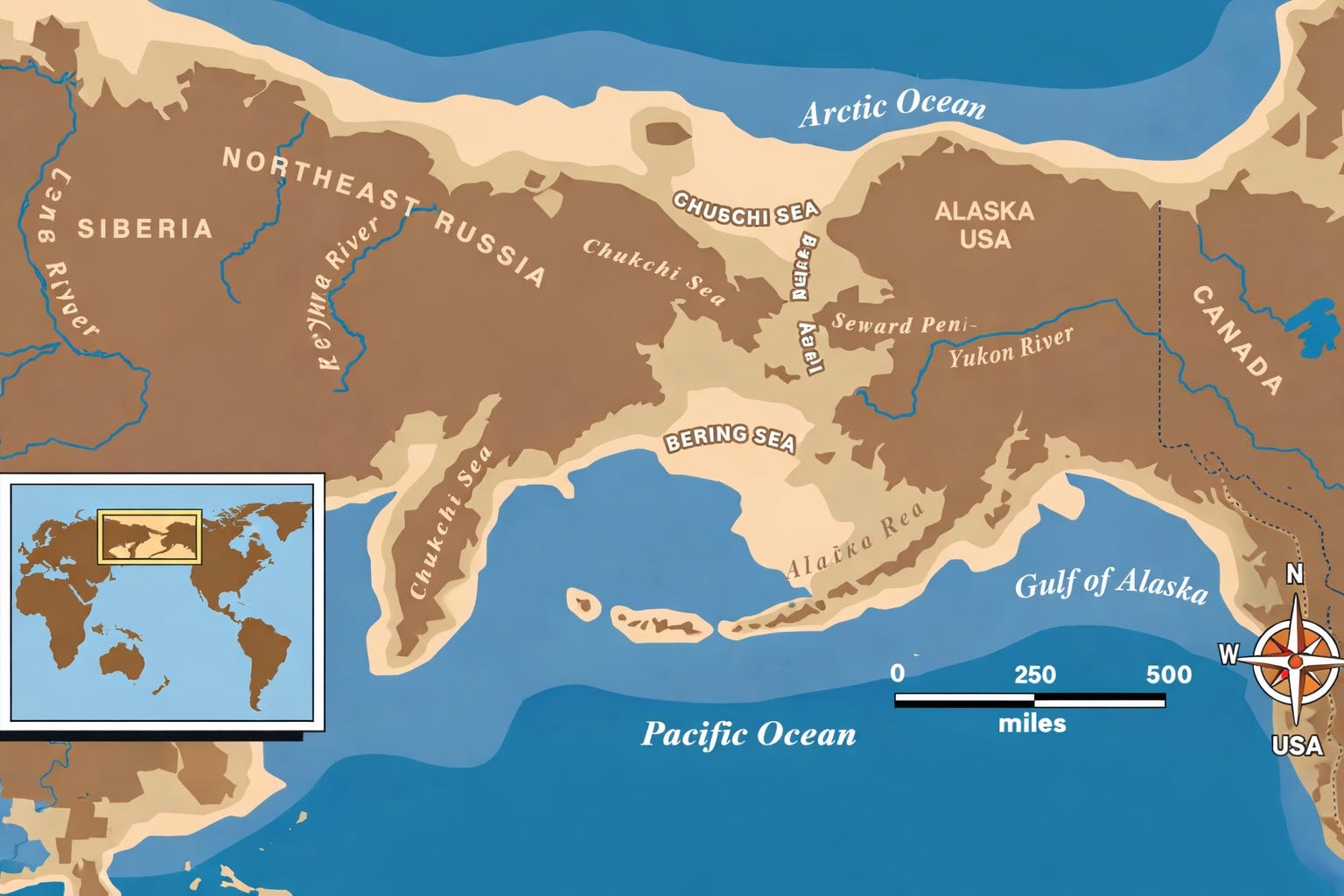
Further south in the Western Hemisphere, in South America, there are suggestions that migratory populations traveled along the Pacific coast by water, with Y-chromosome DNA markers lending credibility to this theory. The first proto-civilization was born there at Norte Chico some 5,000 years ago (~2627 BC), which, like nearly all civilizations around the world, was through the domestication of plants. Researchers believe the domestication of plants and animals dates back roughly 10,000 years, initially used to enhance their hunting and gathering techniques.
Agriculture began in the Americas between 9 and 5 thousand years ago, with civilizations emerging after Norte Chico in Mesoamerica (through maize production) in roughly 1200 BC. Maize (or corn) served as a staple across American civilizations for its high caloric content, its ability to be quickly dried and stored, and its sometimes biennial harvests in warmer climates. In North America, it was one of three staple crops that grew in tandem, known as the Three Sisters — corn, beans, and squash.
Agriculture flourished in the waterways of North America, particularly in the fertile river valleys between the great Mississippi River and the Atlantic Ocean — also known as the Eastern Woodlands. Here, the Three Sisters provided the nutritional needs for a sedentary culture that enabled permanent settlement, larger civilizations, and, inevitably, cities. This occurred throughout the Eastern Woodlands region (Northeast and Southeast on the map below), where almost every culture leaned heavily on the Three Sisters for sustenance and permanence.
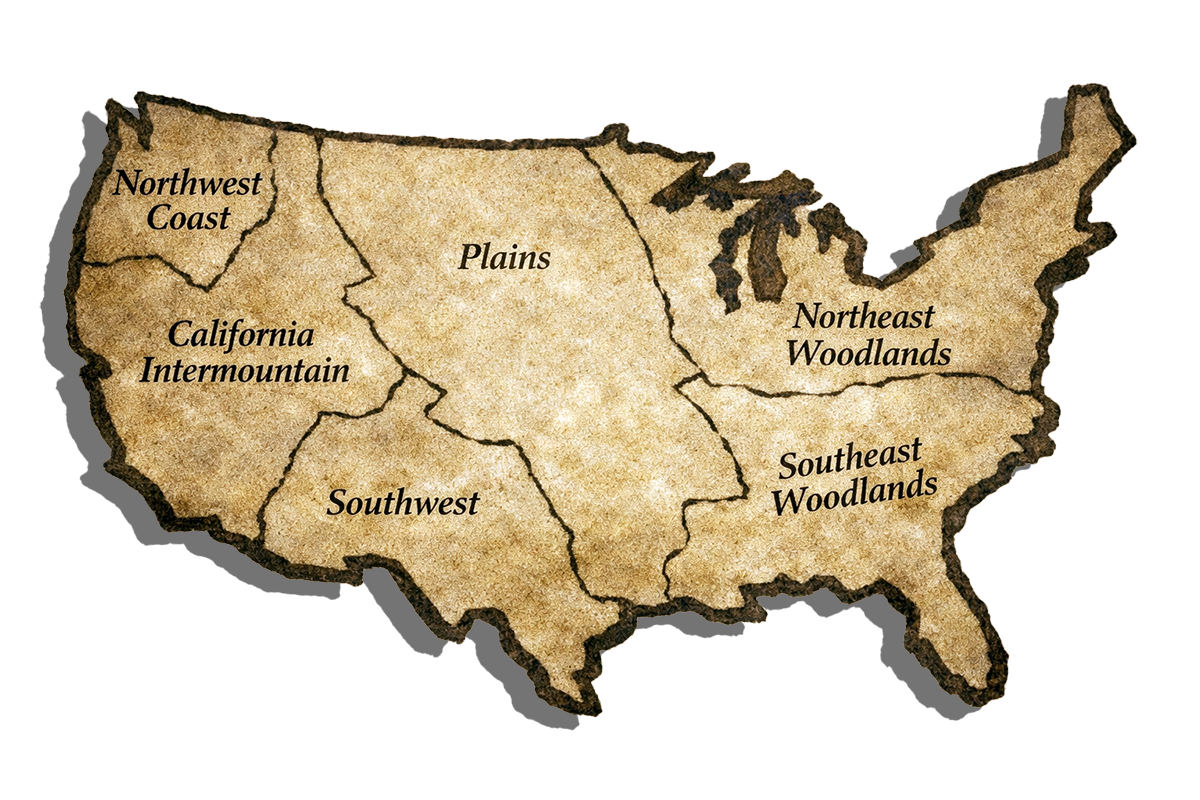
From the Great Lakes, down the Mississippi River, east to the Atlantic Coast, American Indian communities manage forest resources. During controlled forest burns, American Indian communities opened vast park-like hunting grounds and, in turn, revitalized the land for planting the Three Sisters in nutrient-rich ash. This cycle of renewal continued for centuries, with intensive agriculture carried out with hand tools — the only metal used was copper. Typically, men hunted and fished, and women practiced agriculture.
Agriculture enabled the masses to assemble in dramatic ways, leading to social change and, in some cases, to declines in physical health. Analysis of remains reveals that societies transitioning to agriculture often experienced weaker bones and teeth. But despite these potential side effects, agriculture brought essential benefits and, most importantly, consistency. Farmers could produce more food than hunters, enabling some community members to pursue other skills — the arts, government bureaucracy, and refinement of tools and weapons that improved the lives of their civilizations more broadly. Religious leaders, soldiers dedicated to their craft, and political leaders who could now focus their energy on activities other than food production.

Bibliography | Notes
Bennett, Matthew R., David Bustos, Jeffrey S. Pigati, Kathleen B. Springer, Thomas M. Urban, Vance T. Holliday, Sally C. Reynolds, Marcin Budka, Jeffrey S. Honke, Adam M. Hudson, Brendan Fenerty, Clare Connelly, Patrick J. Martinez, Vincent L. Santucci, and Daniel Odess. “Evidence of Humans in North America during the Last Glacial Maximum.” Science 373, no. 6562 (2021): 1528–1531. https://doi.org/10.1126/science.abg7586.
Corbett, P. Scott, Volker Janssen, John M. Lund, Todd Pfannestiel, Sylvie Waskiewicz, and Paul Vickery. U.S. History. Houston, TX: OpenStax, 2014. https://openstax.org/books/us-history/pages/1-introduction.
Gershon, Livia. “Fossilized Footprints Found in New Mexico Track Traveler With Toddler in Tow.” Smithsonian Magazine, October 14, 2020. https://www.smithsonianmag.com/smart-news/11000-year-old-new-mexico-footprints-track-adult-and-toddlers-trip-180976057/.