


Today, I spent the day listening to the SEIU-USWW Gubernatorial Candidate Forum on YouTube, and yesterday, I spent my entire day fulfilling my civic duty on the other side of the aisle at the Crosstalk Gubernatorial Forum, California 2026 (on Rumble) in Orange County. I have been quietly and anonymously listening to X Spaces — hearing what people are actually saying when they think no one is tallying their words.
The most active voices belong to those labeled “Boomers,” a name they clearly resent, though it has stuck all the same.
I am not here to tell anyone how to vote, nor to pass judgment on candidates. This is not advice in that condescending sense. It is a letter (yes, remember those?) — first, to see whether my fellow Millennials scattered across the digital world recognize themselves in it, and second, to offer those on both the partisan left and the partisan right the perspective of a Millennial willing to speak plainly, especially one on the older end of the scale. And to be quite honest, this isn’t even about Millennials.
“It’s your kids, Marty!”
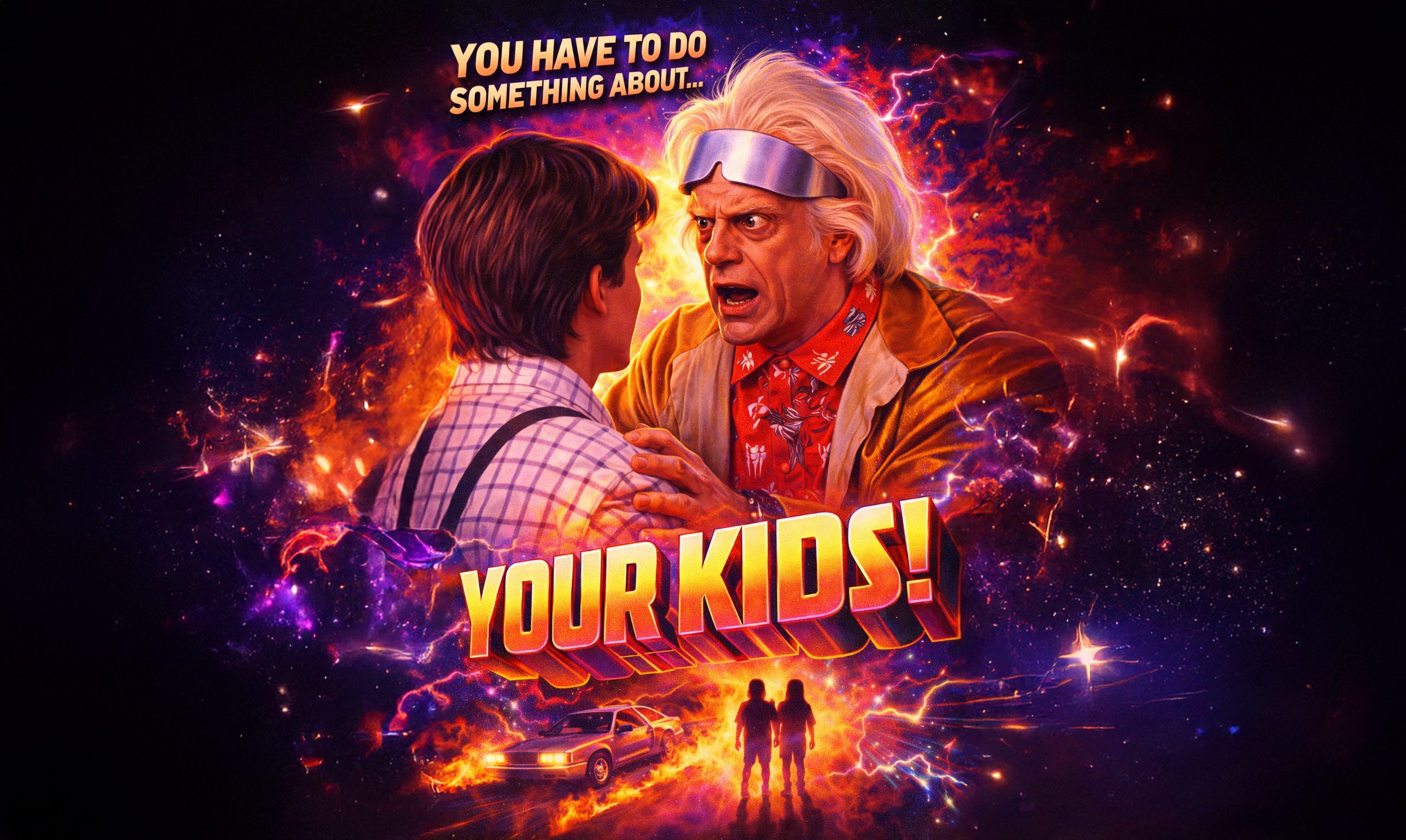
I have heard it said — fairly often, actually — that Back to the Future is the perfect script. I do not know much about screenwriting, or even fancy academic writing, if we are being completely honest. What I do know is history. And for a Millennial, and for the argument here, one thing is certain: it explains perfectly why Millennials, some Generation Xers, and almost all of Generation Z are so angry with the world as it exists today.
Like Marty McFly, I am coming to you from California.
I spent part of my upbringing on the East Coast in my late teens and twenties, but I have lived in Los Angeles, Orange County, Riverside County, and San Diego County. I know my California, mijas.
Here is the thing about Back to the Future. In 1985, Marty was a California middle-class kid, perhaps right on the edge of the working class. His mother tells stories about being a good girl. George McFly is more than a mild science-fiction nerd. Doc Brown is who he is — though I have always wondered about the backstory of his relationship with Marty, and that enormous house.
Then comes the core of the story.
Marty goes back to 1955. Things are different. Race matters a little more — as illustrated through “Mayor” Goldie Wilson. The year 1985 is not as morally sound as 1955 — that is clear. Yet outside of those surface details, Marty realizes something unsettling: his teenage experience is almost identical to that of his parents.
The same ball-busting principal — Mr. Strickland. A father who worked. A mother who stayed home. A house of their own, not an apartment. Everything is clean. The familiar archetypes are all there — the bully, the hero, the nerd, the girlfriend. Prices are reasonable. High school kids have cars. Going on a trip? Wild.
That is the point. Our experience is different. Go back to 1996, the same distance between 1955 and 1985 — and our world is completely insane compared to that time. Taxes. The job market. People, politics, protests. The feeling of it, so stale, industrial traffic, no school buses, expenses that used to be paid for by taxes, just absolutely and utterly different, obligations ignored. This era is more like Back to the Future 2 — where Biff gets that sports book and the filth that came with it.
Now. Do you remember 1996? Let’s take a ride.
Millennials are the bridge — suspended between Generation X and Generation Z. For older Millennials, Generation X were our younger uncles and aunts, our older siblings in many cases, guiding us from the analog world into the digital one. We remember the Oregon Trail because it marked the crossing.
Rodney King. The Los Angeles Riots. Carmen San Diego. O.J. and the Bronco. We are the generation that watched 9/11 live. Our peers became the first warriors of that war. Our early prime was consumed by the crash of 2008. First Black President!
We remember the world before The Donald. We remember the optimism of Obama as adults, the corkiness of George W. Bush, and the young Bill Clinton — the “cool” president who went jogging (like, who does that?) — you’d see the old heads drinking in their lawn chairs, smoking cigarettes after their shift at the brewery in my Hispanic community in Los Angeles.


Patriotism in the classroom. Figuring out what it meant to be a Mexican American. The optimism of a post-Communist world. A society that drilled into us the idea that you could achieve anything — judged by the content of your character, not the color of your skin.
Some of our grandparents were hippies. They had scenes — cars, Elvis, rockabilly, music, Chicano, gangster cholos with mad respect — wide, overlapping worlds of culture. They worked union jobs. Moms stayed home. A few were in low rider clubs. Some went to church. And everyone, in some way, was accountable to God.
Right and wrong were not subjective.
Thieves existed. Crime happened. But we knew it was wrong — no excuses. Kids at my school had fathers in jail, sometimes on a third strike.
Every town had a homeless guy. Most people were respectful, helpful, compassionate. Ours was named Mike. A nice man who preferred distance from a stressful life. Not on drugs. He cleaned up trash and cheered at Little League games for all the boys who knew him. There was also the old couple at the Little League games — no grandkids nearby, but there every season with their seat pads. If your grandparents were not there, or did not care, they always sat at the top of the home-side bleachers.
The nachos were incredible. Coca-Cola. Corporations paid for scoreboards. Invested in the community.
Southern California grandparents all had houses they bought for $5,000. They would always say, “That was a lot back then!” The houses were not special physically, but they were sacred spaces — where you stole a sip of Grandma’s wine, smoked the rest of your uncle’s cigarette, or, gentlemen, found your first Playboy.
Those houses were special.
Every grandpa drank at a bar. Every dad coached something wearing their work attire — not enough time to get home and change — gas was ~$1 per gallon. They helped out because it was their escape. There was one travel baseball team. Everyone else played recreation. We were city champs. Our football program won the “Super Bowl.” A proud moment.
The Golden Days parade. Boy Scouts. No one was rich, but everyone was wealthy.
We watched “the fight” at someone’s house — Tyson, De La Hoya. Oscar? He might be president one day, the first Mexican American. Wild to think about.
We grew up.
Some went to college. Others stayed local — climbing the ladder at In-N-Out, becoming cops, teachers, tradesmen. Different paths. Some had cool cars in the 90s — Chevy S10s, Camaros, Chevelle SSs, Mustangs. Hard work paid off.
Some passed away. Tragedy. A couple were murdered — taken far too soon.
We did not buy things online. We went to swap meets. Churros. Drive-in movies. The Mall. Mall photos — extra glam, extra makeup, hairspray. Painfully embarrassing. Fast food was cheap. Bars were still a novelty. Dance clubs. Country nights. The Boogie. Skate rinks. Arcades. Magazines. Tower Records and zero Starbucks. Helping your uncle move into the first house he bought — the one he still lives in — and flipping through his records: Van Halen. Then getting a burned CD with 2Pac and Biggie.
So yes — this was supposed to be about voting.
What we want is simple. We want those things for our kids. A world that is quieter. Less aggressive. We do not want to hear, “Well, when I was your age…” because this is not an apples-to-apples comparison. Especially for the Generation Z kids. You screwed up with them, apologize, and think of them with your policy decisions.
We want a United States where you can fly your flag without fear. Where you are free to like whichever candidate you want. Where politicians are boring because they worry about balancing the budget. Yuck.
We do not want governors wearing Jordans or three-hundred-dollar sweaters, pretending they know what it feels like to drown under inflation. We don’t want a governor who virtue signals. We do not want politicians obsessed with the one percent while ignoring the other ninety-nine. You think Spencer Pratt is a problem because he’s not qualified? I bet he's found himself an epic lane.
We want our chance to make a difference. And here is the warning.
The people standing behind us in line — this emerging Gen X and Gen Z alliance — are teaming up. Yes, you don’t see it? Those in Generation X who either never handled their personal responsibilities or assumed their Boomer parents would already be dead, and the house would be theirs?
This group is willing to burn the whole 🤬 thing down.
We Millennials are not trying to be pushy. But this is what Millennials want. And those unwilling to recognize it — whether Republicans in California during Proposition 50, or Democrats negligent about fraud — understand this clearly:
The coalition willing to burn it down will do exactly that.
After carefully listening to both forums, one conclusion became unavoidable.
The Democrats were not speaking to Millennials.
And most Republicans were not either.
By the way — Millennials, mostly, are not loyal to a political party.
So here is the question.
How are you going to make California more relaxed?
And stop with the taxes.
Stop with the corruption.

Bibliography | Notes
Vergara, Camilo J, photographer. Maria, Gerardo, and Jazmin, alley west of S. Vermont Ave. between 111th St. and 112th St., Los Angeles. Los Angeles, United States, California, 1996. Photograph. https://www.loc.gov/item/2020700405/.
Vergara, Camilo J, photographer. Curtney redeeming cans and bottles, $90 for a full van, Basic Fibers, Manhattan and 62nd St., Los Angeles. United States, California, Los Angeles, 1996. Photograph. https://www.loc.gov/item/2020705450/.
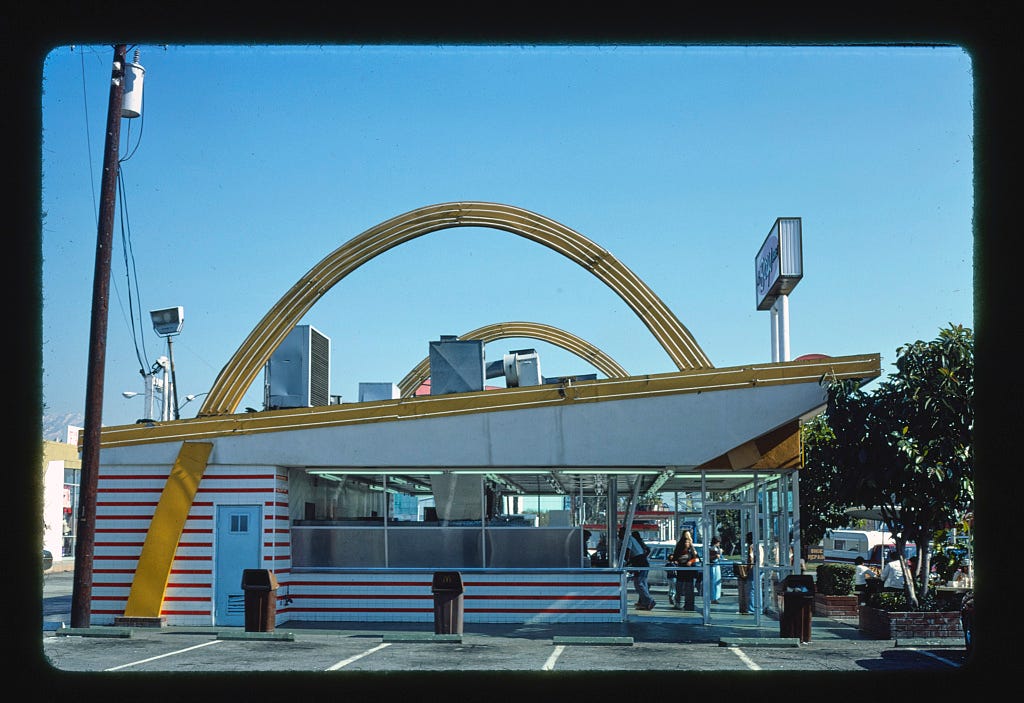
Margolies, John, photographer. McDonald’s, Azusa, California. United States, California, Azusa, 1977. Photograph. https://www.loc.gov/item/2017709071/.